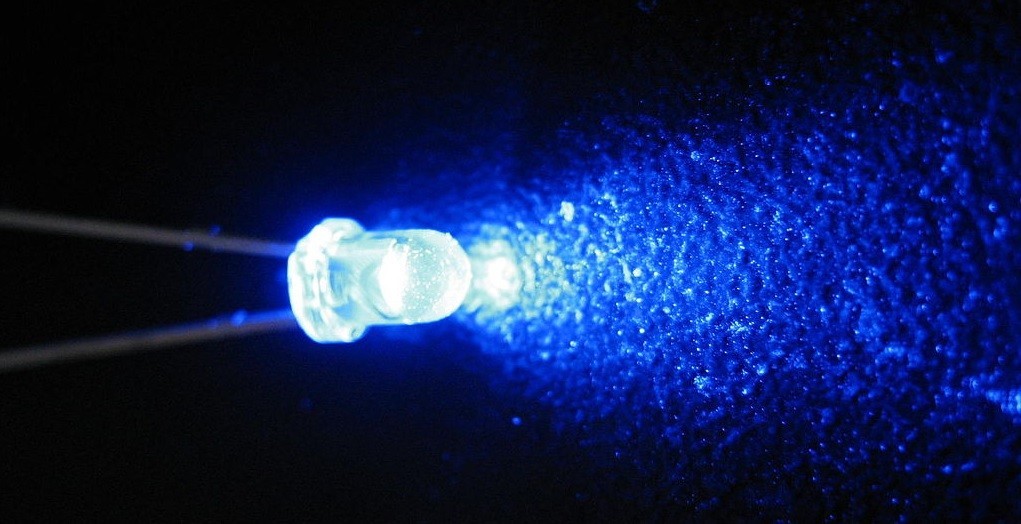
LED lights can be modified to transmit information over the air. Photo credit; Hoenny, Wikimedia.
Anyone who’s been using the internet for more than 10 years will tell you that one of the most important developments in the industry has been wireless connectivity. Whether we’re talking about wifi or mobile networks, the ability to free our computers from wired connections and get fast internet on our phones and tablets (and watches, and printers, and so on) has given rise to all kinds of tech innovation. The mobile internet revolution wouldn’t have been possible without it.
Now, we might be on the cusp of one more radical development. Li-Fi, or Light Fidelity, is a method of using visible light – basically, light we can see with the naked eye – to transmit information over the air. It’s what wifi does with good old traditional radio frequency (RF) technology.
Li-Fi uses visible light to transmit information over the air.
Yep, the same light we use to, well, light spaces can be used for wireless connectivity. All it takes is a modified version of existing LED lights to send the signal, and devices equipped with the right light sensors to receive it. The signal itself is transmitted through modulating light frequencies – light flickering to you and me. Think Morse code but with light. Only, it happens so fast, our eyes don’t realize the changes.
So why do we care? A couple of reasons: first, Li-Fi can seemingly achieve much higher speeds than wifi. In a pilot test a few months ago, Estonian startup Velmenni managed to transmit data at speeds of up to 1GB per second – about 100 times faster than wifi, reported the International Business Times.
Second, because it’s using light to transmit data, and light can’t penetrate walls like radio signals can, it’s much harder for someone outside to intercept the signal, making Li-Fi more secure than its radio-based sibling.
All of the lights
Li-Fi was invented by physicist Harald Haas and a team at the University of Edinburgh. It was first presented to the public during a TED Global talk in 2011. The project spun off from the University of Edinburgh into PureLiFi, a company for further developing the technology and finding commercial and other applications for it.
The basic idea sounds very attractive; anywhere there’s the right kind of LED lights and a light-sensor equipped device, there’s internet connectivity. As long as all the lights at your home or workspace are equipped with the tech, you can move from light source to light source and maintain a seamless connection.
The concept is not unlike infrared technology, but the difference is that infrared’s power is limited due to eye safety standards. LED lights, on the other hand, can have high intensities and thus transmit more data faster, according to PureLiFi.
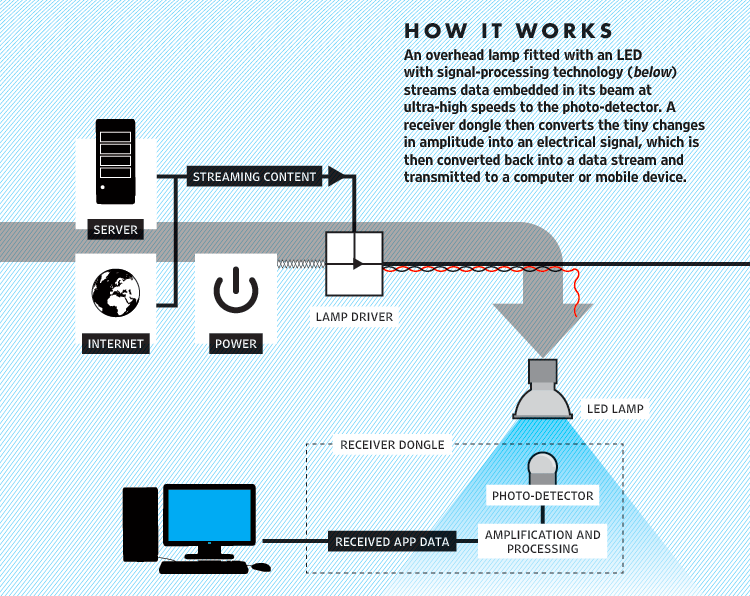
A breakdown of Li-Fi’s connectivity method. Image credit: PureLiFi.
That presents a set of problems. Your house or workspace must be fitted with LED lights that can send the data. Considering you (presumably) just had fiber lines installed, that’s a big ask for residential usage. The tech also can’t work outside during the daytime, since sunlight will confuse the devices’ light sensors (PureLiFi does say the sensors can filter out ambient light when indoors). Also, annoyingly, the tech requires the lights to be on all the time – which might be viable in a public space like a mall, but probably not in a home or an office.
Obviously the tech is still in a nascent stage, and a lot of those problems might be solved as things progress. But as it stands, Li-Fi seems more likely to complement wifi as a wireless connectivity method than supplant it.
Bright ideas





Stay updated on the go with our mobile app.
Get latest insights with smoother, more personalized experience through TIA mobile app.