 Peter Rothenberg · · 4 min read
Japan is in dire need of more angels, investors say
The Bridge Fes is an event that aims to connect tech and non-tech companies, with the belief that new technologies and services will not just come from the IT sector.
The showcase of 100 startups was held Friday in Tokyo with the theme “Tech and Life.” One talk featured two of Japan’s most active angel investors – Kotaro Chiba, a board member of smartphone games and location service platform Colopl, and Nobuyoshi Yamagishi, the former COO of Japan’s largest recipe site Cookpad.
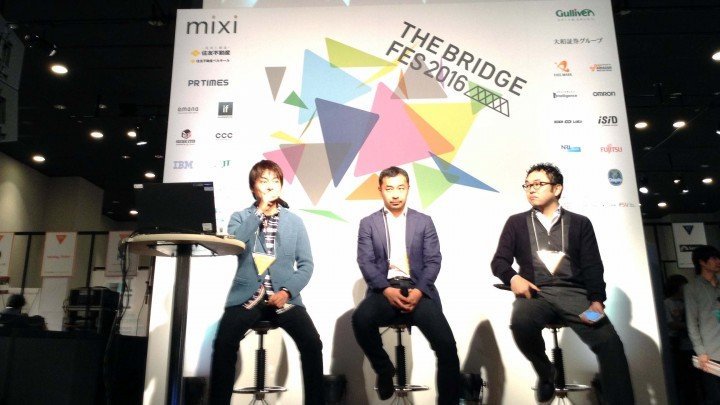
From left: Kotaro Chiba of Colopl, former Cookpad COO Nobuyoshi Yamagishi, and Shinichi Takamiya of Globis Capital.
Japan’s ecosystem has changed a lot in the past two years in Japan, Kotaro explains, with more angels, more money, and 17 unicorns – but there is still a lack of knowledge. The role of the angel investor is not just to fund entrepreneurs, but to give them advice. The panelists estimated that there may be only 20-30 active angels in the ecosystem and called for people with business knowledge to support startups.
Choosing to invest
“Is this CEO making it? Is he strong?” asks Kotaro, who likes to meet founders three to four times before making a decision. Each time, he quizzes them on a different business problem. “I like to see what type of solutions they come up with in such a short time,” he adds. Kotaro also looks for companies that have a positive social impact.
Nobuyoshi, touting that he is now unemployed, gloats: “I think I might be the most active investor in Japan for the past few months.” He has invested in 15 companies in less than six months. “I don’t really have a category,” he says. “I am basically thinking long-term; this [company] will probably make it in 10 years.”
Kotaro is also a quick investor, with 20 deals over the past two years including as a part of corporate strategy and as a partner in other venture capital firms. While he says he is a little shy, he tries to Skype as much as possible and speaks with startups directly about half the time.
What angels can do for startups
What is important is often not what the advice is, but who it comes from, the panelists said. Moderator Shinichi Takamiya, chief strategy officer of Globis Capital, chimed in, adding, “It’s different when someone who has the actual experience says it, even if I say the same thing.”
Kotaro believes it’s important to create the right environment. He takes his portfolio company founders on gasshuku, or intensive group sleepaway camps. He has also created a group of angel investors who advise their portfolio companies.
“I want to help people who are really challenging something,” Nobuyoshi adds, but agrees with Kotaro that angels should focus on coaching. They also agreed that it was important for startups to have mentors, but for the mentors to mostly stay hands off.
Often, the help can be mutual. “These meetings are such a learning point,” Nobuyoshi says. “If I invest [in a startup], I can concentrate on that [vertical].” He enjoys thinking about how a business can succeed and strongly believes that his investment and business experiences complement each other.
Advice for founders
The biggest piece of advice of the day was not to mess up a company’s capital structure.
“You can’t return the capitalization table. You need to make sure you have a solid structure in the seed round,” Kotaro says, warning that startups should get references for their angels. “Sometimes you can get a weird person who says, ‘I’ll give you $30,000, give me 51 percent,’” he explains. Shinichi says that Globis acts like a receiver of the torch from angels and acknowledges that poor capital structure can hurt later rounds.
Nobuyoshi advises founders to stay laser-focused, referencing the fashion magazine Very. “Concentrate on what help or benefit you give to your user,” he says. “There are many places that aren’t doing this.”
Nobuyoshi also suggests founders allocate about one-third of their time to hiring – no matter how busy they are. “I walked around outside for three hours thinking about what I would say to the person I wanted to hire,” he recalls of his time at Cookpad. He strongly recommends considering the exact role of each person they hire.
Reach out
Just like finding team members, founders should constantly try to reach out to angels. Sometimes they can be hard to find, but the panelists offered encouragement. “Now is the best time to be an entrepreneur,” Kotaro proclaims. “If you’re not doing a startup, you’re missing out.”
Nobuyoshi, who likes to point out he’s currently unemployed, says he is ready to help. He wants everyone to know he’s available on Facebook, explaining, “The ecosystem is so small here – I am sure we have one or two people connecting us. Let’s just meet and see if things work.”
Perhaps it’s time to get messaging. Here’s Nobuyoshi’s Facebook.
Stay updated on the go with our mobile app.
Get latest insights with smoother, more personalized experience through TIA mobile app.
Recommended reads
 India-based VC debuts seed fund with $100m corpus
 Does a compelling story trump strong traction when fundraising?
 Y Combinator cuts cohort size by 40% amid market downturn
 Recession Run: 500 Global’s investment plan in SEA
 UK-based foodtech accelerator CamLab launches remote program in Asia
 Singtel pours additional $100m in VC arm Innov8
 Temasek: From investing to launching its own startups
 Entrepreneur First to halt programs in SG
 Y Combinator to welcome Initialized Capital founder as new CEO
 Social finance platform Ethis relaunches angel investor group





Editing by Meghna Rao and Elaine Ramirez
(And yes, we’re serious about ethics and transparency. More information here.)




📅 Upcoming Events
22 October 2026
Payoneer x CSPN Summit 2026