*Okay let me first qualify that, compared to the other PR nightmares of recent years (think MH370), announcing the wrong winner on live TV doesn’t sound quite as catastrophic. Even if it was the wrong winner of the world’s largest, most recognized beauty pageant. Nevertheless, in my opinion, Miss Universe put out a great response.
Miss Universe’s crisis situation was easier to respond to than most other situations, purely because the source behind the problem was immediately identifiable. Few crisis situations have this luxury – PR nightmares are nightmares either because of the situation’s sheer complexity, or how little the company can say for sure at that point. Below the statement Miss Universe released after the now-viral fiasco, I’ve noted several points to consider in constructing the first response statement to a publicity crisis.
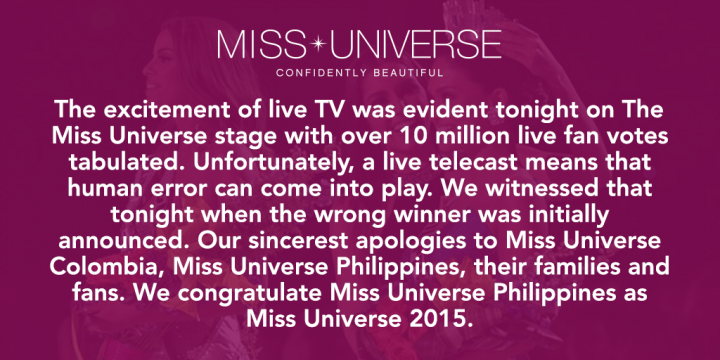
Miss Universe 2015’s Crisis Statement from its Facebook page
Facts, Facts, Facts
The first and greatest thing to remember in any crisis response statement is to stick to the facts. If certain facts work in your favour to alleviate the impact of your incident, feel free to use them. However, not all of you reading this will have a professional PR team handling the situation. If ever in doubt about the positivity of your facts, stay on the safe side and do not attempt to positively spin your story.
Open on a positive note
As long as your crisis doesn’t involve the possibility of lost lives or irreparable damage, try starting your statement off on a positive note. Miss Universe smartly managed to number-drop an astounding figure of live fan votes. Praise your event’s participants for their enthusiasm. Thank your customers for their concern. Or let your users know how much their support so far means to you and your team. That said, now is not the time to over-hype it. Don’t fall back to the comfort of your product pitch, or key messages in direct conflict with the incident. In a food poisoning crisis for example, asserting that “We produce the freshest milk.” is different from saying “We are committed to producing the freshest milk.”
If your incident does involve lost lives or irreparable damage, open with just the facts of what you know and are able to reveal so far. Stay factual.
Apologise & take responsibility
Many companies, leaders or even communications managers become full-on defensive at the prospect of this. “Accept responsibility? What the hell for? We don’t even know who did it, or whether it was sabotage, or if its just a crazy customer’s opinion that went hugely viral, or, or, or…”
Now is not the time for finger-pointing. No matter how right you think you are, or how obvious the facts may be, you will be dealing with way more emotion than logic at this point. Don’t bother assigning blame or hinting at it. You or your company will be crucified for it.
Regardless of what your investigations may eventually turn up, the incident happened on your turf, at your event or in direct relation to your service. Step up to apologise first. Understand that you are not apologising for your company’s mistake (yet). Your apology is for the negative experience encountered by your customers or users. That’s just basic customer service. While doing so, remember not to throw any of your staff or vendors under the bus, whether intentionally or unwittingly. See any mention of Steve Harvey in the statement above? Exactly.
Next, assume responsibility. Again, by doing so, you are not taking the blame for a bad experience, material loss, damage or injuries. You are committing to the promise of thorough and conclusive investigations into why this incident happened. Be explicitly clear about that in your statement. Your colleagues or employees are reading it along with the public. And of course, see that you follow through with that investigation once the dust settles.
Essentially, what your message needs to translate to at this point should be “This happened, and we’re real sorry that you had to experience it. We promise to check out what went wrong to cause this.”
Humility & sincerity
Defiance, denial and condescension will get you nowhere (except perhaps further into the ground). Be emphatic, be sincere (or don’t say it at all), and show plenty of humility in your statement. That will probably mean stuffing your face full of humble pie, but you shouldn’t be having have a problem with that, given that you’re in disaster recovery mode. Ego and pride aren’t your priorities – company reputation is.
By citing “human error”, Miss Universe addressed multiple points by being 1) emphatic, and 2) acknowledging where Steve Harvey went wrong without 3) pinning blame on him. Fine points that make a huge impact.
Reiterating key messages
Close off by reaffirming the message(s) you want stakeholders to take away. This could be something that has been at the center of uncertainty. Miss Universe closed by re-stating again, unequivocally, that Miss Philippines was the winner.





Stay updated on the go with our mobile app.
Get latest insights with smoother, more personalized experience through TIA mobile app.