Michael Tegos · · 7 min read
VivaLing teaches foreign languages to your kids, entertains them in the process
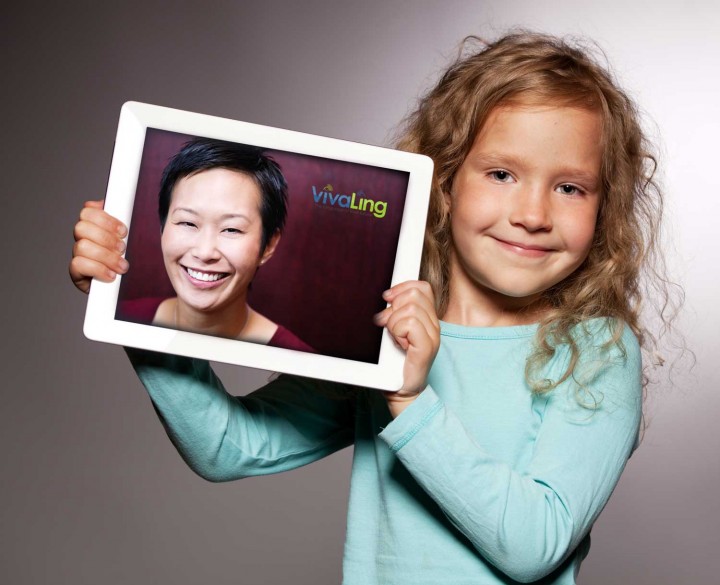
Visit VivaLing’s website and you will immediately notice images of happy children holding up tablets and computer screens depicting smiling adults – showcasing the company’s approach to the teacher-student relationship. It’s not uncommon imagery where elearning and educational initiatives are concerned, but in this case it rings especially true.
“We chose a visual that reflects our philosophy in terms of language learning,” Bernard Golstein, VivaLing’s CEO and co-founder, tells Tech in Asia. “We are about happiness of learning, engagement, motivation, communication above all. We want to make an impact by combining learning convenience with learning effectiveness.”
The Singapore-based startup specializes in language teaching through online video chat (it currently teaches English, Mandarin, French, and Spanish). Pupils can sign up through the website and are then introduced to one of the language coaches working with VivaLing from anywhere in the world. While plenty of online language teacher marketplaces work in a similar fashion, the novelty of this approach has to do with the student demographic it’s going after: VivaLing believes language learning should start as early in childhood as possible, with children as young as three years old encouraged to sign up.
“A huge amount of money, time, and energy is spent by adults trying to learn languages but, unfortunately, it’s too late,” Golstein says. “Some adults amongst us are fortunate [in that] they are more talented than others but this varies greatly. With children it’s different; all children have this talent in them. If we want to make a difference, an impact, we have to take care of this while the learners are still young.”
While this may not bode well for this writer’s attempts at Mandarin, it’s difficult to argue with the position that children absorb a new language much more quickly and easily, just like any new knowledge – provided you can get them interested enough. VivaLing takes care of that by throwing away the textbook and adapting the lesson to each individual pupil. “There is one fundamental thing about language learning; it has to be customized,” Golstein explains. “It has to be made relevant.”
Engaging and retaining

Bernard Golstein, CEO and cofounder of VivaLing.
When the prospective pupil’s parents sign up to VivaLing’s website, they work with the company to create a profile for him/her. Is the child sociable or shy? What are the child’s favorite things? What does the child enjoy doing? All this information is then fed to the language coach and used in the lesson in order to pique the pupil’s interest. “When the session starts, the first things the children see are meaningful to them,” Golstein says. If the child likes Star Wars, they will talk about Star Wars. If the child likes football, or princesses, that [will be the subject of conversation].”
To illustrate, Golstein shows a recorded session where an English teacher (an American expat in Europe) is talking to a French boy living in Asia. The teacher has been informed that the boy likes pirates and has themed her session accordingly, speaking English peppered with pirate lingo and even wearing an eyepatch while she talks about treasure and swordfights.
The results are immediate; the child is looking intently as the teacher counts her “gold” in front of the camera, and then begins to respond to her questions – in English. This is a pupil that just recently, according to Golstein, was not responding at all to his classes and had had all sorts of disciplinary issues. But by engaging him on a level he finds exciting, the coach actually gets him to chat in the language he is supposed to learn. “I think he learned more during that first session with us than in his entire [school] year,” Golstein muses.
Just like the content of the session, the duration and frequency of the sessions are adapted to each student. A session for a child of three to five years old might last about 15 minutes, while a preteen or teen student’s session can last about an hour. Most students take two sessions per week and are given time to revise before the next session by reviewing video of the last one.
Parents are encouraged not to attend the sessions after the first time when the students are over five years old. The company’s approach seems to make sure that no supervision is needed; if it is, the coach is not doing a good enough job. “Insubordinate children are only children whose attention the coach has not been able to catch,” Golstein says. “So we take it as potential for improvement on our side. Honestly, we do not have insubordinate children. Children from age six do not even need their parents to start the session – they can do it by themselves.”





Stay updated on the go with our mobile app.
Get latest insights with smoother, more personalized experience through TIA mobile app.