- Premium Content It takes our newsroom weeks - if not months - to investigate and produce stories for our premium content. You can’t find them anywhere else.
 Gabriel Budi Sutrisno · · 3 min read
Visual: Telkom’s tentacles in the digital space
Telkom’s digital ambitions have become more apparent in the last few years. But that’s not surprising, given how the Indonesian state-owned telecommunications giant’s largest revenue streams are its data, internet, and IT businesses.
One of the company’s recent major moves was to hire a director of digital business, appointing Bukalapak co-founder Fajrin Rasyid to the post in June 2020. Rasyid also serves as commissioner of Telkom’s MDI Ventures unit, which has been actively investing in the tech scene since it was established in 2015.
However, it wasn’t all smooth sailing since his entry. Not long after Rasyid came on board, Telkom shut down Blanja.com, a pioneering consumer-to-consumer (C2C) ecommerce platform that the company founded as a joint venture with US giant eBay.
The closure represented a change in Telkom’s ecommerce strategy. With the C2C space already dominated by the likes of Shopee and Tokopedia, Telkom decided to focus on the business-to-business (B2B) segment, which has seen growing interest recently.
The bulk of Telkom’s digital business came in as strategic investments, whether through MDI Ventures or other subsidiaries. For example, the company invested in multiple rounds of super app Gojek through Telkomsel, its mobile telecommunications operator. More significantly, Telkom formed e-wallet LinkAja in early 2019 with other state-owned companies.
But Telkom is becoming more active in developing its own digital platforms. Tech in Asia notes that the telco firm has developed at least 15 platforms in various verticals. Recent launches include Tanah Air Digital Exchange(TADEX), a programmatic advertising line, and Kuncie, an edtech app.
In this article, we present Telkom Group’s tentacles in the tech industry. Based on its financial statements, the company currently has over 30 subsidiaries – both directly or indirectly – that belong to the following categories:
- Telecommunications, which includes network operators, infrastructure, tower rental, and satellite communications
- Multimedia and content, which includes digital content sales services and multimedia portals
- Property, which includes building and office rental, property maintenance, and property development and management
- IT, which includes system implementation and integration, outsourcing, software license maintenance, data and information services, call centers, and directories
- Investment, which includes investment consulting services, and venture capital
- Other services, which includes ATM maintenance and cash replenishment, trade, tourism, and health insurance
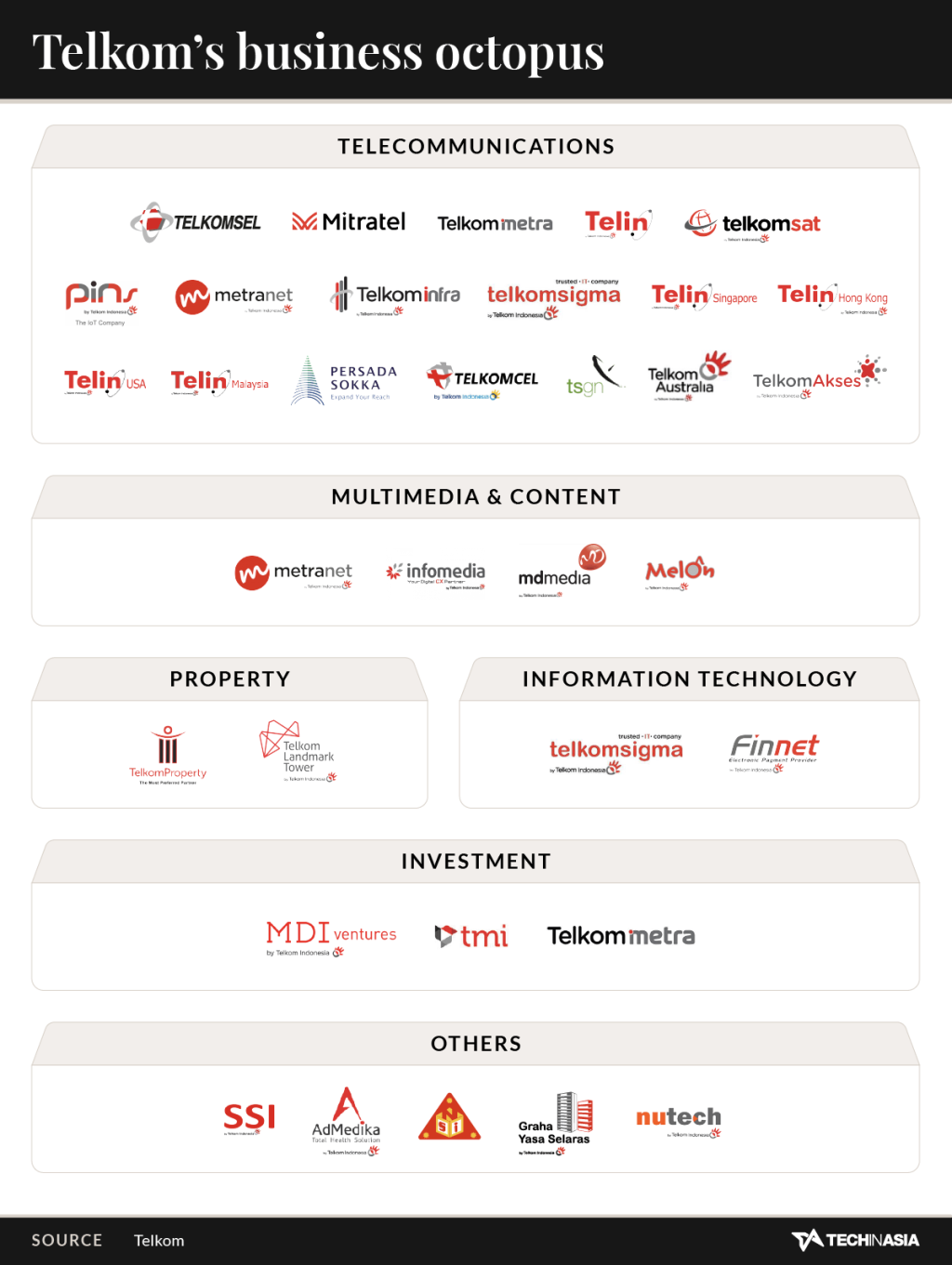
Image credit: Timmy Loen
Here are details of each Telkom subsidiary:

The infographic below traces Telkom’s entanglements in the digital space.
Stay ahead in Asia’s tech landscape
This is premium content. Subscribe to read the full story.
The Indonesian state-owned telco’s influence is shored up by strong public-private partnerships and collaborations across market sectors.
We know this is not ideal. ⌛ Sign up in 20 seconds. Cancel anytime.
Our subscriber community includes professionals from these companies:





Stay updated on the go with our mobile app.
Get latest insights with smoother, more personalized experience through TIA mobile app.









📅 Upcoming Events
22 October 2026
Payoneer x CSPN Summit 2026