 TIA Visuals · · 12 min read
The SEA startup landscape: then, now, and what’s next
Charts and visuals, only for subscribers

Southeast Asia’s tech and startup scene has undergone major transformations over the last decade. From the early 2010s when new ventures were first starting up to the breakneck growth in the middle of the decade as well as the slowdowns induced by the Covid-19 pandemic and global market shifts, the region has had an eventful last 10 years. Moreover, emerging tech has transformed lives, and new services that were previously unimaginable have now become commonplace.
Some industry experts said that the 2020s would mark a golden age for Southeast Asia, as the growing expertise in management, operations, and infrastructure in the region provided the foundation for startups to succeed.
However, the 2020s have given rise to headwinds that stand to deter this growth. The aftermath of the pandemic coupled with a looming global recession, high inflation rates, and a tech winter have created a challenging climate for Southeast Asia’s startups. How will the region’s tech scene weather the storms that lie ahead?
The 2022 Tech in Asia Conference is titled “Southeast Asia: Built to last.” As we gear up for our annual flagship event, we’re taking a closer look at how the region has fared over the last few years, the opportunities that await it, what roadblocks might stand in its way, and whether or not it’s truly built to last.


The region remains a compelling thesis for entrepreneurs and investors alike.
Southeast Asia saw 40 million new internet users come online in 2021, bringing the region’s internet penetration rate to 75%. Among these new users, eight out of 10 are digital consumers, which means that they have purchased at least one item online in the past year. And these trends show no sign of reversal – new internet users are staying online and participating in the digital economy.
The region’s population is seeing discretionary incomes increase and its internet users are open to trying out new online services, creating opportunities for tech firms.

Southeast Asia is also set to fare well against the larger picture of the global economy.
According to the World Bank, global growth is expected to slump from 5.7% in 2021 to 2.9% in 2022 – significantly lower than the 4.1% rate that was anticipated in January. While the World Bank has also shaved its economic projections for Southeast Asia, expectations are still larger than the global average. The region-wide growth forecast is set to be 5% this year, down from the 5.4% rate projected in October 2021.
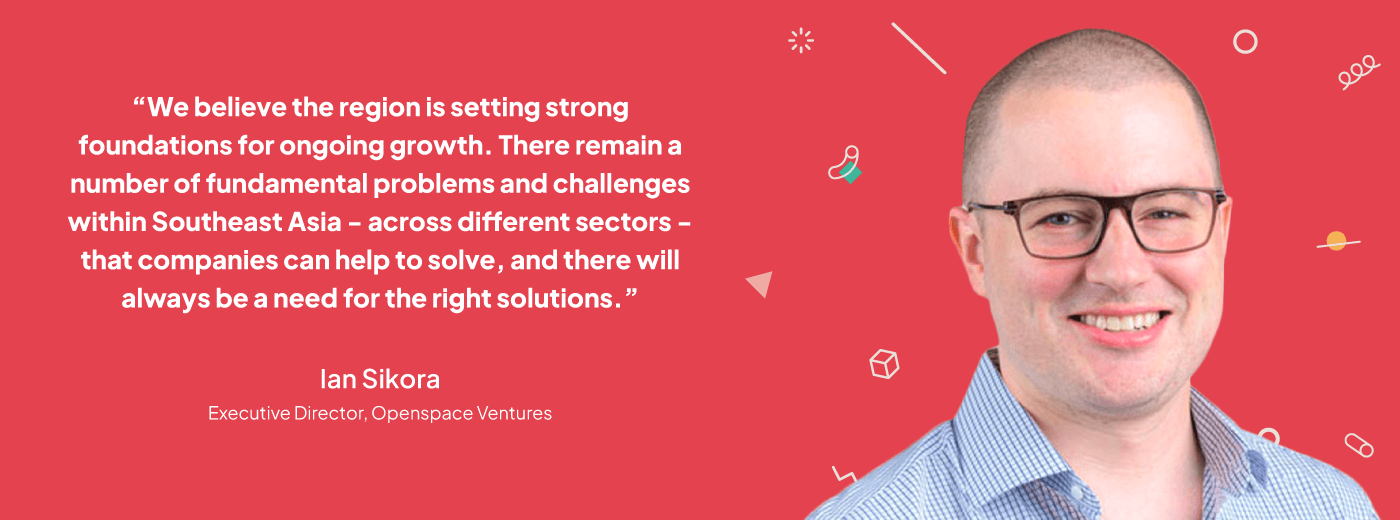
“The next few years will remain challenging, given the overall market conditions, but the fundamental thesis about the region remains firm,” says Ian Sikora, executive director of Openspace Ventures. “Southeast Asia’s emerging middle class represents one of the most attractive opportunities for companies and investors in the world.”

Startup funding in the region has steadily increased since 2017 and came back strong in 2021 after a pandemic-induced dip in the previous year. Over US$37 billion worth of funding went into Southeast Asian startups last year.
Diving into the specific verticals, it’s no surprise that logistics and transportation comes up top, given the growing dominance of super apps Grab and Gojek. Ecommerce and fintech also continue to be key industries, but what’s interesting is the boost in funding received by general internet companies.
While this is largely due to the fundraising activities of major firms such as Sea Group and GoTo Group, it should be noted that 2021 and 2022 also saw a number of Web3 and blockchain companies come up under this umbrella.
However, funding is starting to slow down as macroeconomic conditions lead to investors holding on to dry powder. But some say this may be a good thing for the ecosystem.
“The recent slowdown in funding is acting as a forcing mechanism, as founders now need to put even greater emphasis on profitability,” shares Sikora.

Back in 2020, a concern raised by many investors was how Southeast Asia lacked notable exits. The only firms that had exited by then were Sea Group and Razer, which both debuted in the public markets in 2017.
But the past two years saw more of the region’s firms go public. Bukalapak and Grab made their market debuts in 2021, while GoTo Group and PropertyGuru followed shortly after in early 2022.
Bukalapak’s US$1.5 billion listing was the largest on record on the Indonesia Exchange, and Grab’s US$39.6 billion deal with Altimeter Growth was the world’s largest merger with a blank-check firm. GoTo Group raised roughly US$952 million in its IPO that was oversubscribed 15.7x, while PropertyGuru listed with an enterprise value of over US$1.3 billion.
“In the grand scheme of things, these major IPOs are but a single step in a journey of a thousand miles. What we are seeing is that they have generated positive market signals and increased interest in regional startups, which has consequently attracted more funding into the region,” shares Gary Khoeng, partner at Vertex Ventures Southeast Asia and India (VVSEAI). “These tech IPOs are historical milestones, hugely encouraging for other technology companies and investors in the region.”
The region is expecting to see more of its tech firms make their exits on the road ahead, although the ongoing economic headwinds may delay these processes.

Southeast Asia remains ripe with opportunity, especially in key verticals such as ecommerce and fintech.
Ecommerce continues to be an area of interest for the region’s investors and entrepreneurs. Revenue for the sector is projected to reach over US$142.7 billion in 2022, and it is expected to show a compound annual growth rate of 15.1% that will result in a market volume of US$217.5 billion by 2025. Indonesia is expected to continue to lead the pack in terms of ecommerce growth.
“Southeast Asia’s ecommerce growth has barely scratched the surface and will continue to be one of the few enduring ‘flavors of the decade’ generating consistent investor interest,” shares Jessica Koh, director at VVSEAI.
Within the sector, specific areas of interest include quick commerce and social commerce.

In her view, reseller-led social commerce could facilitate access to Tier 2 and Tier 3 markets via more streamlined and cost-effective acquisition, distribution, and fulfillment channels. Additionally, quick commerce and live commerce could tap into the digital-first and fast-paced lifestyles seen in Tier 1 cities.
Southeast Asia holds plenty of potential for social commerce, especially as the pandemic has brought more people onto platforms such as Facebook, Instagram, and TikTok. Social commerce is worth more than US$13 billion in the region, and some reports say it accounts for close to half of Southeast Asia’s ecommerce spend.
Quick commerce startups have taken off in the region as well, especially in the e-grocery space. Major tech companies like Grab and Foodpanda are also providing quick delivery services.
Meanwhile, the fintech sector remains a rising vertical in the region as payments continue to play a crucial role in Southeast Asia’s growing internet economy. Digital payments make up the largest segment within the space, with a projected total transaction value of US$195.8 billion for this year.
Over the last few years, key fintech segments that have received funding include lending, loans, and credit. Financial exchanges have also gotten a lot of attention, and its growth may be buoyed by the rising interest in cryptocurrency and other related assets.
“I believe that [fintech] will continue to be an area of interest for investors,” says Khoeng. “There are quite a number of subsectors and innovations that would continue to do well. For example, in Indonesia, even though there has been a plethora of startups addressing consumer financing and peer-to-peer invoice financing the past half a decade, areas such as open banking, embedded finance, and even personal wealth management are witnessing significant progress.”

In addition, the growth of blockchain and Web3 companies in the region cannot be understated. Startups with the terms “blockchain,” “Web3,” and “NFT” in their company descriptions only started raising significant funds in 2021. According to Tech in Asia data, only roughly 2.14% firms that raised funds in 2020 had the words “blockchain” in their company descriptions. The following year, that increased to about 4.44%. As of May 2022, 9.2% of companies that raised funds were blockchain-related businesses.
Southeast Asia is now a hotbed of blockchain activity, with numerous startups in the region offering services related to DeFi, Web3, NFTs, and crypto trading. Digital asset trading firms are some of the most popular startups in the region, and play-to-earn gaming is also taking off, buoyed by the success of Axie Infinity.
This momentum is likely to continue. In the first six months of 2022, blockchain startups in the region raised over US$525 million from 24 deals, which is more than the total funding that the sector received from 2018 to 2020.
While it’s still the early days for the region’s blockchain sector, the uptick in funding is a good sign.
“The Web3 and blockchain space is still very early,” says Amy Zhao, lead at Ocular, a crypto fund managed by Openspace Ventures. “Capital inflow could get ahead of the traction, but the capital is an important foundation to attract talent and develop infrastructure.”
However, the ongoing crypto winter as well as major events like the Axie Infinity hack and the Terra collapse may have shaken confidence in the sector on the road ahead. Despite these setbacks, interest in Web3 and blockchain remains high, given the impact it could have on Southeast Asia.
“Despite some headwinds and growing pains plaguing the blockchain sector at the moment, if we were to assume its continued growth and prevalence in everyday life – through its adoption for transaction or investments in decentralized finance – then eventually blockchain will play a major role even in developing regions such as Southeast Asia,” says VVSEAI’s Khoeng.

While Southeast Asia’s tech scene holds plenty of promise, it still faces several challenges.
For starters, while the region has seen some landmark exits, these IPOs have generally not performed up to expectations. Grab, Bukalapak, and PropertyGuru have seen their share prices drop significantly since their debuts, while GoTo Group recently saw its share price return to roughly what it was on its first day of trading after a rollercoaster performance.
Additionally, many of these tech majors have yet to turn a profit at a group level, although specific business units may be profitable and losses are narrowing. This calls into question the long-term sustainability of their business models.
However, these declines in share price aren’t all bad.
“People are discerning enough to know that a good percentage of [these share price dips] is driven by global trends that these companies have no control over,” says Monk’s Hill Ventures’ Lim. “But there is a cautionary tale in terms of what people value. You can only get away with not making money for that much time – at some point, investors do want to see how you can turn a profit sustainably, reliably.”
Another hurdle that the region has to overcome is its lack of talent. As more startups grow and reach the late stages, they experience greater demand for developers and engineers. Poaching and price wars for talent have become more common, which puts younger startups that don’t have the capital at a disadvantage.
“[Talent] will always be a challenge – smart people go where the opportunity is, and so there will always be that tension,” explains Lim. “But good founders will always find ways to overcome it.”
In his view, the rise of remote work and Southeast Asia’s emerging status as a tech and innovation hotbed will play a key role in helping firms overcome the talent crunch, as they can now expand their hiring scopes beyond the region.
It’s also hard to ignore the current global situation. The Russia-Ukraine war, a looming economic crisis, and a tech stock rout have all created a challenging environment for Southeast Asia.
However, it’s too early to say if these headwinds will have a long-term impact on Southeast Asia’s tech scene, although many are bullish on what’s ahead.
“The outlook for Southeast Asia in general is positive,” says Golden Gate Ventures’ Lints. “The region has sustainable GDP growth even during current 2022 market conditions, and we have seen diversification in the ecosystem.”

The region is at a crossroads as it goes through its first major crises since its tech and startup scene took off.
However, the future holds plenty of promise. The growth seen in Southeast Asia’s digital economy will not be reversed and new users will continue to come online, especially as mobile and internet penetration increases and incomes rise. Digital services will continue to play a key role in people’s lives, and opportunities to address niche and specific areas will give rise to new startups and products.
Southeast Asia also has the opportunity to play on a larger field as its companies expand beyond the region to roll out their services around the globe.
“Some of the regional B2B companies have a huge opportunity to become global players,” says Lints. “Historically, we have seen companies coming from Southeast Asia focusing on one or two countries, or the region. Now we’re seeing companies hailing from, for instance, Singapore, active in over 80 countries.”
The region’s tech scene is also likely to become more diverse across all aspects.
“One of the biggest opportunities for Southeast Asian tech firms is diversification,” Lints adds. “Diversification in the number of countries being able to produce unicorns, diversification in exits, and diversification in industries.”
Southeast Asia’s tech sector has come far, and its best years are still ahead of it. What’s crucial now is for its tech companies to continue to meet the needs of its population and work toward developing scalable and sustainable solutions for the future.
“If anything at all, all the ups and downs we’re going through over the last couple of years will harden the ecosystem more,” says Lim. “We’ll see more resilience and resourcefulness in all the stakeholders to last through whatever crisis is ahead of us.”
***
The 11th edition of the Tech in Asia Conference – Tech in Asia’s largest annual flagship event for Asia’s tech and startup community – is titled Southeast Asia: Built to last. This year’s edition will be hosted in person on September 15 in Jakarta and from September 21 to 22 in Singapore. We will also have a full, free stream of the Main Stage in Singapore for those who can’t make it to the event.
Get your tickets for the 2022 Tech in Asia Conference here!
***
This content was produced by Tech in Asia Studios, which connects brands with Asia’s tech community. Learn more about partnering with Tech in Asia Studios.
Credits
Writing and analysis: Stefanie Yeo
Editing: Winston Zhang and Lorenzo Kyle Subido
Visuals: Susi Susanti
Stay updated on the go with our mobile app.
Get latest insights with smoother, more personalized experience through TIA mobile app.
Editing by Winston Zhang and Lorenzo Kyle Subido
(And yes, we’re serious about ethics and transparency. More information here.)