 Jofie Yordan · · 3 min read
Mapping the swift downturn of SEA quick commerce (update)
Charts and visuals, only for subscribers
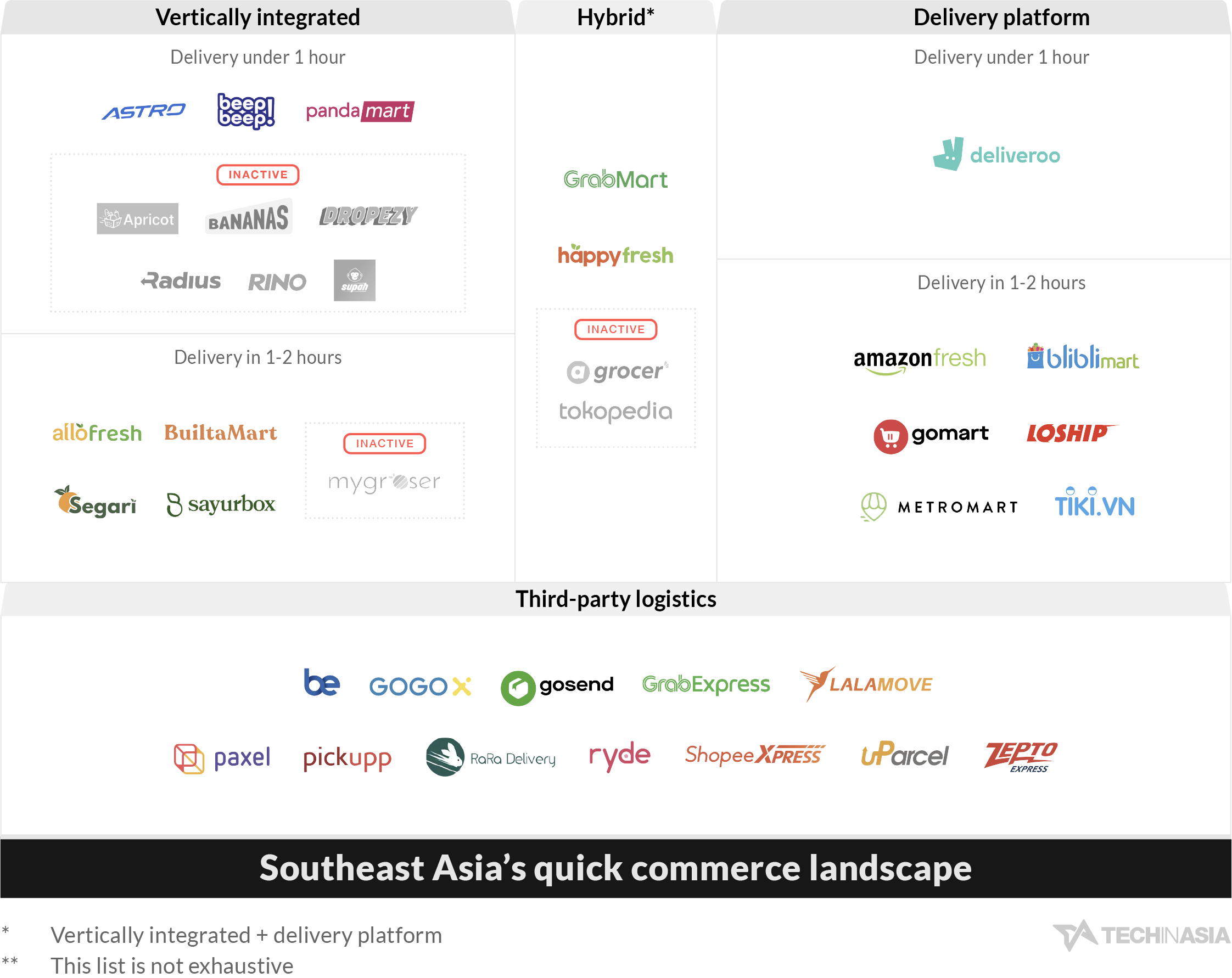
The quick commerce trend in Southeast Asia seems to have fizzled out, well, quickly.
After blooming in early 2022, many quick commerce players in the region – such as Indonesia’s Dropezy and Bananas, and Thailand’s Apricot – have either shut down their operations or pivoted to other business models.
Last month, Indonesian ecommerce giant Tokopedia also closed its quick commerce unit, Tokopedia Now. The service was first launched in November 2021.
Throughout the past year, only Indonesia-based Segari raised funding from investors. Meanwhile, Singapore-based quick commerce delivery provider Ryde went public on the New York Stock Exchange in March.
Aside from these, no other quick commerce players in the region disclosed any new rounds of funding or announced M&As.
Instead, a few names bowed out from the sector, such as Vietnam’s Rino and the Philippines’ Supah, which is owned by social commerce firm SariSuki. AirAsia Grocer now also seems to be more focused on its B2B export and import services.
As is often the case with rising sectors, the challenge in quick commerce lies in profitability. Players need large capital to build dark stores – small warehouses in key locations near consumers’ homes – while achieving the right product or inventory mix to keep users coming back.
See also: Why SEA lags India in quick commerce race
There is also the question of whether 15-minute grocery deliveries are really crucial. Many regular e-grocery players offer quick delivery services – with orders arriving in a maximum of two to three hours – and often at a cheaper price. This ultimately makes it difficult for pure quick commerce players to pare back spending on discounts and other promotions.
Of the pure quick commerce players in the region, only a few remain (like Tiger Global-backed Astro and Singapore-based BeepBeep). In contrast, heavyweights such as Grab, GoTo, and Foodpanda still provide quick commerce services with a delivery time of 30 minutes to 2 hours.
General players focused on e-groceries such as HappyFresh, Sayurbox, and Segari still offer instant delivery services but only in certain locations.
Can SEA learn from India’s success?
While quick commerce appears bleak in Southeast Asia, the situation is quite the opposite in India.
The industry’s gross merchandise value in India grew by 77% to US$2.8 billion in 2023 from US$1.6 billion in 2022, according to strategy consulting firm Redseer. Its growth even surpassed that of the country’s ecommerce sector, which recorded an uptick of only 14% to 15% in the same period.
Credits
Share, tag us, and land on our Wall of ❤️ !
Stay ahead in Asia’s tech landscape
This is premium content. Subscribe to read and use our charts, graphics, and other visuals legally
Unlike in India, quick commerce in Southeast Asia continues to lose popularity and has seen players shut down or pivot.
We know this is not ideal. ⌛ Sign up in 20 seconds. Cancel anytime.
Our subscriber community includes professionals from these companies:





Stay updated on the go with our mobile app.
Get latest insights with smoother, more personalized experience through TIA mobile app.