- Premium Content It takes our newsroom weeks - if not months - to investigate and produce stories for our premium content. You can’t find them anywhere else.
 Tay Tian Wen · · 6 min read
Visual: Startup unicorns are becoming decacorns faster than ever before
Today’s unicorns took an average of seven years to reach a valuation of US$1 billion. For the rare few – just 0.000125% of startups worldwide – growing from a unicorn into a decacorn took a surprisingly shorter 2.5 years to achieve.
The speed at which decacorns – companies that are valued at US$10 billion and above – are emerging poses questions for hundreds of startup unicorns today. In which geographies or sectors have decacorns risen faster? What implications does this have for startup ecosystems and global VC funding in the future?
In this visual story, Tech in Asia explores the rise of decacorn startups. The chart below shows how long it’s taken them to become the titans they are today.
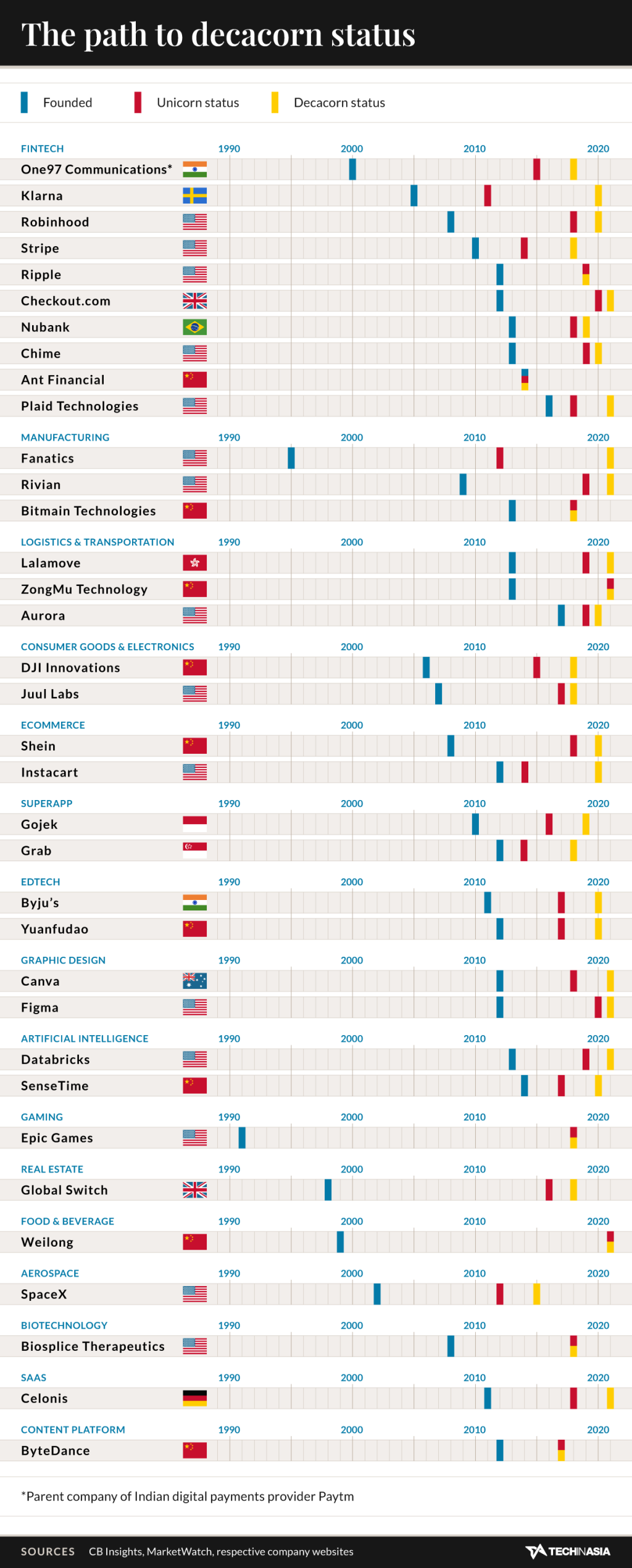
Image credit: Timmy Loen
As decacorns are defined as privately held companies, we have excluded publicly traded firms in our analysis.
Currently, 46% of the world’s 33 decacorns are located in the US, while startups in China account for slightly over 23%. Most operate in the fintech industry. In fact, over the last seven years, funding for fintech startups has grown at a 59.2% compound annual growth rate (CAGR) from a little over US$4 billion in 2013 to US$105 billion in 2020.
The 2008 global financial crisis led to the rise of challenger banks and altered the industry as we know it. Since then, investor interest in fintech startups has continued to grow, alongside new trends such as “buy now, pay later” – marked by the soaring valuations of Swedish e-payments firm Klarna and Australia’s Afterpay.
Read more: Why the time is ripe for ‘buy now, pay later’ in Asia
While there are fewer decacorns in China than in the US, Chinese players have emerged slightly faster. On average, unicorn startups in China like Shein and Yuanfudao took just 1.4 years to become decacorns, while those in the US took 2.4 years.
Some companies have taken much longer: Klarna and US sports merchandise retailer-manufacturer Fanatics slogged it out for nine years before reaching the coveted US$10 billion valuation mark.
Meanwhile, Chinese computing chip and software designer Bitmain Technologies achieved the milestone in less than a year. A swift valuation surge for the company in 2018 can be partly explained by sustained investor confidence following 2017’s cryptocurrency boom, which saw Bitmain’s net profit soar nearly 700% year on year.
On our list, Elon Musk’s SpaceX was the first to arrive at decacorn status in 2017, achieving the feat in 15 years. The timeframe is not surprising given the company’s complex task of designing and launching reusable rockets.
Despite a handful of startups earning the decacorn badge, there really isn’t a fixed path to achieving the status.
US-based video game and software developer Epic Games is the oldest company to join the decacorn club. Founded in 1992, it took 25 years before the firm became a unicorn and a decacorn in the same year. Analysts attribute its US$15 million valuation to its proprietary software, Unreal Engine, that developers use to build their games and which now has many use cases that transcend gaming.
Stay ahead in Asia’s tech landscape
This is premium content. Subscribe to read the full story.
The global decacorn club grew 50% in just the first half of 2021, and more are hailing from startup ecosystems outside of the US and China.
We know this is not ideal. ⌛ Sign up in 20 seconds. Cancel anytime.
Our subscriber community includes professionals from these companies:





Stay updated on the go with our mobile app.
Get latest insights with smoother, more personalized experience through TIA mobile app.








📅 Upcoming Events
22 October 2026
Payoneer x CSPN Summit 2026