 Imran Khan · · 3 min read
How virtualization is helping companies solve real problems

Growing your business is hard. Scaling up operations, infrastructure, and people is not only challenging, but also daunting. How do you know whether any of it will actually work? When will you have to upgrade next? How long can you sustain your business on the current infrastructure?
Virtualization offers one way to build in flexibility, agility, and support into your rapidly expanding business. It does this by allowing you to run multiple instances of software in parallel, without investing in new hardware.
Here are two industries that are already benefitting from virtualization.
1. The doctor will see you now

Photo credit: DarkoStojanovic
Healthcare is being modernized. Patient files have gone digital and doctors now have access to detailed patient histories. With each visit to the doctor, information increases exponentially. Making sense of all that data soon becomes difficult and cumbersome.
Hunting through paperwork is difficult, but hunting through digitized paperwork with multiple login screens and devices is equally frustrating, especially in an industry where time is a life-or-death difference.
How does one increase patient care time while controlling costs? Virtualization helped one hospital deal with this problem.
Through the virtualization of its infrastructure, the hospital was able to spin up new virtual servers within minutes as required, instead of waiting for physical servers to be delivered. This saved on server space, along with operations and maintenance costs. 282 virtual servers on nine HPE Server Blades could now fit on a single rack, instead of 18, freeing up space and costs for other projects.
The consolidation didn’t just stop at the server centers. Data was stored centrally, which meant that the hospital could replace fully functional PCs with ‘thin clients’ (terminals without hard disks). This meant that the devices acted as access points to the centrally housed data, reducing costs and increasing consolidation of data and processes.
This, among other improvements helped the hospital save over 62,500 man-hours a year. That’s collectively over seven years more time in front of patients instead of a screen.
2. Planning for accidents
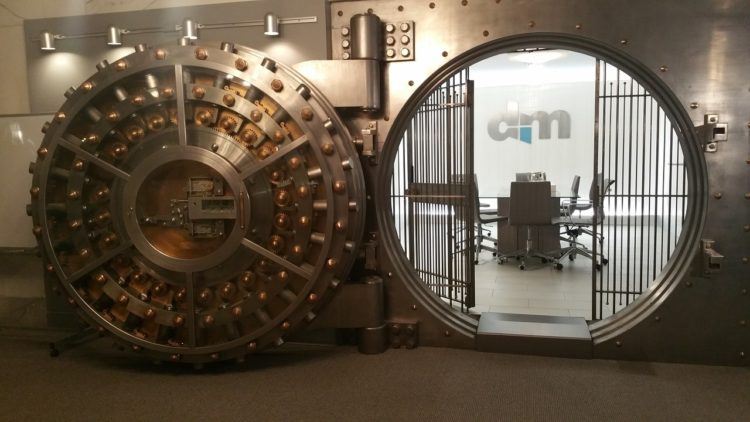
Photo credit: ahobbit
Like hospitals, visits to the bank aren’t always fun. You end up filling endless forms or waiting in equally endless lines.
A small community bank with a single branch of 20 employees faced the same problems that many companies do: data security and cost reductions. The story goes that the IT director once stepped on a power strip and unplugged one of the bank servers. The bank was down for hours.
Having learned the lesson the hard way, the bank decided it was time to upgrade its entire infrastructure. It streamlined its infrastructure using HPE Converged Infrastructure, and was able to improve energy efficiency by converging its servers, storage and networking into a single shared infrastructure. These data centers brought down operational, maintenance, and networking costs. Converging its entire storage into one central pool saved money and time. It also helped the community bank to quickly scale operations up (or down), depending on what the needs were in real time.
Learning from the IT director’s clumsy mistake, the bank was able to shrink its recovery time from three days down to just three minutes, patch management (acquiring, testing, and installing multiple code changes to a system) accelerated by 75 percent, and the IT director was able to regain 10 hours a week that he used to waste on dealing with system issues and troubleshooting.
But how to ensure that this was a success? He recreated the accident that lead to the decision in the first place. When the server’s power source was unplugged, the other server took over operations in less than a minute. It was business as usual.
Virtualization is helping businesses across industries deal with the same problems that plague companies in similar phases of their business life cycle. Through virtualization, companies can offset clumsy mistakes, deal with data without being inundated, and most importantly, save costs and time.
Hewlett Packard Enterprise is an industry leading technology company that enables customers to go further, faster. With the industry’s most comprehensive portfolio, spanning the cloud to the data center to workplace applications, our technology and services help customers around the world make IT more efficient, more productive and more secure.
Stay updated on the go with our mobile app.
Get latest insights with smoother, more personalized experience through TIA mobile app.
Recommended reads
 Can this AI agent redefine debt collection?
 Zuckerberg’s strategy to cure all disease by 2100
 Inside OpenAI’s public-first bet on medical AI
 The hardware secret that gave OpenAI the edge on Anthropic
 Why ‘vibe PMing’ is the future of product management
 Escaping the LLM bubble: AMI Labs goes the physical AI route
 A middleman model makes free patient tracking possible
 Gen Z Harvard dropout builds AI platform for architects
 You can’t spell India without AI
 TiDB is engineering the infrastructure for AI’s agentic future





Editing by Terence Lee, Peter Rothenberg, and Steven Millward
(And yes, we’re serious about ethics and transparency. More information here.)




