Grace Priscilla Teo · · 5 min read
Amazon CTO: why ‘vibe coding’ is dangerous
This article summarizes Amazon CTO Dr. Werner Vogels’ keynote session at AWS re:Invent 2025.
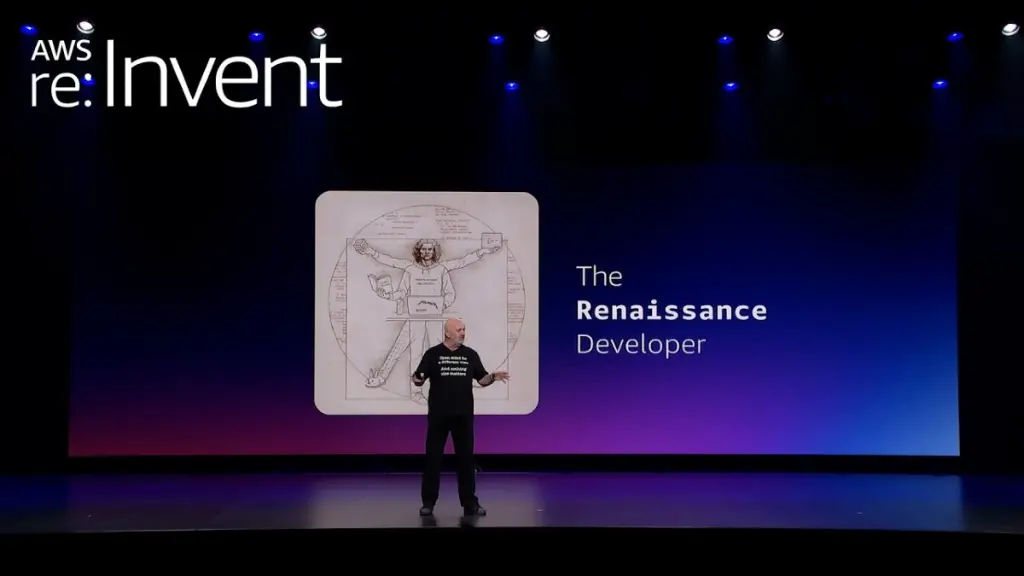
Dr. Werner Vogels, CTO of Amazon, at AWS re:Invent 2025 / Photo credit: Amazon
Dr. Werner Vogels, CTO of Amazon, argues that although AI promises to automate coding, it actually places more responsibility on humans. This change forces companies to value checking quality and planning more than speed.
The renaissance developer
To stay useful in an AI world, engineers need five key traits. This shifts the focus from simply writing code to solving larger problems.
- Curiosity: A constant desire to learn and take things apart to see how they work.
- Systems Thinking: Seeing that software acts like nature, where small changes can cause big reactions.
- Clear Communication: Using clear language so the AI does not make mistakes.
- Ownership: Taking full responsibility for the code and safety, even if the AI wrote it.
- Broad knowledge: Mixing deep skill in one area with knowledge of many other subjects.
The modern engineer must connect different fields
Vogels describes this new goal, “I think we are again in a time of renaissance, and you are the new Renaissance developer… The skills you need to be successful in your job are a unique mix of personal skills, functional depth, and industry knowledge.”
The shift to T-shaped engineering
This shift in responsibility changes the definition of a good engineer. While knowing one field well was once enough, the demand for quality requires thinking that connects different areas.
Vogels suggests that the “I-shaped” specialist, someone with knowledge in only one area, is becoming outdated. To solve hard problems, developers must look past their main skill.
Vogels looks at his mentor’s method, “My old mentor and friend, Jim Gray, was interested in so many more things than just databases… Jim wasn’t what I would call an ‘I-shaped’ developer at all. His curiosity reached far beyond databases. I would describe him as ‘T-shaped’: deep in one domain, but broad in understanding.”
Skills in many areas improve system design
This flexibility changes how engineers build systems. A specialist sees only their part, but a generalist sees the problems between services.
The CTO explains the benefit, “A database developer who understands front-end performance or cost-aware architectures can make better architectural choices… They can dive deep into specific problems, but they will also understand how their work fits into a larger system.”
Adopting an ecosystem mentality
Once an engineer adopts this broader mindset, they must apply it to the complex environments they build.
Minor tweaks cause major disruptions
Software systems act like nature. A change in one service can start a chain of errors across the network.
He links this to software, “Every service, every API, every queue is part of a larger system. You can’t change one part in isolation. Alter a retry policy, and you affect load. [If] you add a cache, you change traffic flow… That single feedback loop reshaped the balance of the entire system.”
Using plans to write code
The verification gap
Implementing mechanisms over intentions





Stay updated on the go with our mobile app.
Get latest insights with smoother, more personalized experience through TIA mobile app.