Malavika Velayanikal · · 10 min read
What it takes to build a successful SaaS startup: founders share 5 steps

(This article was co-authored with Prasanna Krishnamoorthy and is part of a series of articles on the emerging SaaS story in India.)
What makes Indian SaaS succeed on the world stage? What does it take to build a successful SaaS startup in Asia? How can young SaaS startups leverage the experience of their more established peers to improve their odds of success? How can SaaS startups derive insights from available data to chart their road ahead to profitability and growth?
These are questions that keep coming up with the rise and rise of Indian SaaS. A survey of SaaS startups by advisory firm Signal Hill and industry think-tank iSPIRT (Indian Software Product Round-Table) provides some answers. It was conducted between September and November last year and analyzed inputs from 76 companies, 35 of them with an ARR (annual recurring revenue) of over US$1 million. Freshworks, Capillary, ChargeBee, Exotel, Orangescape, and CleverTap are some of the Indian SaaS startups that took part in the study.
In the first part of this series, we looked at the SaaS story blooming in India, through the lens of a case study on the unfair advantages that an Indian SaaS startup typically has over its counterparts around the world.
See: The unfair advantage Indian SaaS startups have over rivals around the world
Today, we broaden that out with insights derived from the Signal Hill-iSPIRT survey to see how startups in India and other Asian hubs sharing similar characteristics can make the most of those advantages.
Path to profitability
India became the world’s top destination for outsourcing of IT services from the nineties on the back of tech talent at significantly lower costs. Today’s Indian SaaS startups enjoy the same low-cost environment for building cloud-based software products for global clients.
This is reflected in the survey which looked at the costs and path to profitability:
- Two-thirds of the startups that crossed US$1 million in ARR (annual recurring revenue) recovered their CAC (cost of acquisition of customers) in less than a year.
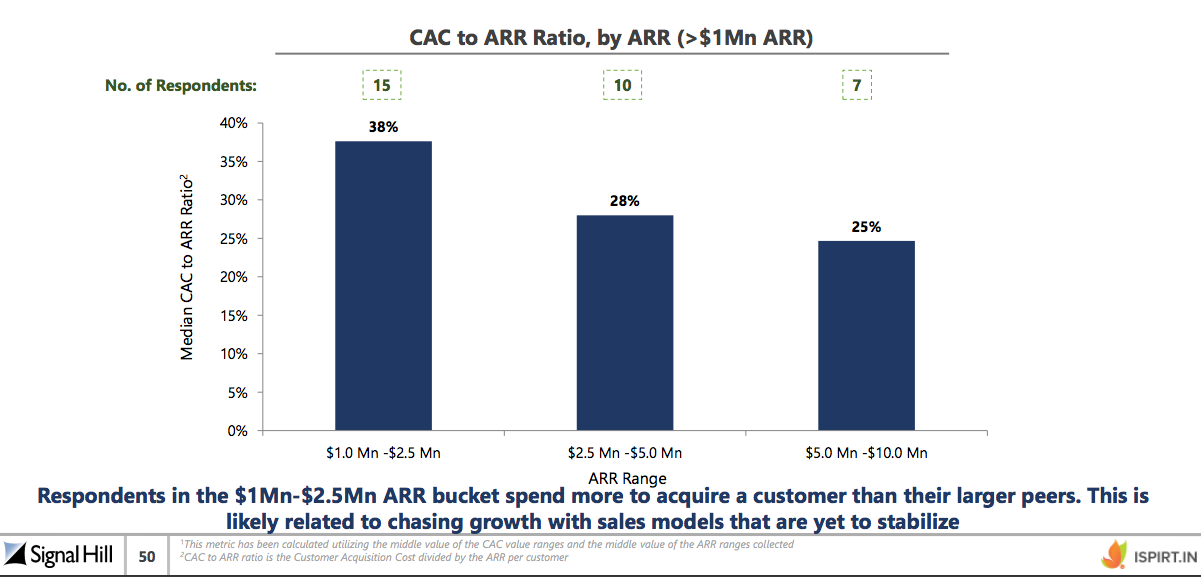
- Their larger peers, with over US$2.5 million ARR, had lower CAC, as their sales models stabilized and they had to spend less on chasing growth.
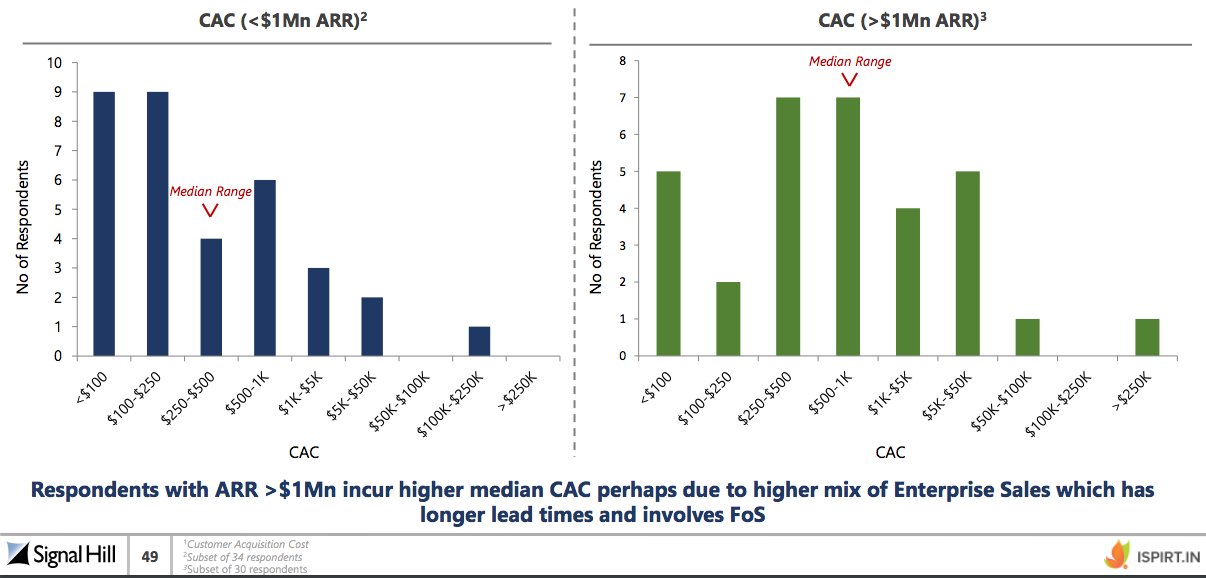
- The CAC is also lower for the early-stage startups with ARR below US$1 million because they rely only on digital marketing and inside sales.
It’s apparent from this that it’s when the startup crosses a threshold to reach larger enterprise clients does its CAC go up. That’s because beyond that threshold it involves some feet-on-street sales and longer lead times. Then the CAC comes down again when the startup scales up and has steady clients.
Shifting gears for the scale-up phase
Need for speedy innovation
Balancing cost and quality
Bootstrapping scores over seed funding





Stay updated on the go with our mobile app.
Get latest insights with smoother, more personalized experience through TIA mobile app.