Photo credit: Sole Treadmill.
Encased in a glass pedestal, Huawei’s Mate 9 Porsche Design was the most expensive phone I’d ever seen. It sat next to a gleaming, black Porsche (the car) at Huawei’s launch event last November with a price tag of over US$1,500.
China’s smartphone market today is a much different beast than it was five years ago. A Porsche-inspired smartphone may not be for everyone, but it shows what lengths companies need to go to dazzle increasingly sophisticated Chinese consumers. Domestic brands that were once known as cheap copycats of Apple have also expanded to pricier flagships. Xiaomi, for instance, rolled out its luxury Mi Mix last year, a bezel-less phone that comes with a whopping 256GB of internal storage. An even posher version comes with 18 karat gold accents.
Chinese brands once known as cheap copycats of Apple have expanded to pricier phones.
For Apple, which will debut its highly anticipated iPhone 8 today, hitting Chinese consumers with an expensive but extraordinary phone could help the US tech giant get its mojo back. According to industry analysts, Apple saw its market share in China decline for the first time in 2016. This year, it slipped to fifth place in China’s smartphone market.
“The tenth anniversary is quite a big deal in China,” Kitty Fok, managing director of research firm IDC China, tells Tech in Asia. “Some people are actually holding out on replacing their old Apple phone and waiting for the [iPhone] 8 to come out.”
“This year, Apple can probably push up their sales quite well,” she says.
A higher bar
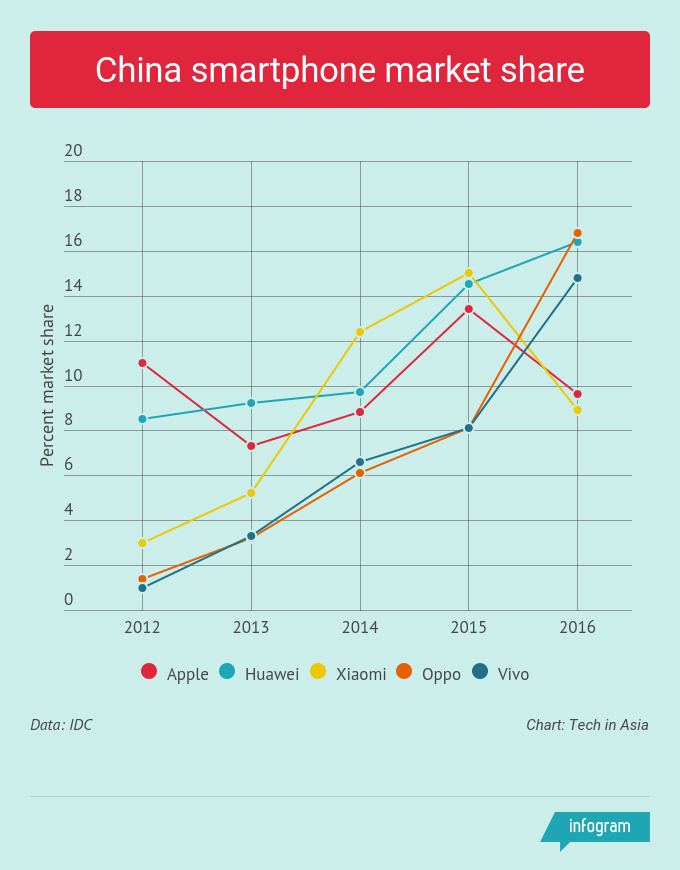
Apple’s market share plummeted in 2016 as Huawei, Oppo, and Vivo continued to rise.
China’s shift towards more expensive phones could play in Apple’s favor if its iPhone 8 – particularly the most glam “iPhone X” variant – succeeds in impressing Chinese consumers who can afford a US$1,000 device. At the same time, if the iPhone 8’s capabilities and design are not vastly superior to existing offerings, then Apple will be overshadowed by domestic smartphone companies – which are also crushing it overseas.
China’s more modest consumers also have higher expectations. Built-in beauty filters, dual cameras, and speedy fingerprint scanners are becoming the new normal in mid-range smartphones. Minimal upgrades, as seen in the iPhone 7, won’t be enough to woo back Chinese buyers.
“One of the biggest challenges for Apple is that basically it’s a hardware company [in China],” says Fok. Whether it’s iCloud, Siri, or Apple Pay, Apple’s ecosystem is truncated in the country.
“There are a lot of other alternatives available in China. It has limited Apple’s diversity of other technology,” she explains. The content business, for instance, is dominated by local tech giants, like Tencent, Baidu, and Alibaba. Last year, Apple’s e-books and movies store was blocked by the Chinese government.
However, augmented reality could be a new differentiating factor for the iPhone. Apple’s ARKit, which will be released in iOS 11, will give developers new capabilities to mix virtual objects with the real world through the phone’s camera. Already, huge companies like Ikea have developed an array of beta augmented reality (AR) apps in anticipation of iOS 11, from a The Walking Dead inspired zombie game to an app that helps you find friends at music festivals.
Second chance





Stay updated on the go with our mobile app.
Get latest insights with smoother, more personalized experience through TIA mobile app.