Josh Horwitz · · 3 min read
Unlocking the secrets of localization: how to build great apps for global users (LIVE BLOG)
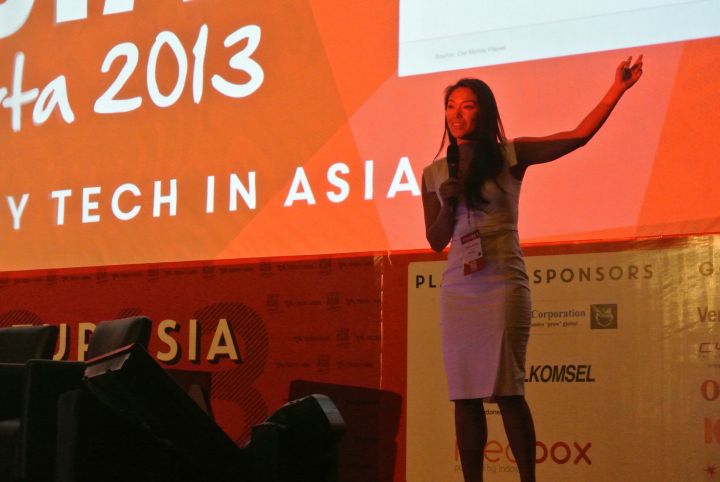
Tuyen Nguyen, Google Mobile Publisher Advocate, took the stage at Startup Asia Jakarta 2013 to give the dirt on how to localize content while reaching an international audience.
#15:55: Nguyen takes the stage!
#15:55: What does being a “Mobile publisher advocate” entail? Basically, help developers create good content.
#15:56: Every year is “the year for mobile.” In Indonesia, smartphone penetration is only at 14 percent. But the countries with the lowest smartphone penetration are the countries that are seeing the fastest smartphone adoption rates. A lot of countries in APAC are outpacing global averages in smartphone adoption rates.
#15:57: As users adopt smartphones, their consumption habits change. Users are spending three times the amount of time on apps than they are on the mobile web, according to recent studies, Nguyen says.
#15:59: As an app developer, where can you make money? Ad revenue is probably the future, but what about today? Nguyen notes the US and EU have the largest number of smartphone users in the aggregate, which makes them an optimal target market. If you localize to the top five most widely spoken languages globally, you can access 70 percent of the market.
#16:00: Even if your users like your app, 18 percent of users will uninstall it. Meanwhile, one-third of users report having experienced poorly localized apps. So if an app is poorly localized, it’s even more likely to be deleted.
#16:02: Nguyen defines “internationalization” as “design to be adaptable for many languages and cultures.” “Localization,” meanwhile, she defines as “adapted for many languages and cultures.”
#16:02: Metrics to look at if pursuing language expansion: top languages used on the web and which language group has the highest potential revenue.
#16:03: Google offers APK services to aid in translation.
#16:04: Nguyen takes the gaming vertical as a means to further analyze localization. For the majority of users, with the exception of China, brand is not important, according to studies.
#16:05: Nguyen explains how smartphone users are usually on-the-go, and therefore tend to interact with games that are more transactional with greater frequency – like puzzle games, which have level-by-level interaction. Tablets, meanwhile, are primarily used at home. Users are therefore more likely to interact with action and adventure games, which are more immersive experiences.
#16:07: Nguyen argues that monetization should be at the forefront of the planning stages of apps, and advises against postponing thinking about monetization until traction is gained. Although freemium can give you access to more users, in-app purchases can give you access to more revenue. If the app is meant to be short-term entertainment, the one-time fee of 99 cents might be the lifetime value of the app. But if the app is meant to be used on a long-term basis, in-app purchases offer more opportunities to earn revenue from the app’s lifetime value.
#16:09: About 85 percent of users are never going to make an in-app purchase, Nguyen says. So how can you monetize the 85 percent of those users? Ads, Nguyen says. Nguyen says that when she works with developers, she notices that they are under the impression that users don’t like ads. But this is in fact not necessarily the case.
#16:11: Asian users prefer personalized ads, while Western users prefer contextual ads, says Nguyen. In the latter case, if a Western user is playing a puzzle game, he or she would rather see an ad for another puzzle game rather than an ad for the user’s favorite clothing brand.
#16:14: “A successful app developer builds an app for users, while an unsuccessful app developer builds for himself,” says Nguyen.
Note for Live Blog readers: Click refresh to keep the updates coming!
This is a part of our coverage of Startup Asia Jakarta 2013, our event running on November 21 and 22. For the rest of our Startup Arena pitches, see here. You can follow along on Twitter at @TechinAsia, and on our Facebook page.
Stay updated on the go with our mobile app.
Get latest insights with smoother, more personalized experience through TIA mobile app.
Recommended reads
 Indonesian AI startup goes global
 Forrest Li on scaling Sea, building smarter bots, and founder grit
 An AI assistant that joins sales calls and scores team skills
 Beyond the check: Why VCs need more than capital
 SGX’s CEO says it doesn’t need a unicorn to win
 SMEs want AI too, but not the kind Big Tech is selling
 Oatside’s alt-milk rise hits a profitable gear
 Alibaba’s financial health in 12 charts
 Asia’s telcos bundle AI into mobile plans. Will it pay off?
 M-Daq chases bigger clients as revenue falls, losses grow