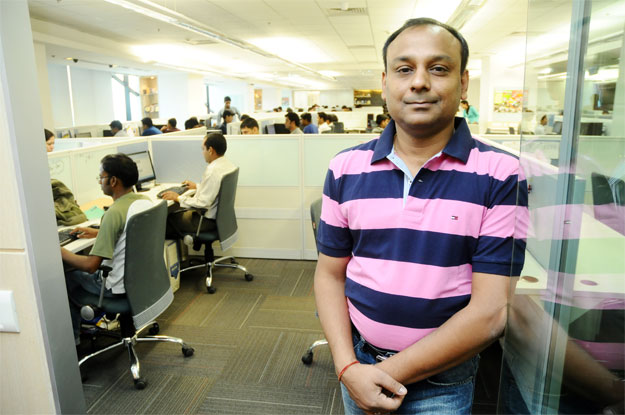
Dinesh Agarwal, founder CEO of Indiamart.
It was in 1996 that Dinesh Agarwal started to write the names and addresses of small businesses from his apartment in East Delhi. His wife and parents would help in the stamping and sealing of the thousands of envelopes that would be sent across India.
Dinesh would then go to the post office and deposit those huge bundles of envelopes in the mail. About 2 percent would post back with their contact details, phone numbers, business details. He would then list them on a website he built.
That’s how India’s largest business listings website Indiamart began. He managed to get 100 paying clients on board during 1997-1998. The company now has about 2.2 million suppliers on its platform and about 100,000 paying customers.
From Indian railways to exam paper checking
Dinesh had earlier worked at a government-owned IT corporation in the early 90s. He was posted at the New Delhi Railway Station where he would oversee the freshly introduced computerized reservations system.
Getting to know real-time availability was a huge task which technology solved. The success led to a computer revolution even in telecoms where manual exchanges were replaced with automatic telephone interconnect systems, leading to fewer cross connections and higher chances of getting a call through.
He was also tasked by another government agency to work on a technology that would ease paper checking for government exams.
Dinesh correctly realized that the internet would soon change the world. So he decided to return back to India in 1995 to turn an entrepreneur.
“I come from a business family and had saved some money to sustain the business and household,” says Dinesh.
Surviving the dot-com bust
Dinesh, an engineer with HCL in his US stint from 1992 to 1995, got back to India just as the internet was being born.
Everyone was opening a dot-com. And there was a flush of money through venture capital, a game we did not understand.
He returned with a passion to build small websites – and to build a useful database.
He started scanning directory books of the Federation of Indian Exporters and government data to get the names of businesses in sectors like garments, handicrafts, spices, gems, and jewellery.
“Everyone was opening a dot-com. And there was a heavy flush of money through venture capital, a game we did not understand,” says Dinesh, sitting at the 13th floor of his Greater Noida-based office, which overlooks lush green farmlands away from the buzz of nearby Delhi.
Shifting from the big city
Ecommerce and beyond
Tips to handle failure





Stay updated on the go with our mobile app.
Get latest insights with smoother, more personalized experience through TIA mobile app.