 Twitter is the world’s first and largest micro-blogging site and is gaining steam across the world. Unfortunately it isn’t gaining any in China, all thanks to her great firewall, which bans the population from Twitter. Jumping on this opportunity, Sina (新浪) launched its own micro-blogging site (Sina Weibo, 新浪微博) back in August last year.
Within a short 5 months time span, Sina Weibo has grown into one of the most valuable online properties in China. It currently has over 50 million users in China and Taiwan.
I met one of Sina’s marketing executives (who doesn’t wish to be named) during a tech meetup in Taipei. She told Penn Olson that Sina Weibo’s growth in Taiwan has been pretty impressive. It currently has over 500,000 users in Taiwan and has recently launched its complicated Chinese version to cater for Taiwanese users. The surge in user adoption rate in the country has motivated Sina to set up an office in Taiwan late last year. Sina currently has about 20 staff in Taiwan and is looking to expand its team as the number of Taiwanese users grows.
Sina Weibo success isn’t about copying what features Twitter has. Its micro-blogging platform has its own unique personality and is customized for the Chinese community. In fact, I believe there are 4 things that Twitter could learn from Sina Weibo. Catch them below. Note that all screen captures are translated via Google Translate.
1. Threaded conversations
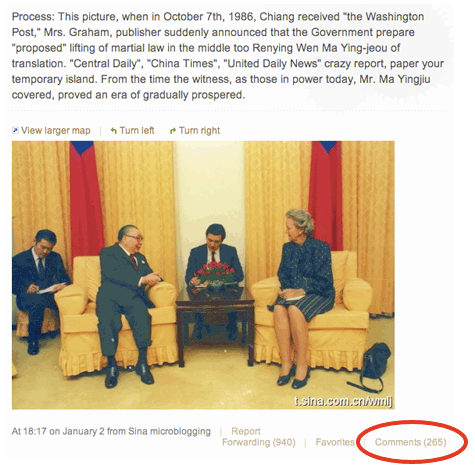
If you don’t consider Twitter as a social-networking site, I can totally understand why. To many people, Twitter is more about sharing and reading than conversing with other users. Twitter’s platform doesn’t encourage group conversations. It’s okay when you’re speaking to just one person, but it gets messy when you’re trying to tweet to a group of friends. It’s a different scene in Sina Weibo.
A popular weibo (equivalent to a ‘tweet’ in Twitter) can easily gather hundreds of comments, threaded as one. The interactivity within the community is simply amazing. It encourages comments and builds engagement within the community. Now, think about what threaded conversations can do for businesses. It improves mindshare, as more people are involved with the brand through discussions and not just simply passing the message. Customer service and gathering users feedback are also easier to track. If Twitter were to pick this up, it will improve both community and business interactivity. Oh, wouldn’t it be great if Twitter’s Promoted Tweets has threaded conversations too? It will make ads more impactful.
2. Content Categorizations
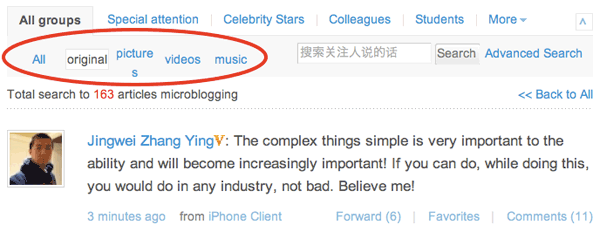
Content overload is a problem that Twitter faces. Perhaps, Sina Weibo has a solution to offer. Besides seeing the entire weibo in your stream, Sina Weibo categorizes content in 4 different groups: (1) Original content, (2) Images, (3) Video, and (4) Music. The original content filter is extremely useful as it surfaces the original weibo from the retweets (转发) and noise. It gives users a much cleaner overview of what’s happening, straight from the minds of the creators. Sina Weibo users can also view videos and mp3 without leaving the Chinese micro-blogging site. It works pretty much like Facebook, where content can be consumed right on the spot.
3. Topics and Trends Categorizations
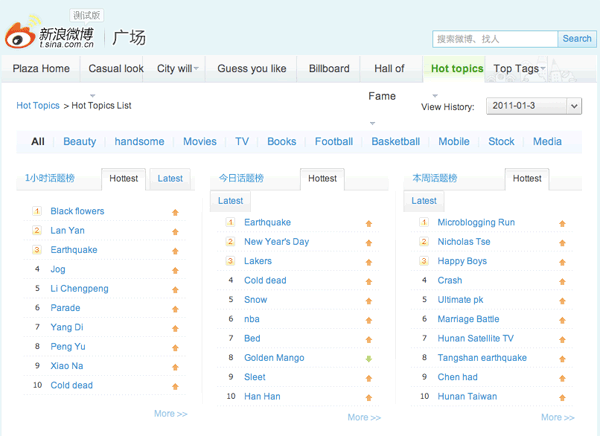
Here’s a second solution for Twitter’s content overload problem. Sina Weibo also categorizes content based on topics. Some of the hot topics include babes, hunks, movies, media and games. Each topic group has its own trending titles. These titles are ranked according to its buzz volume. Sina Weibo’s topics and trends categorizations make it easy for users to follow their interest, all within a few clicks. Compared to Twitter’s trends (which is based only on location), Sina Weibo seems to offer a better solution in this aspect.
4. Share Pictures Through Mobile Phone





Stay updated on the go with our mobile app.
Get latest insights with smoother, more personalized experience through TIA mobile app.