 Stefanie Yeo · · 4 min read
Here’s how this company is tackling the challenges of enterprise tech adoption

Tech is part of our everyday lives, and nowhere is that more evident than in the office.
The use of enterprise tech, which allows IT resources and data to be shared across an entire organization, is on the rise in workplaces. It’s used to support businesses in all aspects of operations, from handling payroll to managing inventory.
However, navigating all this new tech can be frustrating. Poor user experience and design lead to bad customer experience, which in turn results in millions of dollars in losses.
Additionally, employees have to adapt to unfamiliar systems, which results in lower operating efficiency and ultimately affects the business’ bottom line.
To manage these issues, various companies like WalkMe are developing solutions to help make enterprise tech endeavors easier.
Bridging the gap between user and tech
Founded in 2011, San Francisco-headquartered WalkMe is a digital adoption platform that helps companies bridge the gap between end users and tech.
According to company co-founder and CEO Dan Adika, the inspiration for WalkMe came about when one of the founders was helping his mother do online banking. “Basically, his mom was driving him nuts,” Adika shares. “So we were like, ‘Why is there nothing that can just show her what to do?’”

Dan Adika, CEO and co-founder of WalkMe / Photo credit: WalkMe
He likens WalkMe to a GPS device, which enables users to navigate a city even if they’re visiting it for the first time. That’s unlike most software, which people can’t use without asking for instructions, watching videos, reading manuals or visiting a knowledge base, the head executive added.
WalkMe eliminates that problem by providing a layer on top of an enterprise software system that helps users to operate it and complete tasks. Hosted on Amazon Web Services, it combines a variety of technologies and coding languages like Amazon Redshift, JavaScript, and Python, among others, to build a comprehensive platform that can adapt to any software.
The startup’s digital adoption platform assists businesses with their enterprise tech problems in three main ways.
1. Tech adoption
Setting up and implementing a new system can be a long and difficult process. After investing money in implementing a new piece of software, for instance, companies face the challenge of getting their employees to actually use it.
“Using the software and adopting it are two different things,” Adika points out. “For example, I can use the CRM (customer relationship management) software, but if you ask me what my forecast is for the quarter, I will open an Excel file to work it out instead. So I’m not truly adopting it, I’m just using it as a database.”
As a result, many companies struggle with unlocking the full potential of technology.
WalkMe’s platform addresses this concern by making the learning curve less steep. It either walks users through the entire process to get a task done step by step or by actually doing it for them using information that the person inputs. “Anything you need to do with the software, you just go to WalkMe,” Adika claims.
2. Change management
In the wake of company reorganizations and other rapid changes in business operations, employees may find it difficult to adapt to the new systems that are put in place.
According to Adika, the average employee juggles 20 to 30 applications, which are constantly being updated or replaced, and they have to keep up with all these new processes, rules, and methodologies.
He brings up the example of filling up new forms in a standardized manner, explaining that data integrity is compromised if employees do this incorrectly.
With WalkMe’s platform, any changes made to the processes or applications in use are reflected immediately and can be communicated to employees easily through the walk-through process.
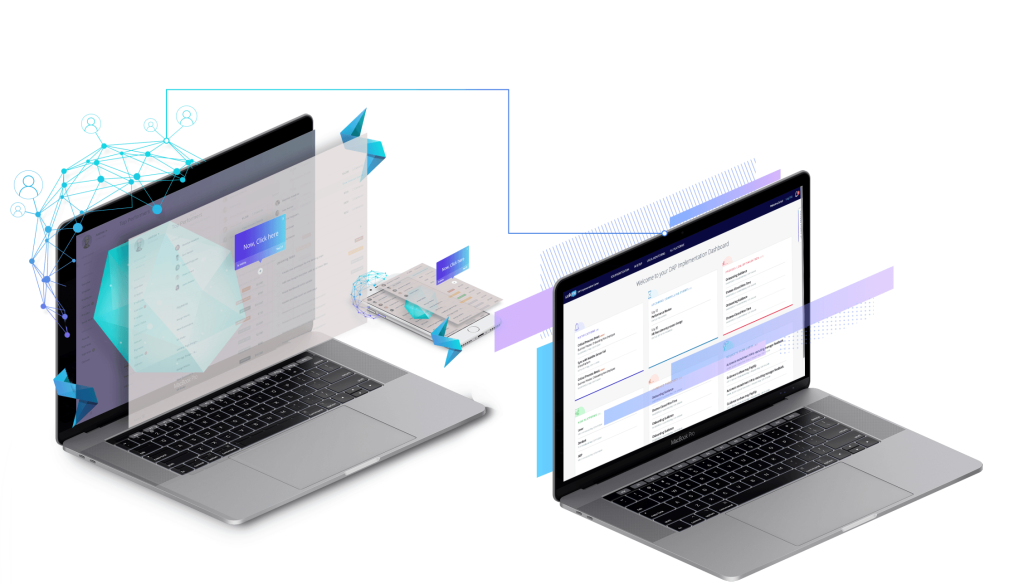
Photo credit: WalkMe
3. Resource optimization
Another issue that businesses have to deal with is optimizing their resources.
“Let’s say you’re a bank or a brokerage firm, and you have 800,000 support calls a quarter with people asking basic questions such as ‘How do I change my password?’” Adika posits.
In such instances, WalkMe’s platform can help with call deflection, where instead of being directed to a customer service hotline, people are re-routed to an alternative form of customer service – in this case, WalkMe. The platform takes them through the process, step by step.
This way, companies can reduce headcount, as fewer people are required to answer customer service calls. It also helps to increase adoption and return on investment.
On top of call deflection, WalkMe also helps ensure that employees are using software and filling in forms correctly, improving efficiency and ensuring greater data integrity.
Adapting software to humans
Since its inception, WalkMe has expanded across the world, opening in locations such as London, Tel Aviv, Sydney, and Singapore.
Looking to the future, the company is considering using deep learning algorithms to improve its platform’s capabilities. WalkMe’s goal is to understand user interfaces just like humans do and operate as the ultimate application programming interface.
Through this, WalkMe will not only make tech adoption easier, but it will also enable businesses to identify problem areas and come up with effective solutions.
“We believe that in a few years, human beings won’t need to learn how to use software. Instead, software will adapt to human beings,” Adika says.
WalkMe is a data adoption platform that aims to bridge the gap between end users and technology, driving higher engagement and adoption of digital assets by improving the user experience.
Visit their website to find out more.

Stay updated on the go with our mobile app.
Get latest insights with smoother, more personalized experience through TIA mobile app.
Recommended reads
 TiDB is engineering the infrastructure for AI’s agentic future
 From data to durians: H2O.ai’s journey to AI-led accessibility
 Inside OpenAI’s public-first bet on medical AI
 ‘Good morning, Dave’: The new world of physical AI in daily life
 Ex-ByteDance exec bets cameras beat chatbots in $3m AI play
 Freeze headcount until AI becomes the true production line
 Escaping the LLM bubble: AMI Labs goes the physical AI route
 Why Google moved fast on AI in Search but held back on chat
 This startup helps chipmakers stop repeating the same mistakes
 Nvidia CEO urges rethink of corporate structure




Editing by Winston Zhang, Jaclyn Teng, and Eileen C. Ang
(And yes, we’re serious about ethics and transparency. More information here.)






