- Premium Content It takes our newsroom weeks - if not months - to investigate and produce stories for our premium content. You can’t find them anywhere else.
 Scott Shuey · · 7 min read
Turing’s wild pivot: from job boards to GPT lords
In April, Jonathan Siddarth, CEO and founder of Turing, called for better benchmarks in artificial general intelligence (AGI) at the International Conference on Learning Representations (ICLR), one of the most influential AI forums on the planet.
That Siddarth was asked to give that talk is not surprising. Over the past six years, Turing – named after Alan Turing, a pioneer of early computing and creator of a test to determine a machine’s capacity for intelligent behavior – has become closely associated with AI infrastructure after the California-based startup helped OpenAI develop GPT-3 in 2022.

Image credit: Timmy Loen
Today, Turing sits at the heart of AI infrastructure, powering not just frontier research at OpenAI, Anthropic, Meta, Google, and Microsoft, but also contributing to systems that are rapidly reshaping the very idea of work, intelligence, and innovation.
Siddarth describes Turing’s research as generating and providing data to help the models get better at coding, reasoning, math and STEM.
It’s a far cry from where Turing started. The company’s early days were rooted in a simple idea: use AI to find and match top-tier engineering talent from around the world.
Siddarth called his startup’s initial collaboration with OpenAI “fateful,” coming just as the latter was training GPT-3. OpenAI needed high-quality data to teach the model how to write code, and Turing had access to a talent pool capable of producing it.
What started out as a data partnership quickly evolved into a foundational role in large language model (LLM) training.
“It became very clear that software engineering input was very important for making LLM smarter not just for coding but for general reasoning,” he tells Tech in Asia. As the models improve at coding, they “get better on other reasoning tasks that have nothing to do with coding. We actually don’t understand it very well.”
Thanks to the collaboration, Turing became “an AI infrastructure company … one of the fastest-growing in the world that’s also profitable,” says Siddarth.
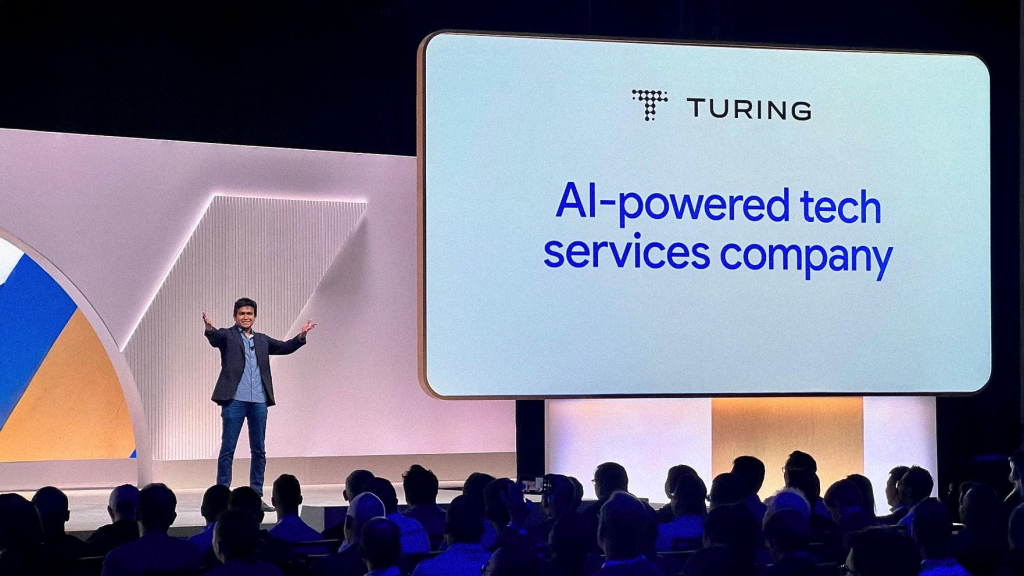
Turing CEO Jonathan Siddharth on stage / Photo credit: Turing
With US$167 million in annual recurring revenue, Turing raised funding at a US$2.2 billion valuation in March. Since then, the company’s revenues “have almost doubled,” Siddarth says.
Global players including WestBridge Capital and Malaysia’s sovereign wealth fund Khazanah joined the funding round.
Fighting for engineers in the Valley
The benchmarking future
Intelligence as infrastructure
Stay ahead in Asia’s tech landscape
This is premium content. Subscribe to read the full story.
Founder Jonathan Siddarth talks about how Turing became the backbone of AI infrastructure, the need for better benchmarking, and AGI-driven job losses.
We know this is not ideal. ⌛ Sign up in 20 seconds. Cancel anytime.
Our subscriber community includes professionals from these companies:





Stay updated on the go with our mobile app.
Get latest insights with smoother, more personalized experience through TIA mobile app.










📅 Upcoming Events
22 October 2026
Payoneer x CSPN Summit 2026