 J.T. Quigley · · 5 min read
Visiting Japan? You’ll love this free restaurant menu translation service
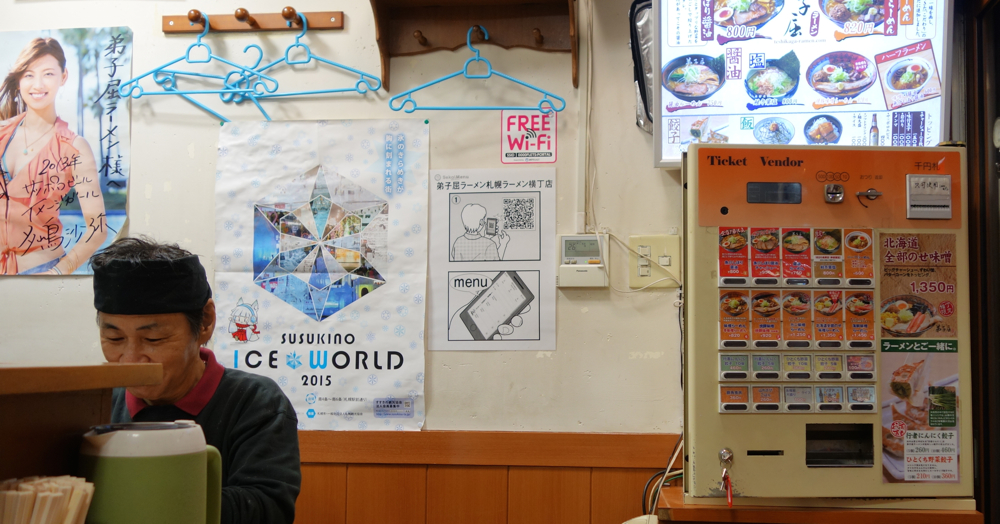
A Sekai Menu QR code hangs on the wall of a ramen shop in Sapporo.
In his 20s, Nobuyasu Fukunishi worked at several bars and izakayas (Japanese style drinking and dining establishments) around Sapporo’s Susukino nightlife district. The neighborhood, a stone’s throw from the massive snow sculptures that accompany the city’s annual Yuki Matsuri (Snow Festival), plays host to many of the two million visitors from elsewhere in Japan and abroad during the week-long event. The city, the prefectural capital of Hokkaido, also acts as a jump-off point for international skiers and snowboarders who want to experience the island’s legendary powder snow.
Fukunishi’s company, Es-planning, wants to help those tourists cope with the local language barrier – as well as help restaurant staff avoid awkward encounters with foreigners who can’t read or order in Japanese. Its seven-month-old service, Sekai Menu (meaning “World Menu” in English), provides multi-language localization of food and beverage menus via QR codes placed around partner restaurants. Users can simply scan the code and place their order via smartphone or tablet, ensuring that neither party gets lost in translation.
“A bunch of us went out to an izakaya one night and ordered nomihoudai (a timed all-you-can-drink plan),” Fukunishi says. “The waiter took so long to bring our food and drinks so I thought ‘why can’t we just order by smartphone?’ If the waiter didn’t have to come back and forth to our table every time we needed something, it would save time and effort. Of course, such systems exist, but the barrier for entry is high in Japan – around JPY 500,000 (US$4,300) just for the introductory fee, so we wanted to provide a low-cost alternative.”
The team’s initial focus was simply ordering, but Fukunishi realized the importance of adding language localization when Tokyo won the 2020 Olympic bid.
“After Tokyo was selected, we realized that it would be a lot easier to get foreigners to Hokkaido if we could make it easier for them to visit local restaurants,” he explains. “We get an influx of tourists for the Yuki Matsuri, but they often only go to chain restaurants, drug stores, convenience stores, and big box retailers. I want them to experience real Japanese food and culture. These kind of local experiences will make them come back.”
Word of mouth
Sekai Menu, a subsidiary of Es-planning that’s internally funded, runs a skeleton crew of one full-timer, three part-timers, and Fukunishi himself. Instead of aggressive sales tactics, the service relies largely on word-of-mouth for growth.
“One strategy is to look for the businesses that stand out among their peers and gain influence through them to convince their peers to join,” Fukunishi explains. “We’re working one tourist area at a time, focusing on famous restaurants to establish a foothold. Word-of-mouth has more impact than knocking on doors shop by shop, especially around here.”
So far, the service has attracted 40 restaurants in Japan, but that number is about to skyrocket. Sekai Menu recently partnered with Tokyo Station’s “Kitchen Street” dining plaza, and each restaurant there will begin utilizing the service soon. Fukunishi says he’s been approached by Vancouver International Airport about running the service in reverse for inbound Japanese tourists, and some high-profile restaurants in Australia and Vietnam have also been in talks with the company.
By the end of the year, Fukunishi hopes to offer Sekai Menu service at 3,000 restaurants in Japan and 500 more establishments outside of the country.
30 languages
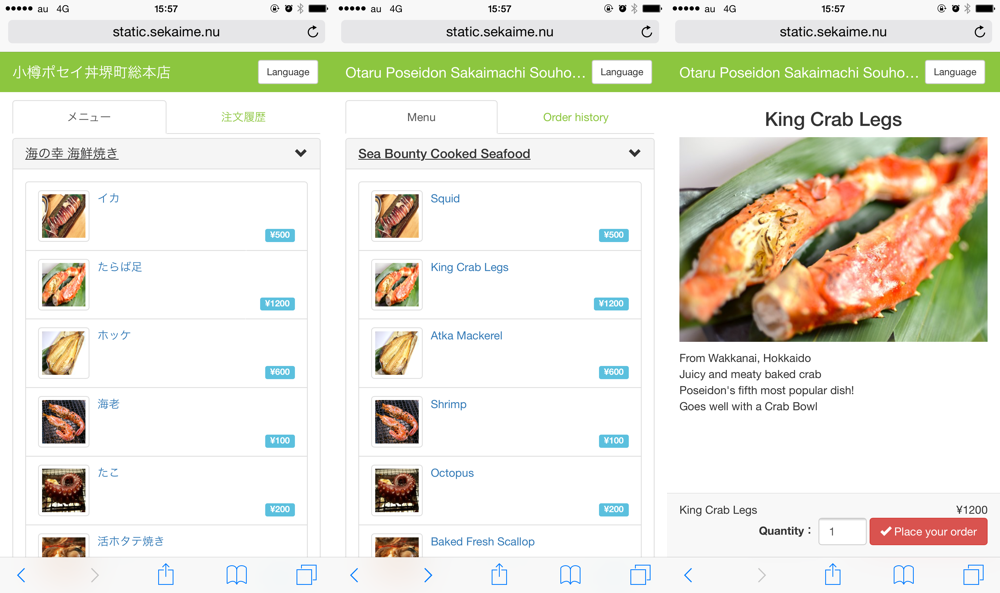
Using Sekai Menu is incredibly simple: participating restaurants put Sekai Menu placards on their dining tables with a custom QR code. Users scan the code, and a menu appears in whichever language their device’s system is set to (the service offers a total of 30 different languages, but it’s up to each individual restaurant to choose how many to add). Default languages include English, Chinese (simplified and traditional), Korean, and Thai. Menu browsing and ordering is all done in-browser. A companion app for the restaurant staff, available for iOS or Android and optimized for tablets, acts as a simple point-of-sales system for receiving orders. It’s also possible to have multiple tablets receiving orders for large restaurants.





Stay updated on the go with our mobile app.
Get latest insights with smoother, more personalized experience through TIA mobile app.









📅 Upcoming Events
22 October 2026
Payoneer x CSPN Summit 2026