 Edith C. · · 6 min read
Top tips for adopting automated machine learning by an AI expert

Product recommendations have become part and parcel of the online shopping experience. Ecommerce sites like Amazon, Shopee, and Carousell can predict what customers might like and suggest millions of items for them instantly.

Photo credit: gregorylee / 123RF
The ability to do this is largely enabled by automated machine learning (autoML), which is the process of applying machine learning to real-world problems automatically.
But marketing isn’t the only way to use autoML, as enterprises can also apply it in fraud detection, risk management, and other departments. Using it, however, is not without challenges, so companies need to pay attention once they decide to adopt it.
Benefits of autoML
Some tasks needed to develop AI and machine learning applications are repetitive. For example, processes such as the selection of algorithms, diagnostics, training, and tuning can often be left to autoML.
That’s why Colin Priest, vice president of AI strategy at machine learning solutions firm DataRobot, says that the method is perfect for achieving scale in data science projects.
“With autoML, what remains for the data scientist to do is to turn a business problem into a modeling problem, to add domain-specific knowledge into experimental design, and turn predictions into optimal business decisions,” says Priest.
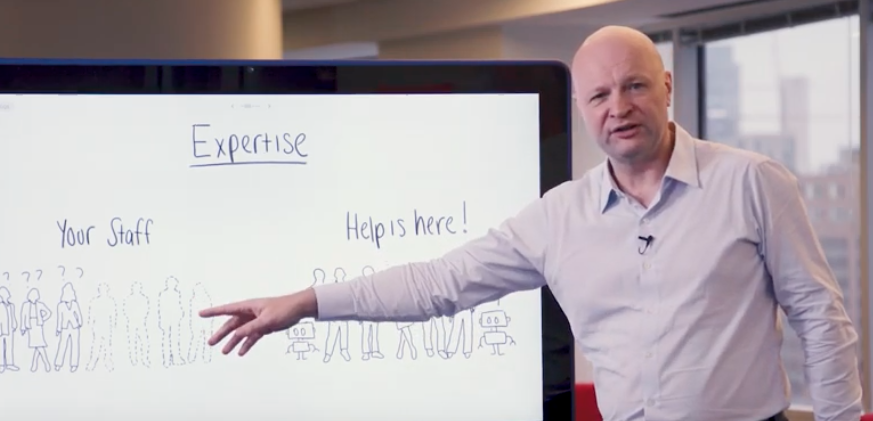
Colin Priest, vice president of AI strategy at DataRobot / Photo credit: DataRobot
Adopting it helps enterprises grow, reduces the risks associated with having humans code manually, and shortens the time it takes to complete projects.
Since data scientists are in short supply, autoML also allows non-technical personnel to tackle data science activities and increases the number of people who can contribute to such endeavors.
In the manufacturing industry, for instance, a strong business team can use autoML to effectively predict exactly which machines are about to break down. This gives way for informed decisions to be made across functions like software and hardware maintenance, staffing and scheduling, and finance.
This year, DataRobot released a whitepaper on autoML, detailing its rise, discussing its benefits, and sharing stories of businesses that have successfully leveraged it to achieve tangible bottom-line results. Based on the report, Priest shares some of the best practices to follow to properly integrate autoML.
1. Start collecting data
This is a no-brainer. A business should collect and store data on consumers to help it make better decisions. However, Priest says this doesn’t always happen in Asian companies.
“In Asia, banks are great data houses, but not retailers. Retailers rarely keep transaction data or link it to customers, which means they can’t turn this back into decisions on customers,” he notes.
Companies should identify a measurable outcome that they wish to predict, such as sales or customer churn. They should also recognize that paper-based data will be incredibly hard to collect, so they must invest in digitization.
Useful data can include numbers (e.g. sales amounts), categories (e.g. product types), or text (e.g. customer feedback), and ought to be enough for autoML to find patterns.
With a slew of privacy breaches and data scandals in recent years, regulators all over the globe have also become stricter on internet companies. That’s why it’s important to think about compliance as well. Startups can do this by getting consent from customers, informing users why the information is needed, and learning about their local data laws.
2. Assemble a dream team

Photo credit: Verkeorg
When integrating autoML, business people need to be involved from the beginning to help envision the workflow.
Take insurance company American Fidelity, for example. Its vice president of research and development, Shane Jason Mock, was put in charge of identifying new technologies that could potentially transform existing processes at the firm.
In 2018, he piloted an automated email sorting system using DataRobot’s machine learning technology and the robotic process automation (RPA) tool from software company UIPath.
According to Priest, the system’s efficiency impressed senior executives, who encouraged the rest of the firm to find use cases for machine learning or RPA. Now, American Fidelity’s actuarial team uses DataRobot to build anti-fraud models.
This just shows how critical it is to get the backing of senior officials in the organization. On top of having executive sponsors (company leaders who help drive progress for a project), senior management members need to spot opportunities and prioritize them, acquire the right resources, and help manage the risks of the project. Untrained executives might identify the wrong opportunities, leading them to try inaccurate use cases or plan projects carelessly.
The last thing a company wants is to create team silos, as this often leads to disastrous results. For instance, an insurance company wanted to cross-sell financial products to existing customers and had its data science team build a model to tackle this. However, the team released the relevant customer prospects to each insurance agent as a printed list comprising hundreds of names. As such, it was too time-consuming to search, making it unusable for insurance agents, defeating the purpose of the project in the first place.
Even if you have good tools like autoML, you also need a technical person who can set up the entire model.
3. Focus on low-risk endeavors that can be completed in less than six months
According to Priest, any project that takes more than a year is “almost certainly doomed for failure,” and ones that last longer than six months are also at high risk.
The issue, he says, is in the unforeseen problems. “A huge project can be delayed a year or two, and you have to go through multiple budget cycles asking for more money when nothing is delivered.” he clarifies.
On top of that, the longer a project drags, the more likely enterprises face attrition, where people involved in the venture leave and take important domain knowledge with them. Priest’s advice for companies is to seek ideas that can be delivered to market in a shorter time.
4. Beware of team silos
It’s not uncommon to see long-term projects abandoned or stalled because the final product couldn’t be implemented in the organization. One major reason for this is that IT teams aren’t informed early enough in the project’s life cycle.
Companies with a host of legacy systems must also make sure their programs can be implemented side by side with the new project. For instance, banks run old marketing systems that don’t integrate with other software. Even if a new predictive marketing tool helps it discover customers who will be excited by a new product, decisions can’t be implemented without knowing what the campaign is and what system to use.
Finally, the way teams keep data may also be different: Some record information on paper, while others use digital methods. It’s almost impossible to automate siloed processes, so it’s necessary to align these ahead of time.
5. Debunking the ‘replacement’ myth
AI performs tasks; it doesn’t replace staff. As such, autoML should enhance workflows involving humans. “Choose tasks to automate that are just procedural, at scale, and are just annoying for your staff to do so your staff can be freed up for tasks that are more human and productive,” Priest recommends.
He shares that any autoML project he has seen which is about reducing expenses or replacing staff as its primary goal tends to fail. “You can sometimes achieve lower expenses, but if that’s the primary project goal, you’re solving the wrong types of problems,” explains the executive.
Priest adds that to improve businesses, the best types of problems to address are those that involve bringing in more customers, developing your product, boosting customer satisfaction, and optimizing production lines.
DataRobot helps organizations transform into Al-driven enterprises. Its automated machine learning platform empowers data scientists of all skill levels to build and deploy accurate machine learning models at speed.
Read DataRobot’s whitepaper on the benefits of automated machine learning to learn more.
Stay updated on the go with our mobile app.
Get latest insights with smoother, more personalized experience through TIA mobile app.
Recommended reads
 Will cars drive the future of AI? This Chinese company thinks so
 Why robots still need humans to make warehouse automation work
 How AI is breaking SaaS where trust matters most
 Why falling AI costs spark investor panic but drive new revenue
 Escaping the LLM bubble: AMI Labs goes the physical AI route
 How AI agents will be the new software buyers
 Inside OpenAI’s public-first bet on medical AI
 Gen Z Harvard dropout builds AI platform for architects
 Why Notion warns that AI token spend hides actual product ROI
 How an ex-OpenAI lead views the shift from software to robots





Editing by Nathaniel Fetalvero, Jaclyn Teng, and Eileen C. Ang
(And yes, we’re serious about ethics and transparency. More information here.)



📅 Upcoming Events
22 October 2026
Payoneer x CSPN Summit 2026