 Mary-Anne Lee · · 4 min read
From solo devs to fledgling studios, here are 6 tips from Malaysia’s games industry
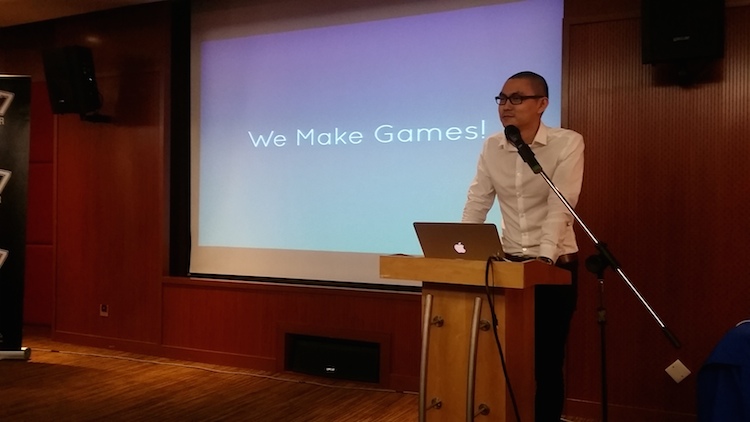
Games in Asia’s recent Malaysia Meetup, aptly titled “braving the frontiers”, saw its three speakers share a variety of experiences with an eager audience. Shawn Beck of Velocibox fame talked about his adventure as a solo game developer, while Richard Sun from WIGU Games detailed his privately-funded company’s journey so far. Appxplore’s Desmond Lee rounded up the evening with an open-floor question and answer session about Appxplore’s recent acquisition by Fatfish Internet Group.
See: Fatfish chooses Malaysian mobile games studio Appxplore for first acquisition after IPO
Here are some of the best takeaways of the Malaysia Meetup:
Fail early, fail fast, fail often
Beck says that a game he co-developed under the studio Sunnyside Interactive was left floating in the App Store for about a year while he and his co-developer Sam Goh waited for funding to properly market it. They started on a new game while waiting, but the lack of feedback on Dreamcatcher caused the mistakes they made there to go uncorrected – and these seeped into their next game.
Beck’s recommendation? Make a game small, keep it small, and release it for that “taste of failure” before going into your next game.
Keep it simple
Beck’s next game, a lightning-paced hack-and-slash that aspired to be a 2D Devil May Cry for the tablet, didn’t feel cohesive enough, and had too many things going on. He ended up having to scrap the game, but took away a valuable lesson summarized in this quote by renowned writer, Antoine de Saint-Exupery:
Perfection’s not achieved when there’s nothing more to add, but when there’s nothing left to take away.
His latest game, Velocibox, was built on this tenet.
See: Indie game dev is tough whether you’re funded or not
Understand what feedback really is
Beck reached out for feedback from others when working on other games, but he soon came to realize something important: that feedback should define usability, balance, and clarity, but not design. “Only you as a designer can see the grand scheme of things,” he says.
Discipline
This seems a no-brainer, but this nugget of wisdom means a lot more than just showing up for work. WIGU Games’ Sun says that discipline had to be enforced in the WIGU studio when the team was just starting out. “We were okay with flexi-hours, we thought they could be cool and trendy in tech,” he says, “but flexi-hours don’t work for a new team.”
Sun gave an example: if someone starts at 10:30am, he might leave later, but eventually he’ll also start to come in later at 12pm, 1pm, and then 3pm. Even if he stays till 3am at night, the team doesn’t stay together and it’s difficult to build cohesion that way. The solution was naturally to enforce fixed working hours to keep the team together.
Know your distribution channels
Get an investor who believes in you





Stay updated on the go with our mobile app.
Get latest insights with smoother, more personalized experience through TIA mobile app.









📅 Upcoming Events
22 October 2026
Payoneer x CSPN Summit 2026