Zhixin Tan · · 7 min read
A look at livestreaming in Southeast Asia after the initial hype has cooled off
The livestreaming industry, enabling real-time interactions between fans and content creators, has taken off around the world – especially in China where there are several established livestreaming platforms like YY, Inke, Momo, and Douyu.
Across Southeast Asia, there are only a couple of notable livestreaming platforms, such as Bigo Live, Thai platform Kitty Live, and Singaporean startup BeLive. The big players, like Bigo and Kitty, tend to be backed or owned by Chinese firms.
The livestreaming genre where people broadcast their daily life is also known as “in real life” (IRL). It’s one of the most popular genres because it invites everyone to participate and can therefore potentially reach mass scale.
Although IRL livestreaming became a hot topic in Southeast Asia in its early days around 2015, it soon became obvious that the format has some issues. The revenue model wasn’t sustainable for some creators, and IRL livestreaming earned a bad reputation for its adult content.
Today in Southeast Asia, livestreaming is diversifying. Video game livestreaming and livestreaming for social shopping are starting to emerge as niches for specific audiences. It’s also being challenged by new formats, such as short-video apps. Meanwhile, IRL livestreaming is trying to find its place after the initial hype has cooled off.
Livestreaming’s early days in the region
When livestreaming emerged in Southeast Asia in 2015, apps such as BIGO Live quickly moved up the charts in countries like Indonesia and Thailand.
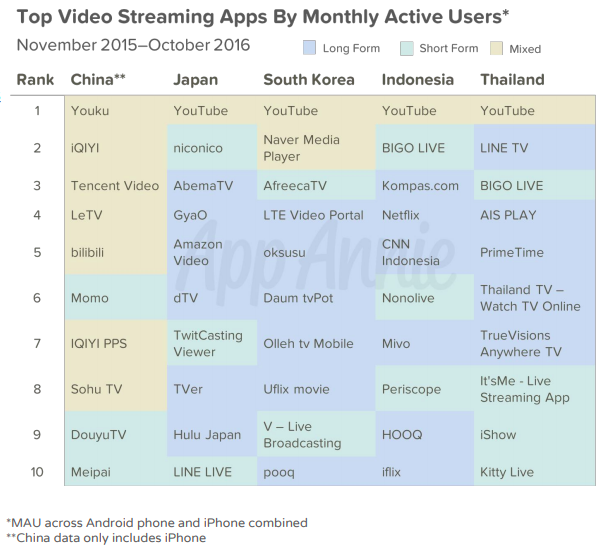
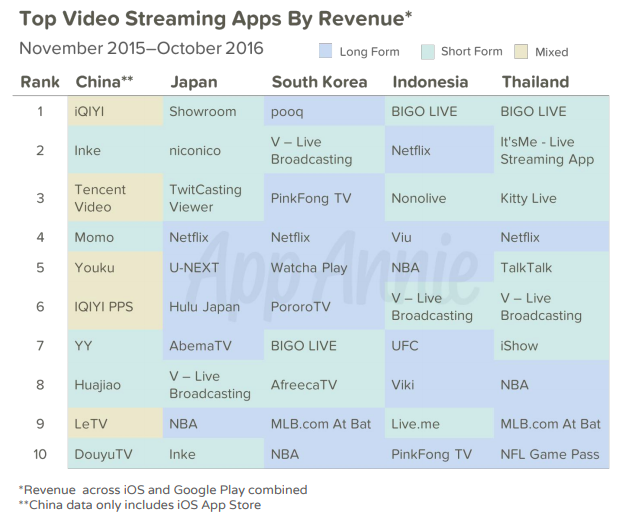
According to App Annie’s report on video streaming in Asia, Bigo Live surpassed all other platforms in its category in Indonesia and Thailand, such as US-made Periscope, in terms of monthly active users. It also led in its category in terms of in-app revenue.
Livestreaming platforms appeared to be doing well in the region, but that rosy period did not last long. In Singapore, for example, some early adopters were starting to become disenchanted with the format.
In a conversation with KrAsia, a popular streamer who goes by the handle Junn0215 shared that he first started broadcasting on Bigo Live around late 2015. As a foreign full-time music student studying in Singapore, Jun turned to livestreaming to connect with like-minded people.
His content varied from music to cooking and chatting. He also started a new concept and held his own version of American Idol on Bigo Live, which became popular. But he soon ran into some disagreements with Bigo Live’s management team.
Jun revealed that a team from Bigo flew down from China and offered to sign him on as a contract streamer, which would have given Bigo Live ownership of his content, an agreement he did not want to enter into. Eventually, Jun left the platform in 2016, only to join its competitor, BeLive, later.
Virtual gifting model: not for every market
Bad reputation
Short video, gaming, and shopping livestreams gain momentum





Stay updated on the go with our mobile app.
Get latest insights with smoother, more personalized experience through TIA mobile app.