
I’m on vacation this week! That ought to mean relaxation and some carefree fun, but unfortunately my bliss was broken almost immediately by an experience I had trying to take a flight with Tiger Airlines.
My flight was scheduled for 10 AM, and that’s what was printed on my ticket. But at the desk, a Tiger Airlines rep told me the flight had been delayed until 12. That’s annoying, of course, but it happens. Then when I reached the gate, I discovered the departure display board had our flight leaving at 2:30 PM. There had been no PA announcement to inform us the flight had been delayed, though.
Needless to say, this was confusing. My ticket had one departure time, a Tiger Airlines rep had told me another, and now the big board was telling me a third time. Which one was correct? No one seemed to know, and the passengers around me were clearly also confused and upset.
I tried calling Tiger Airlines’ customer service line, but no one answered. I checked their Twitter account and tried to get a clarified flight time from it, but it’s just a promotional robot — there was no human behind the account to answer my question. Finally, I tried to submit a complaint about this via their website, but submitting complaints requires customers to fill out a lengthy form — does Tiger Airlines really need my street address to address my complaint properly?
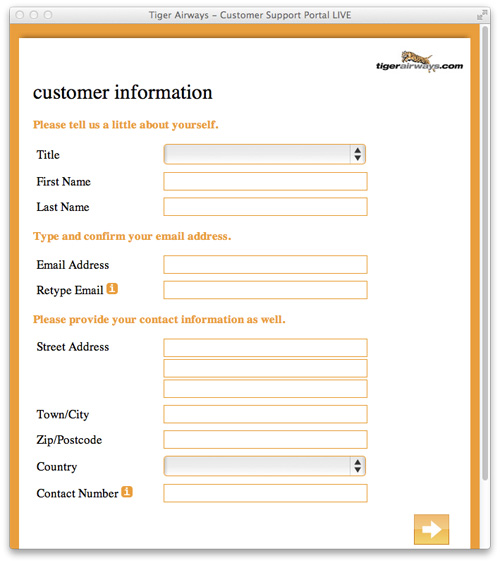
Stupid customer support web form, by Tiger Airways
Looking at other Asian airlines, like AirAsia, it’s clear Tiger could — and should — be doing a much better job with customer service in the era of web 2.0. Where Tiger’s Twitter is just a bot that pumps out non-interactive promotional drivel, AirAsia uses Twitter to interact with customers, answering their questions and solving their problems. I suspect if I’d been flying AirAsia, I could have gotten some clarification from their Twitter account, passed that information along to my fellow passengers, and everyone would have known what was going on.
Similarly, there’s no need for complicated web forms for customer service issues, and there’s a reason most web savvy companies offer simple forms that look something like this:
- Name:
- Problem:
- Contact info:
I’m sure having a longer form cuts down on Tiger Airlines’s complaint numbers, but it sure doesn’t help with customer satisfaction. And why the heck was no one answering the phones at their customer service line? That would have been unacceptable even twenty years ago; now, it’s just ridiculous.
Delays happen, but if Tiger Airlines was making good use of web 2.0 tech like Twitter to engage in an actual dialogue with consumers, the way AirAsia is, it could have saved me and my fellow passengers a lot of confusion, and maybe saved itself a few customers.
I’ll probably keep flying with Tiger — let’s face it, they offer really cheap flights, and it’s hard to pass that up — but I suspect at least a few of my fellow passengers may not ride the Tiger again. And it’s not like it costs that much to hire a real person to run your social media sites. Interactivity is no longer a luxury, it’s a customer expectation. And sooner or later, companies that continue to ignore this fact are going to get left behind — no matter how cheap their flights are.





Stay updated on the go with our mobile app.
Get latest insights with smoother, more personalized experience through TIA mobile app.










📅 Upcoming Events
22 October 2026
Payoneer x CSPN Summit 2026