Research firm comScore has released information today on the different ways that people in Japan kept themselves informed after the tragic earthquake and tsunami back on March 11. Despite all the praises that we heap upon social media and mobile services – not to mention the high-tech stereotypes we associate with Japan – television proved to be the number one medium. 83 percent of those polled in the study said that they considered TV to be “a very important information source after the disaster.”
Fixed internet ranked as the second most popular at 72 percent. But what’s most surprising about the numbers (surprising for me at least) is that more respondents listed radio as an important source of info than mobile phones.
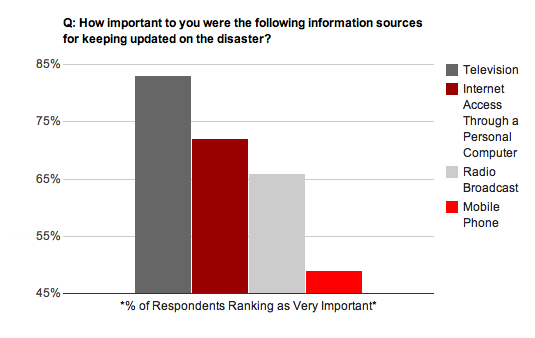
But that’s not to say that mobiles weren’t used much after the quake. According to comScore, far from it actually. The firm claims:
36.5 million people accessed information on their mobile phones following the earthquake and tsunami, representing 36.2 percent of the mobile population in Japan.
36.2 percent? That struck me as a little low when I first read it. I wonder if respondents were thinking of the mobile outages immediately after the quake when they were polled? Certainly in areas where there were power outages, radio must have been a godsend.
The Elderly Effect #
But a look at the breakdown of responses according to age demographics (below) provides a little insight on the radio/mobile anomaly. Notice the divergence of the lower red and grey lines in the graph below (mobile and radio respectively). Among older respondents, radio was clearly favored over mobile. A similar divergence occurs in among older people if you look at TV versus fixed internet (upper portion, dark grey and dark red).

I’m curious as to how big comScore’s sample size is (and have sent them a mail to ask), but I suppose given that Japan’s population is so disproportionately old, maybe it shouldn’t come as a surprise that the overall survey results is reflective of their preference for traditional media.





Stay updated on the go with our mobile app.
Get latest insights with smoother, more personalized experience through TIA mobile app.









📅 Upcoming Events
22 October 2026
Payoneer x CSPN Summit 2026