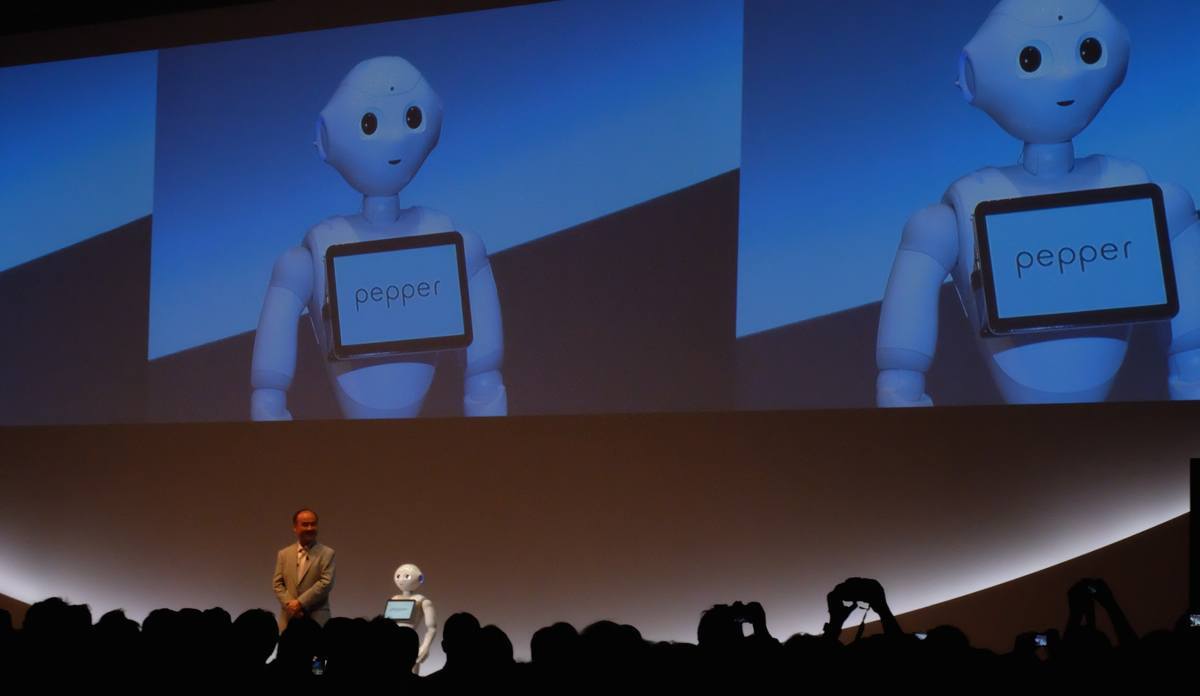
At the annual SoftBank World conference in Tokyo this morning, CEO Masayoshi Son asked the audience a rhetorical question: would you rather be friends with someone who’s extremely smart but devoid of emotion, or with someone a bit less sharp who’s kind and sincere?
“I’m sure that most people would rather have the warm-hearted person as a friend,” he said. “Someday robots will be more intelligent than human beings, and [such robots] must also be pure, nice, and compassionate toward people.”
Just over a year ago, at SoftBank World 2014, Son unveiled Pepper – a humanoid robot that the Japanese internet and telecommunications giant claims is the first to also respond to and exhibit human emotions. Despite a delayed consumer launch and limited visibility outside of SoftBank’s brick-and-mortar shops in Tokyo, Pepper has been evolving behind the scenes.
Son explained that last year, at 2 am the night after revealing Pepper to the world, he thought of 100 ideas about emotions. Even though it was the middle of the night, Son phoned his engineers and shared those ideas. The conversation led to “100 patent filings,” according to the CEO. He explained that Pepper’s current emotion engine simulates the secretion of three hormones tied to human emotions: dopamine, noradrenaline, and serotonin.
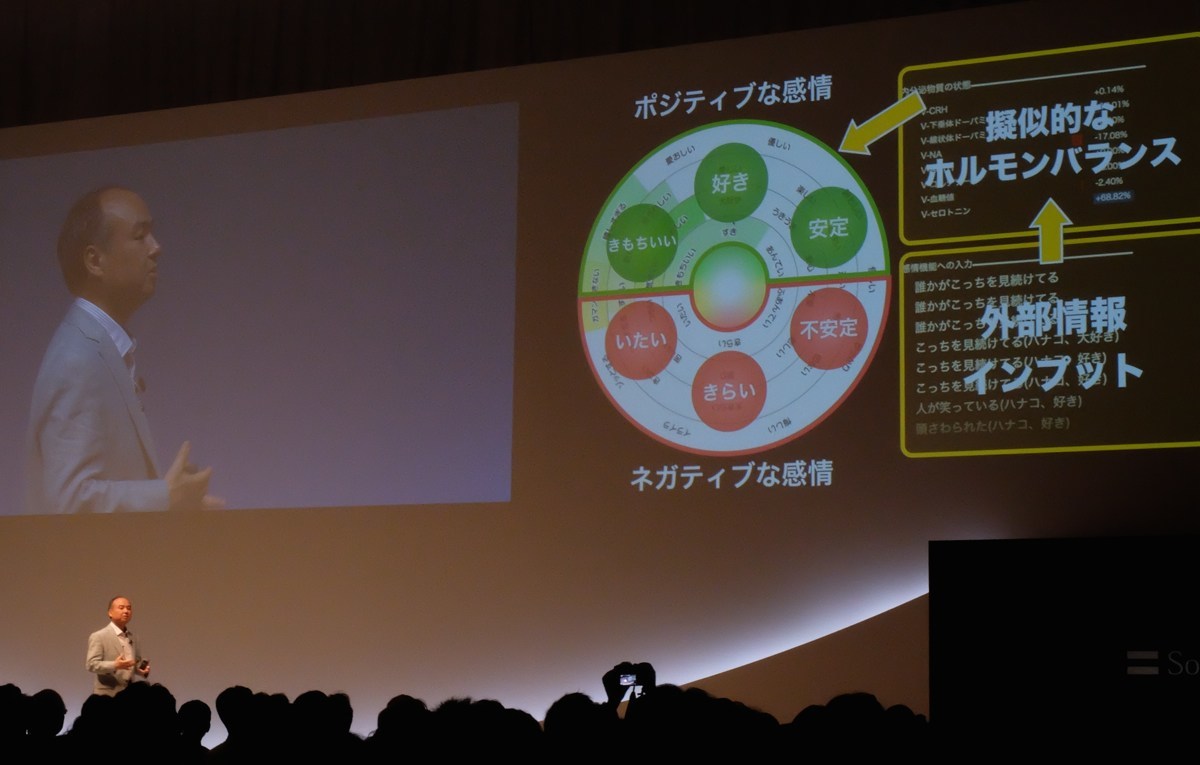
From six basic emotional reactions – like, good feeling, and balance are the positives, while hate, hurt, and imbalance are the negatives (as pictured above) – Pepper’s emotion engine can then branch off into more complex feelings. Giving Pepper a warm hello after returning from work could trigger a “like” response, while sitting down and actually chatting with the robot could then become an “enjoy” response.
By 2040, Son anticipates that the robot population will exceed the human population, at roughly 10 billion.
“In 30 years, some robots will fly, some will [swim], some will be micro-sized, some will be very large, some will be humanoid,” he said. “Everything that moves will be robotized and loaded with artificial intelligence.”
Teaching the machine
In February, IBM announced that it would partner with SoftBank to bring its sophisticated Watson AI platform to Japan. IBM’s goal was for Watson to master the Japanese language – its first based on Chinese-derived characters rather than the Roman alphabet.
As Watson has built up its Japanese ability through SoftBank’s robot, Pepper too has been “upgraded” thanks to Watson integration. Son invited Pepper on stage to demonstrate the telco’s upcoming Pepper for Biz service, featuring Watson’s machine-learning algorithm.
By simply holding a product in front of Pepper, the robot was able to recognize it and describe what it does. When Son waved a bottle of shampoo in front of the robot, it named the brand and explained that it’s used to removing oil from the scalp. Then, Son waved a tube of toothpaste. “I don’t know that one,” Pepper said. “Can you tell me what it is?” Son told Pepper the brand name, and the robot asked to be shown the product again. On the second try, Pepper repeated the brand name – and also explained that it was specially formulated for removing plaque. Not only had Pepper memorized the brand, but Watson helped it search for more information to have a better understanding about it.
Pepper for Biz will go live on the first of October. Companies will then be able to “hire” a Pepper robot for JPY 55,000 (US$440) a month.
Singularity





Stay updated on the go with our mobile app.
Get latest insights with smoother, more personalized experience through TIA mobile app.











📅 Upcoming Events
22 October 2026
Payoneer x CSPN Summit 2026