 Zachary Tan · · 5 min read
How 3 very different innovators are simplifying their customers’ lives

In every crisis lies an opportunity. As Covid-19 continues to keep most countries under lockdown, businesses have had to adapt, thrive, and provide value with their solutions. One way to do this is by offering clients customized strategies to facilitate their digital transformation – an extra step that founders are realizing could reap greater rewards.
Here’s how three startups are helping their customers navigate the path to digitalization.
Manycore: Simplifying homeowners’ lives through an SaaS software
Choosing home furnishings can be an exhausting process: People often spend excessive amounts of time and money working out realistic renders of home layouts with interior designers.
To address this, three alumni from the University of Illinois at Urbana-Champaign – Victor Huang, Chen Hang, and Zhu Hao – founded Manycore in 2011 and, two years after, launched a cloud-based software-as-a-service design platform for the home furnishing and real estate sectors. But in the startup’s early days, it had trouble drawing the interest of its initial target audience: interior designers.
“Most interior designers told us that if they used web-based tools, customers would get the impression that they had spent less time designing [the prototype], which would appear unprofessional,” recalls Huang.

Victor Huang, co-founder at Manycore. / Photo credit: Manycore
Faced with this unenthusiastic response, the team pivoted by introducing its product to homeowners, allowing users to design homes in minutes and render photorealistic images in seconds while saving on interior design costs. By bridging this gap, laymen and new homeowners could begin their interior design journeys with a user-friendly solution.
“Prior to this, users would have taken days or weeks to contact, negotiate, and secure interior designers,” Huang shares. Legacy interior design software can also be difficult to learn and often requires months of practice for a user to create a simple design, he noted.
As more homeowners began using the Manycore platform, interior designers became more willing to adopt it for their own professional use. In 2018, the team launched Coohom, the international arm of its platform, enabling the company to amass the 22 million users it has today.
In fact, even interior suppliers took notice. When Chinese ceramic tile brand Marco Polo started a partnership with Coohom in 2019, it was the first step towards digitalizing the 25-year-old brick-and-mortar business.
Coohom’s platform enabled Marco Polo’s designers to efficiently generate designs featuring latest products. This has a double benefit: It allows customers to better visualize offerings while providing a space for Marco Polo employees to improve their design skills.
Wiz.ai: Creating customized voice AI solutions for enterprises
It isn’t uncommon for people to face problems specific to their business or industry. For Wiz.ai CEO and co-founder Jennifer Zhang, working with clients to come up with a solution that satisfies both the business and its customers is a cornerstone of the company’s product.
Founded in 2019, the Singapore startup employs machine learning, automatic speech recognition, and natural language processing to build its smart voice AI engagement solutions. In practice, this allows companies across various industries – from finance and banking to logistics and ecommerce, among others – to replace their call centers with voice-based chatbots.
Collaboration with customers begins with a series of creative workshops to understand and identify the most optimal use-cases of their business, says Zhang.
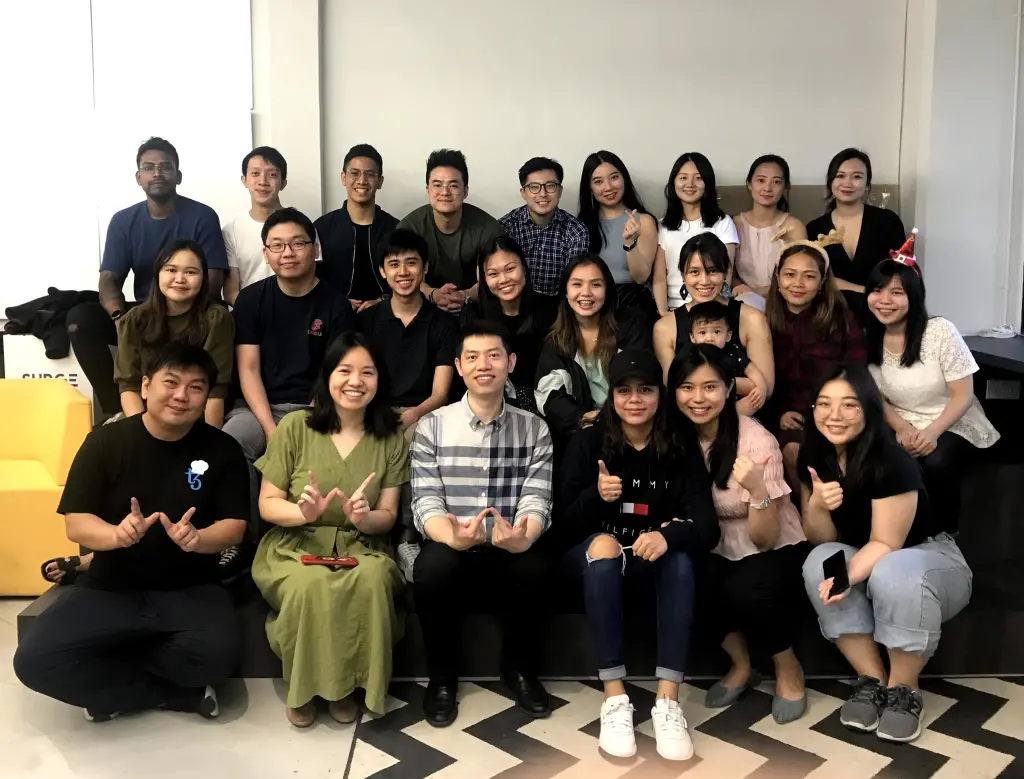
Jennifer Zhang, CEO and co-founder at Wiz.ai (in green), with the team. / Photo credit: Wiz.ai
“From here, we map out the most common customer engagement touchpoints that can be automated using voice AI,” she adds. “We then work closely with our internal stakeholders to define the scope of the talkbot, integrate Wiz.ai into their existing systems, and conduct multiple rounds of testing to ensure the product is deployed smoothly.”
In December 2020, the company worked with Carro to roll out its talkbots, helping the Singapore-based car marketplace automate outbound lead generation as well as customer engagement calls. These talkbots were able to handle almost four times the volume of calls than a human agent and generate a similar customer response rate, allowing Carro to tap into 20,000 potential leads that had previously gone unaddressed.
In fact, the talkbots are so indistinguishable from actual humans, Zhang says that customers regularly thank the talkbots when calls conclude.
Labster: Edtech solutions from Europe to North America
As Covid-19 pushed the world into remote working and studying arrangements, Danish edtech startup Labster found itself in the challenging situation of trying to serve the urgent needs of schools in its largest market, North America, while being based in Europe.
“It was a very intense time,” says Michael Jensen, founder and CEO of Labster. The team responded to school closures by expanding beyond its initial focus on college students to include high school pupils.
“We were very certain that by making large parts of our product free, the benefits of building up awareness and adoption would have a positive effect for us in the long term,” he explains. The strategy worked: Within a few weeks, more than 50,000 teachers had signed up with Labster.

Mads Tvillinggaard Bonde, founder and executive chairman of Labster (above left), and Michael Jensen, founder and CEO. / Photo credit: Labster
With schools having to restart from home as soon as possible, Labster only had two weeks to train and onboard 2 million students and hundreds of teachers.
To overcome this hurdle, Labster introduced a flexible plan that involved daily webinars and training, allowing teachers and administrators to log in and out of sessions according to their schedules. This resulted in a usage increase of some 20x compared to the same period last year, Jensen says.
Looking ahead, Jensen is eyeing developing regions such as Africa’s rural areas, where the infrastructure for internet connectivity remains underdeveloped.
“Our simulations and technologies are designed for very low bandwidth access, requiring only around 50 MB to download [content],” says Jensen, adding that this makes Labster perfect for areas where internet connectivity is patchy. This means that students could use 3G or EDGE connections to access Labster’s simulations.
Considering the often bandwidth-heavy nature of video-based training, Labster’s data-friendly solution could help make education more accessible for the masses.
Manycore, Wiz.ai, and Labster are portfolio companies under GGV Capital. To find out more about the funding and support that the venture capital firm offers to its portfolio companies, visit its official website.
This content was produced by Tech in Asia Studios, which connects brands with Asia’s tech community. Learn more about partnering with Tech in Asia Studios.
Stay updated on the go with our mobile app.
Get latest insights with smoother, more personalized experience through TIA mobile app.
Recommended reads
 The 2026 Prediction Bingo update: half right, fully accountable
 Rlwrld takes aim at US robotics giants with new foundation model
 Zhipu AI’s formula for surviving China’s tech market
 Talking teddy bears highlight the challenges of AI toys
 Why AI is hiring problem, not just a technology one
 An AI that turns Figma designs into production-ready code
 AI bubble grows as bets rise
 When AI meets human nature
 GSR Ventures exec says no to LLMs, opts for market-ready AI products
 Why SaaS is dying and service as software is rising





Editing by Nathaniel Fetalvero, Rebecca Liew, and Eileen C. Ang
(And yes, we’re serious about ethics and transparency. More information here.)



📅 Upcoming Events
22 October 2026
Payoneer x CSPN Summit 2026