 Kun Su · · 4 min read
Comparing the ecommerce markets in Thailand, Vietnam, and Malaysia
The ecommerce market is growing rapidly in Southeast Asia. Its sales are expected to reach US$88 billion by 2025, making up 6 percent of total retail sales. Two critical factors behind this growth are a growing middle class and rapidly expanding internet access.
At iPrice, we wanted to explore this by conducting a study on the ecommerce markets of three big countries in the region: Thailand, Malaysia, and Vietnam. We chose these three countries because the competition between them is tight, not only in ecommerce but in the economy in general.
We conducted this study based on our own proprietary data, insights from Socialbakers, open source data from Consumer Barometer, and a study by Google and Temasek. Here are some interesting findings.
Lazada is the top choice
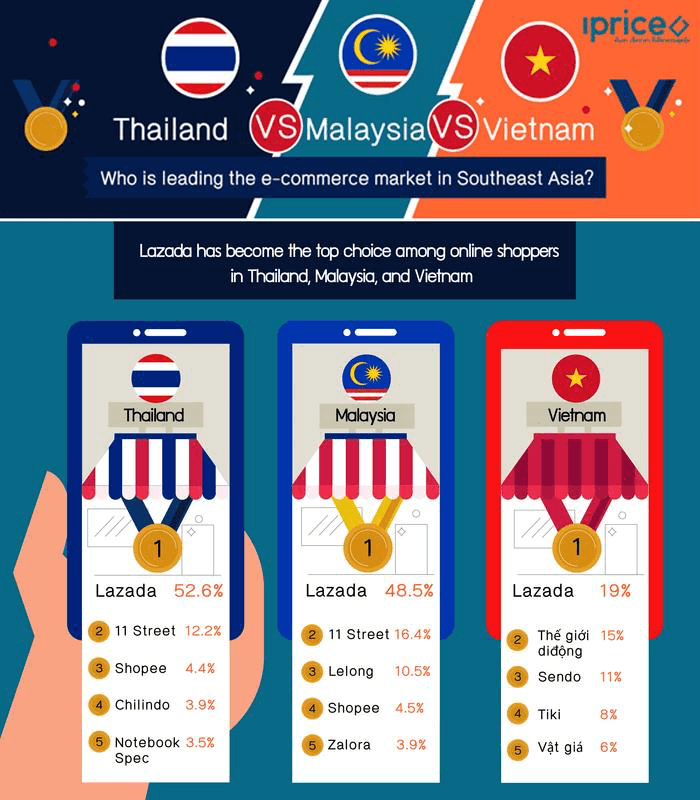
Top ecommerce merchants in each country.
Lazada has been operating in SEA for approximately five years. With Alibaba’s sizeable investment in April 2016, it has become the top choice among online shoppers in the region, especially in Thailand, Malaysia, and Vietnam. This is based on our Map of E-commerce data, revealing the rankings of top ecommerce stores in each country by their share of traffic.
In Thailand, Lazada has a 52.6 percent traffic share. This is followed by 11street with 12.2 percent and Shopee with 4.4 percent.
In Malaysia, Lazada dominates with 48.5 percent, followed by 11street with 16.4 percent and Lelong with 10.5 percent.
But the situation is slightly different in Vietnam. Although Lazada ranked first on the list with a 19.9 percent share of traffic, the space is diversified by many local players such as Thegioididong with 15 percent and Sendo with 11 percent.
For Thailand and Malaysia, where Lazada leads with a big margin, consumers have fewer quality options. It will be interesting to see how other merchants pull together to gain market share in the coming years.
Lazada’s 4 percent lead in Vietnam, however, proves the tight competition between players in the country. Consumers are better off in this scenario as competition brings about higher quality products and services.
Methodology:
- The data was gathered from our Thailand, Vietnam, and Malaysia Map of E-commerce studies.
- The share of traffic was calculated by the company’s traffic divided by the total traffic of all ecommerce platforms on the list.
- This was based on an analysis of 38 ecommerce merchants in Thailand, 62 in Malaysia, and 50 in Vietnam.
Consumer preferences
Search and purchase decisions
According to data from Consumer Barometer, Malaysians tend to seek more information on promotions and deals. Fifty-six percent of Malaysians reportedly sought out promotions, deals, coupons, and store sales; only 50 percent of Vietnamese and 37 percent of Thai do so.
Thai people engage more with ecommerce Facebook pages
Thailand to be the second biggest ecommerce market in SEA by 2025





Stay updated on the go with our mobile app.
Get latest insights with smoother, more personalized experience through TIA mobile app.









📅 Upcoming Events
22 October 2026
Payoneer x CSPN Summit 2026