 Medical tourism, defined as the practice of crossing borders for the purpose of getting healthcare, is huge. Patients Beyond Borders estimate the the global market size is around US$15 billion, based on roughly five million patients spending an average of US$3,000 per procedure.
But finding quality and affordable healthcare is like fumbling in a room blindfolded: There are so many service providers around, at varying levels of quality. Discerning which to pick becomes a repetitive chore.
Two startups, Singapore’s MediSherpa and Chicago and Taiwan-based HuliHealth, are determined to fix this. Both companies are building an extensive database of health care providers and doctors, listing their credentials, crowdsourced feedback, cost, addresses, and contact information.
Their pitch to healthcare providers is simple: By listing on their sites, they can get more visibility and customers.
Beyond the medical database feature however, both startups are taking a vastly different approach towards achieving their goal of making medical tourism more transparent. Here, we profile both startups and find out what makes them unique.
MediSherpa
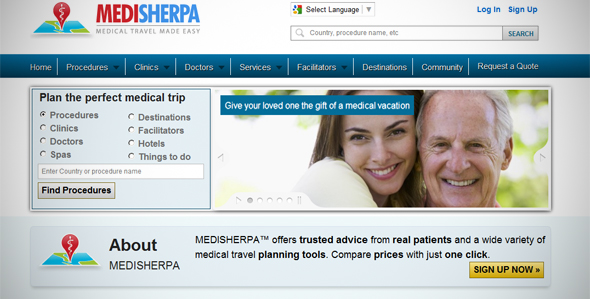
The website has an extensive database of 300,000 medical institutions and professionals from Singapore, Malaysia, Thailand, India, Australia, and more. A lot of the information on there is incomplete, however, but I’m told they’re working hard to plug the gaps by hiring a medical writer, sourcing for user-generated content, and finalizing partnerships with medical travel writers.
They’ve also just unveiled MediQuora, a platform that is meant to complement MediSharpa. As its name implies, it works like Quora, a crowdsourced Q&A site, except that MediQuora focuses specifically on in-depth medical procedure and destination information. The founders argue that Quora is too large and unfocused, resulting in the need for similar sites that target a specific niche.
True to their Asia-centric focus, MediSherpa will eventually launch a Traditional Chinese Medicine service by collaborating with several TCM physicians. Also in the pipeline are partnerships with travel companies on medical travel packages. Finally, they are working with the Singapore Tourism Board to offer a Singapore-centric product.
Launch date: Their beta site went online in 1st February 2012.
Traction: In March, they had 24,000 uniques from 93 countries and over 300 patient testimonials. They have exceeded that figure.
Funding: They have received an initial S$50,000 (US$40,000) iJam grant from MDA, a Singapore government agency. They will pursue tier two funding from iJam and the National Research Foundation.





Stay updated on the go with our mobile app.
Get latest insights with smoother, more personalized experience through TIA mobile app.








📅 Upcoming Events
22 October 2026
Payoneer x CSPN Summit 2026