Bernard Leong · · 3 min read
The Entrepreneur’s Bookshelf: Why Great Leaders don’t take Yes for an answer
Leaders often hear ‘yes’ far too often. Hierarchy and seniority are particularly important for Asian culture. The question is, how do you effectively exert your influence both as leader or as follower? Here is an excellent monograph “Why Great Leaders don’t take Yes for an Answer” by Michael Roberto that depict the rules of leadership, particularly in the area of building consensus and managing conflict among teams.
Michael Roberto’s “Why Great Leaders don’t take Yes for an answer” is a book about leadership. Back in the old days, when I meet my mentor at the beginning of a meeting, she will always ask me to tell her the bad news first before the good. In truth, the author of this book exposes the problem that most leaders don’t hear bad news until it’s too late. Oftentimes, they were being told the opinions which they want to hear. To deal with this delicate problem in leadership, Michael Roberto, a professor from Harvard Business School compile his course “Leadership” into a single book to teach you how to stimulate dissent and debate to improve your decision making. He also demonstrate how to keep the conflict constructive. As we know conflict can be destructive and produce counter-effective results at times. Leaders, as the author believes, need to cultivate debate and build consensus.
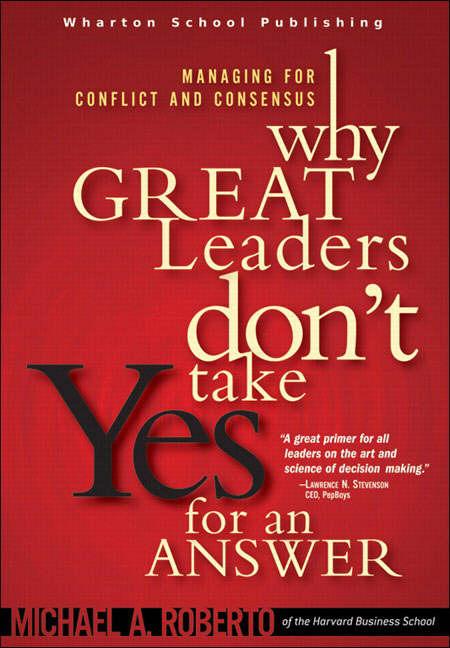
In this book, he provided a few case studies which the leaders failed in not building consensus among his team and led themselves into disaster. Of the more notable examples, he discussed the Columbia space shuttle disaster, President JFK’s failure during the invasion on the Bay of Pigs and the tragedy on Mount Everest. The key points of the book is broken down into five parts:
- How real organizations make real decisions: i.e. the decision is never linear and the executive will bounce back and forth with his surroundings to come to a conclusion he build upon existing data.
- Five myths of executive decision making: They are (a) The Chief Executive decides, (ii) Decisions are made in the room, (iii) Decisions are largely intellectual exercises, (iv) Managers analyze and then decide and finally (v) Managers decide and then act.
- How to foster open debate to build long term consensus: The leader actually achieve “diversity in counsel but unity in command.” It’s like what I like to say to my team, “I am open to suggestions, but I will make the final call.”
- How to move to close the deal: At times, it is the inability to decide that led to paralysis in decision making. This book uses several strategies to deal with such situations.
- Finally execution: How to execute effectively as a leader.
I like the insight that is offered by this book on leadership as compared to many other books which I have read about. It’s a must have reference if you need to find a way to build a team around you.
Technorati Tags: Entrepreneurship, Singapore Entrepreneurs, Leadership, Conflict Resolution, Decision Making , Group Think, Michael Roberto





Stay updated on the go with our mobile app.
Get latest insights with smoother, more personalized experience through TIA mobile app.