- Premium Content It takes our newsroom weeks - if not months - to investigate and produce stories for our premium content. You can’t find them anywhere else.
 Joe Gan · · 11 min read
Why a Chinese Tesla rival failed to start its multibillion-dollar engine
When Tesla first entered China in 2018, it threw itself into a snake pit with over 400 competitors – each of them armed with fresh subsidies and funding from Beijing, with dreams of having their own high-power electric car roll off the conveyor belt one day.
But as the electric vehicle (EV) sector was dealt blow after blow – first the US-China trade war in 2018, then Covid-19 in end-2019 – the competition has been whittled down to a handful of players. The Chinese government has also signaled that it would eventually stop financial support for the space – a move that would bring low-end manufacturers to a halt.
That said, the race is heating up – Chinese EV makers like Nio and Li Auto struck while the iron was hot, raising billions of dollars by going public on the New York Stock Exchange and Nasdaq, respectively. Fellow EV firm Xpeng Motors followed suit, selling nearly 100 million shares at US$15 each on August 28, raising some US$1.5 billion.
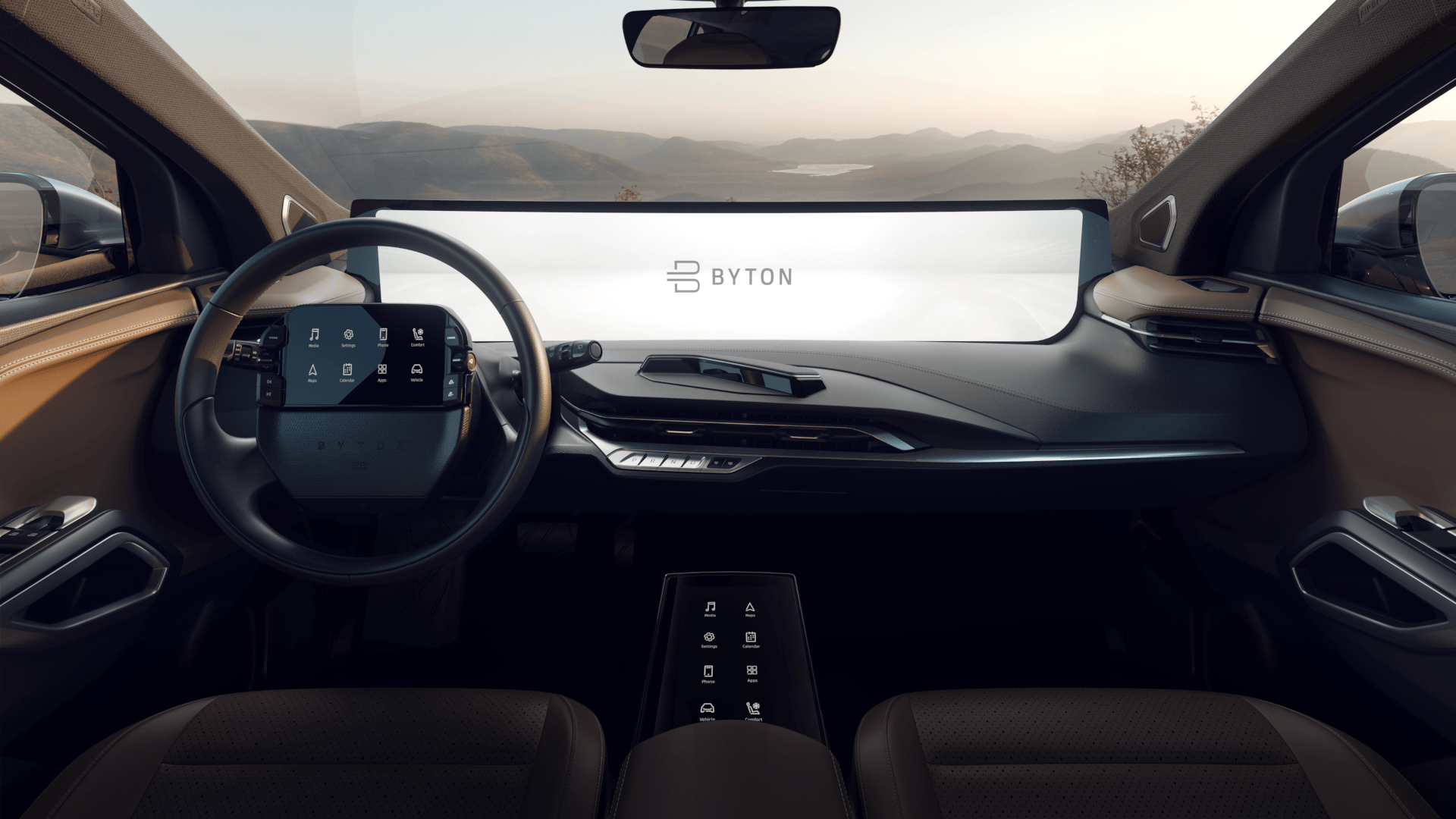
The interior of Byton’s M-Byte car / Photo credit: Byton
Nanjing-based Byton looked to be hot on the trail of its peers. It had bagged over US$500 million in series B funding and opened R&D centers across Europe, North America, and China. The prototype for its debut car M-Byte received a warm reception too – its claim to fame being the 48-inch video screen that spans the whole dashboard.
In August last year, Byton announced that its US$500 million series C was “almost in place” from investors including China’s oldest state-owned automaker, First Auto Works (FAW) and state-owned capital funds. This would’ve valued the firm at US$4 billion.
But then it all went cold
Byton suspended its China operations for six months to conduct a “corporate reorganization,” it said in a July 1 interview with the Global Times. It was unable to pay employee salaries due to the fallout from the Covid-19 pandemic, which it claimed led to “unfinished fundraising moves.”
In late August, Byton applied to register a new tech company, Shengteng, as part of ongoing efforts to get its cogs turning again. It expects to get a business license for the new outfit and plans to raise 2 billion yuan (US$289 million) for Shengteng to accelerate the mass production of the M-Byte.
On the staff front, Byton made headlines in April after it furloughed thousands of employees, keeping just a skeleton crew of about 100 people on reserve. It has since recalled about 30 workers and plans to enlarge its on-duty staff to 200. The carmaker is not giving up its vision – the Byton website still accepts reservations for cars.

The company’s cost-cutting measures came as a shock. Months passed without its series C funding round materializing, echoing long-standing suspicions that the firm, once seen as a serious contender for leadership in the Chinese EV market, had fallen behind major rivals.
Byton wasn’t alone. It’s the third sizable EV upstart to give up since Tesla’s Elon Musk started his made-in-China offensive – Bordrin Motors and Jiangsu Saleen Automotive Technology wound their operations down earlier in 2020.
Byton has remained tight-lipped about why its series C round tanked, but former employees that spoke to Tech in Asia gave several reasons that could have caused the firm’s vehicular dreams to run close to empty.
Specs found wanting
Why not focus on China?
Stay ahead in Asia’s tech landscape
This is premium content. Subscribe to read the full story.
Covid-19 put a huge dent in China’s electric vehicle sector, but Byton is left behind in the dust. But does its answer to survivability lie closer to home?
We know this is not ideal. ⌛ Sign up in 20 seconds. Cancel anytime.
Our subscriber community includes professionals from these companies:





Stay updated on the go with our mobile app.
Get latest insights with smoother, more personalized experience through TIA mobile app.








📅 Upcoming Events
22 October 2026
Payoneer x CSPN Summit 2026