Terence Lee · · 7 min read
Can meditation impact entrepreneurship and the world? Google’s happiness guru thinks so
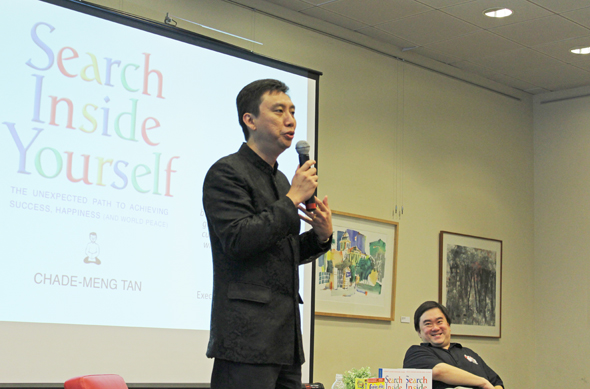
Meng (front) gives a talk at the National Library. Next to him is cartoonist Colin Goh.
Chade-Meng Tan, Google employee #107, smiled the moment he spotted the SGE team at the lobby of Orchard Parksuites, a stately service residence located in the heart of Orchard Road in Singapore.
Although here on holiday to visit family and friends, the jovial “zen master of Google” had been giving talks about his latest book, “Search Inside Yourself”, which he hopes will bring about the conditions for world peace.
Wearing a slightly faded Google Earth T-shirt, the Nanyang Technological University (NTU) alumnus seemed at ease while talking in an odd mix of Singlish and American twang. He explained the intricate workings of the brain, shared stories about Buddha to illustrate insights, and cracked jokes whenever he could.
Meng is an atypical Singaporean. When Google went public, he became multi-millionaire rich. His official job title, Jolly Good Fellow, started as a joke. But he stayed on at the company, transitioning from an engineer into the Head of Personal Growth at GoogleEDU, the search giant’s workforce development program.
He also began classes in Google that taught emotional intelligence to employees, infusing meditation exercises with neuroscience research and Buddhist philosophy. The classes have been turned into a book.
In brief, the book claims that meditation can lead to emotional self-awareness, which allows people to manage their emotional states. Greater self-mastery leads to self-confidence and inner happiness, which then enables empathy and compassion. And that brings the world on a path to world peace.
Yes, meditation can benefit entrepreneurs and investors
Painfully aware that simply talking about world peace makes him sound silly, the book suggests that people with great empathy and confidence make better leaders at work, citing research as the basis. It’s a tactic that Meng hopes will make meditation mainstream.
“A couple of interesting data points,” he said during the interview, “those people in Google who after taking my class moved to another team, they became a lot happier.”
For entrepreneurs, knowing what feeds their own motivation and excitement is an important trait. By discovering what is important to them, they will be able to take the necessary risks to achieve their goals.
Meng also believes that his course develops resilience. Reflecting his love for wise sayings, he quoted from real estate mogul Feng Lun (whom he had tea with recently), who once said: “Entrepreneurs like to challenge the impossible.”
In the entrepreneur’s pursuit of the unattainable, being mindful — or self-aware — allows them to be calm in all situations. Once they are able to perceive their emotions with “high-resolution” clarity and vividness, they would be able to manage an undesirable emotion just when it arises
So, by learning to deal with the emotions that come with failure, an entrepreneur will retain a sense of optimism. This creates resiliency.





Stay updated on the go with our mobile app.
Get latest insights with smoother, more personalized experience through TIA mobile app.