- Premium Content It takes our newsroom weeks - if not months - to investigate and produce stories for our premium content. You can’t find them anywhere else.
 Glenn Kaonang · · 6 min read
Price beats intelligence for OpenAI’s newest model
When OpenAI unveiled GPT-5 last week, the company touted sharper reasoning, better coding, and smoother performance. In practice, the new model felt less like a leap in brainpower and more like a tune-up.
For end-users, OpenAI wants one model that routes every request to the right variant. But it admits that the system doesn’t always work as intended, and the company has just brought back access to older models.
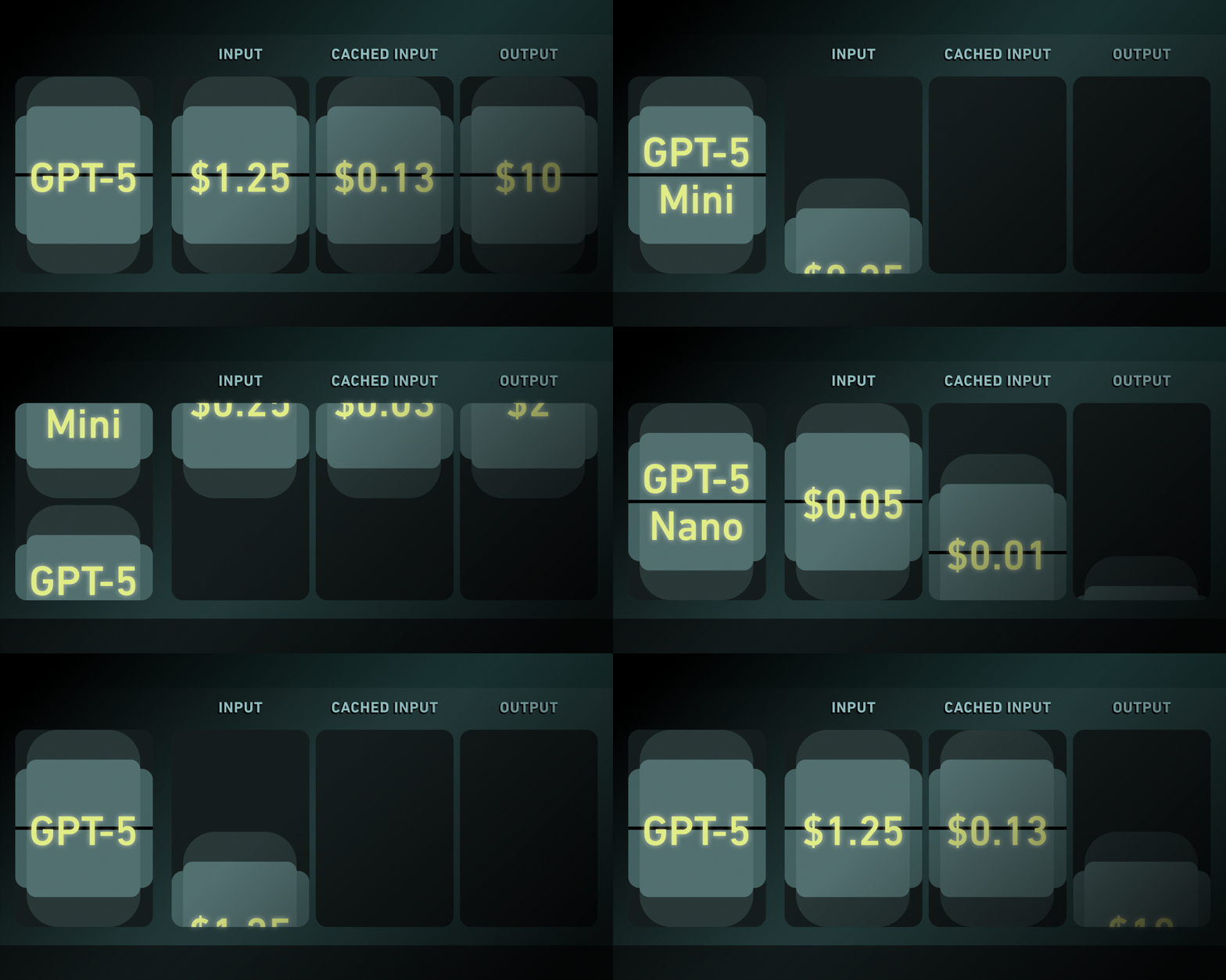
Image credit: Timmy Loen
For businesses, GPT-5 comes in three variants – main, mini, and nano – giving them more control over balancing cost and capability. AI founders interviewed for this story see lower API costs as a positive step even if they don’t see it as a performance breakthrough.
In Southeast Asia, GPT-5’s impact on AI startups may ultimately hinge on pricing and how well they keep token costs from eroding margins.
“Pricing killer”
On X, some developers are calling GPT-5 a “pricing killer” rather than a performance breakthrough. Benchmarks show it’s only “marginally better” than OpenAI’s own o3 or Anthropic’s Claude Opus 4.1, but the cost per token is far lower.
At US$1.25 per one million input tokens, GPT-5 is half the price of GPT-4o. Only Google’s most advanced model, Gemini 2.5 Pro, comes close on both capability and price.
For startups that depend on OpenAI’s API, cheaper tokens can mean better unit economics – more revenue per dollar spent on model calls.
Robert Zheng, co-founder of Singapore-based Orion Arm, says that with GPT-5, OpenAI makes it more feasible for startups with tighter budgets to build on the model’s capabilities. Orion Arm runs Toki, an AI-powered calendar assistant that enables users to schedule events by texting them through chat apps like WhatsApp or Telegram.
See also: Ele.me co-founder snags $11m for AI calendar app
Zheng points to another sweetener: cached tokens. At US$0.125 per million tokens, GPT-5 is a “game-changer” for startups using retrieval-augmented generation, a technique that boosts model answers by adding extra information to the pre-trained model.
Cached tokens cost less because the API detects and skips reprocessing repeated input, like common prompt prefixes or background context. This lets developers save time and money when the model doesn’t have to “think” through the same parts again.
Play it smart
The untested frontier
Stay ahead in Asia’s tech landscape
This is premium content. Subscribe to read the full story.
GPT-5’s launch may have underwhelmed many, yet Southeast Asia’s AI founders remain cautiously optimistic. Here’s how cheaper tokens could change the region’s AI game.
We know this is not ideal. ⌛ Sign up in 20 seconds. Cancel anytime.
Our subscriber community includes professionals from these companies:





Stay updated on the go with our mobile app.
Get latest insights with smoother, more personalized experience through TIA mobile app.








📅 Upcoming Events
22 October 2026
Payoneer x CSPN Summit 2026