 Michael Tegos · · 5 min read
TIA x Gree Ventures Meetup: apps are dying, startups & corporations can be friends
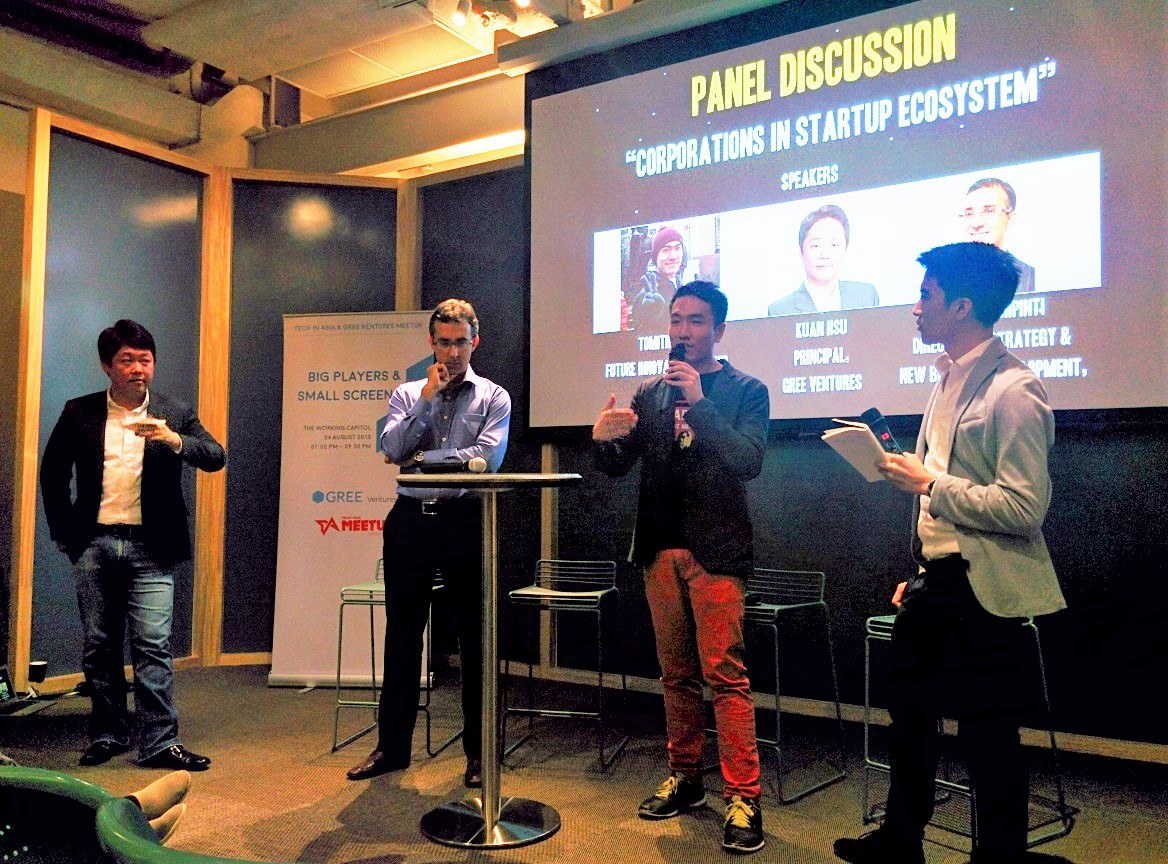
(From L to R:) Gree Ventures principal Kuan Hsu, Philips APAC director of strategy and business development Bruno Occhipinti, Starhub future innovations seeker Tomithy Too, Tech in Asia editor & head of insights Anh-Minh Do
Startups are often billed as great disruptors – new models that put fear into big corporations and shake the establishment down to the foundations. There’s no question some startups have brought about tectonic changes in their industries, but a more pragmatic view would be that corporations and startups actually complement each other.
This sometimes uneasy symbiosis was the topic of the first panel at Tech in Asia’s latest Singapore meetup organized with Japanese venture capital firm Gree Ventures at coworking space The Working Capitol. Hosted by our own Anh-Minh Do, the discussion featured Gree Ventures principal Kuan Hsu, Starhub’s future innovations seeker (his actual title) Tomithy Too, and director of strategy and business development for Asia Pacific at Philips, Bruno Occhipinti.
It shouldn’t be too surprising that different corporations approach startups differently. A telco like Singapore’s Starhub, for example, looks to startups in order to keep an eye on new tech trends it might benefit from, and new potential revenue channels, Too explained. The telco works with accelerators in the region to provide guidance and resources to budding startups who might one day help the telco in return.
Occhipinti didn’t mince words talking about the power imbalance inherent in this equation. When startups engage with a corporation, it’s obvious that for startups, that relationship might be their best and only shot, while the corporation can simply pick and choose from a portfolio of hundreds. On the other hand, corporations can’t match a startup’s nimble nature and flexibility.
For this reason, it’s important for these young businesses to find bridges to connect them with corporations, Occhipinti said. Usually it will be a person in the corporation who can be the communicator between the two. Too agreed and elaborated on the concept of the “internal champion,” as he put it, saying that this person inside the corporation can help startups navigate its tangled web of systems and unlock its resources. But startups should set ground rules about how they will work with the corporation and what each party’s responsibilities are, Occhipinti said. Given the staff turnover at large organizations, it’s possible the person who connected and championed the startup today might not be there tomorrow.
Philips has been making its own moves to foster relationships with startups, such as launching medtech incubator Sanara Ventures in Israel through its Philips Healthcare arm, together with Teva Pharmaceutical Industries earlier this year. The company is also looking into Asia Pacific for startups in what it has dubbed the “healthtech” space.
Speaking for Gree Ventures, which as a venture capital firm is much closer to the startups’ day-to-day, Hsu mentioned that part of his firm’s job is to prepare them for that connection. A startup, by definition, doesn’t usually have the strict hierarchy and procedures of a larger entity. So Gree tries to instill some “discipline” in them, to prepare them for dealing with a corporation’s more rigid structure. This is especially important as most startup exits in Japan are usually through mergers and acquisitions (M&A), not IPOs, Hsu mentioned. So Gree needs to get its portfolio startups ready for the corporate world.
Mobile is coming
Mobile is rapidly rising worldwide when it comes to distribution and usage of apps and online services. The trends this creates and the impact on tech startups in Southeast Asia were the topic of the second panel, featuring Junde Yu, VP for Asia Pacific of mobile analytics startup App Annie, vice president of Samsung’s Media Solution Center (Southeast Asia & Oceania) Nicholas Wodtke, and work messaging app Pie CPO and co-founder, Pieter Walraven.
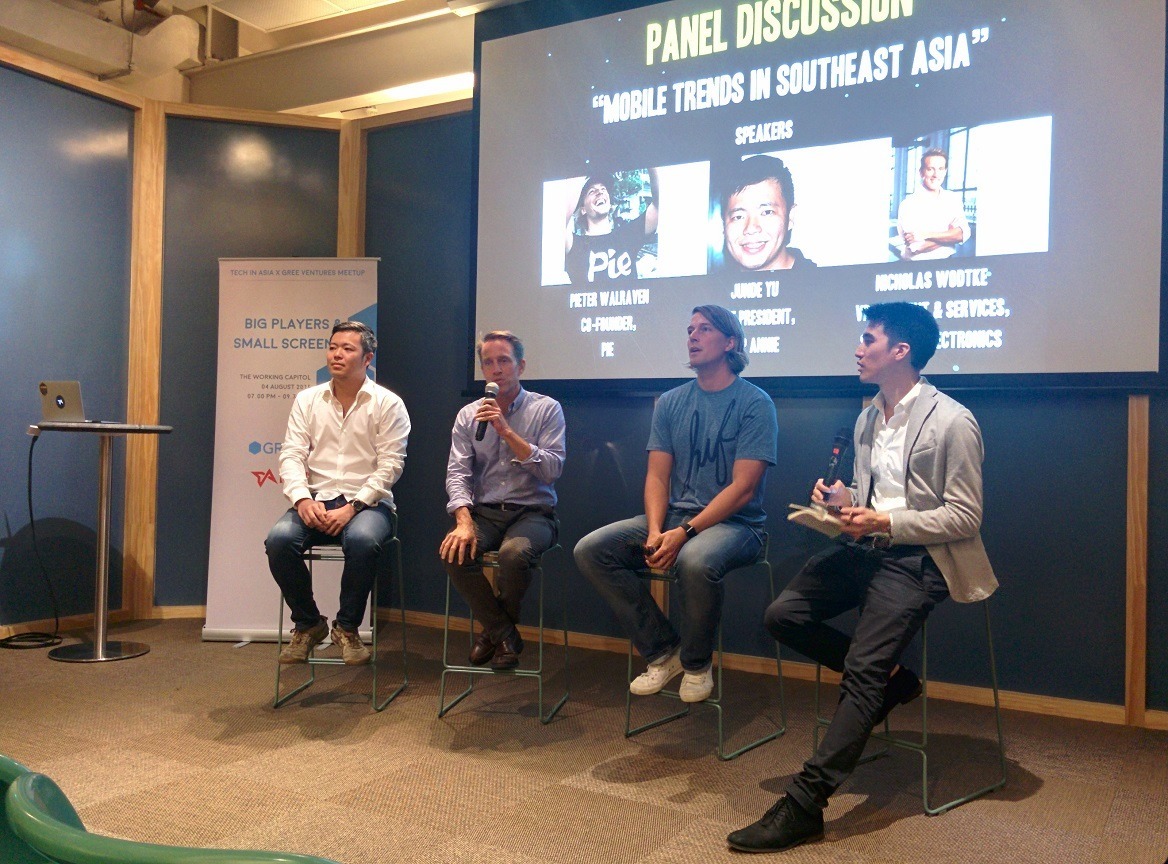
(From L to R:) App Annie Asia Pacific VP Junde Yu, Samsung Media Solution Center VP Nicholas Wodtke, Pie CPO & co-founder Pieter Walraven, Tech in Asia editor & head of insights Anh-Minh Do
Southeast Asia is interesting in the sense that smartphones have enabled a lot of countries here to get online perhaps for the first time, Yu pointed out. This creates a huge online audience that would simply not be there without mobile devices. What’s more, it creates new challenges. For example, people in emerging markets in the region accessing services through their mobiles now need reliable billing solutions as credit card penetration is low.
Wodtke identified the difficulty of monetizing the mobile audience in Southeast Asia. It’s a global struggle to get users to pay for content, and the consumers are effectively in control in this regard. Walraven mused that a large part of this demographic is called upon to pay for software for the first time. The model of smaller, recurring payments instead of a larger, one-time payment seems to be going over better, he said.
Wodtke pointed out that startups need to have clear plans of monetizing and becoming competitive in their space, where for every idea there are always loads of available choices to the end user. He offered the perhaps controversial – but probably true – view that, were venture capital to suddenly dry up, there would be a severe shake up. Several startups that don’t have their act together financially would have to drop out of the game. That’s why everyone needs to sharpen their offering, he said.
Trends identified by the panel in the region were Android tools such as file and memory managers, launchers, and utilities (as more users get comfortable with their devices and start tweaking them to suit their needs); the lowering of device costs as monetization moves to the cloud, which means people are selling phones at cost; and AI and analytics that provide more insight into what users want and how they use apps and services.
Wodtke made another strong statement in predicting the “death of the app” in the next five to 10 years. An app is not a business plan, he said, but a delivery mechanism. So startups must understand they are delivering a service, a platform, which can then should be distributed in any number of ways, an app being only one of them.
Stay updated on the go with our mobile app.
Get latest insights with smoother, more personalized experience through TIA mobile app.
Recommended reads
 Indonesian AI startup goes global
 Forrest Li on scaling Sea, building smarter bots, and founder grit
 An AI assistant that joins sales calls and scores team skills
 Beyond the check: Why VCs need more than capital
 SGX’s CEO says it doesn’t need a unicorn to win
 SMEs want AI too, but not the kind Big Tech is selling
 Oatside’s alt-milk rise hits a profitable gear
 Alibaba’s financial health in 12 charts
 Asia’s telcos bundle AI into mobile plans. Will it pay off?
 M-Daq chases bigger clients as revenue falls, losses grow





Editing by Terence Lee
(And yes, we’re serious about ethics and transparency. More information here.)



