 Kyle Johnson · · 6 min read
Laservall’s laser-focused R&D: enabling smartphones, EVs, and more

Take a look at your phone.
If it’s a high-end smartphone, chances are you’re already holding a piece of Laservall’s handiwork.
The Hong Kong-based company specializes in high-precision laser solutions and smart automation systems – the microscopic welding and cutting that goes into building the electronics we use every day.
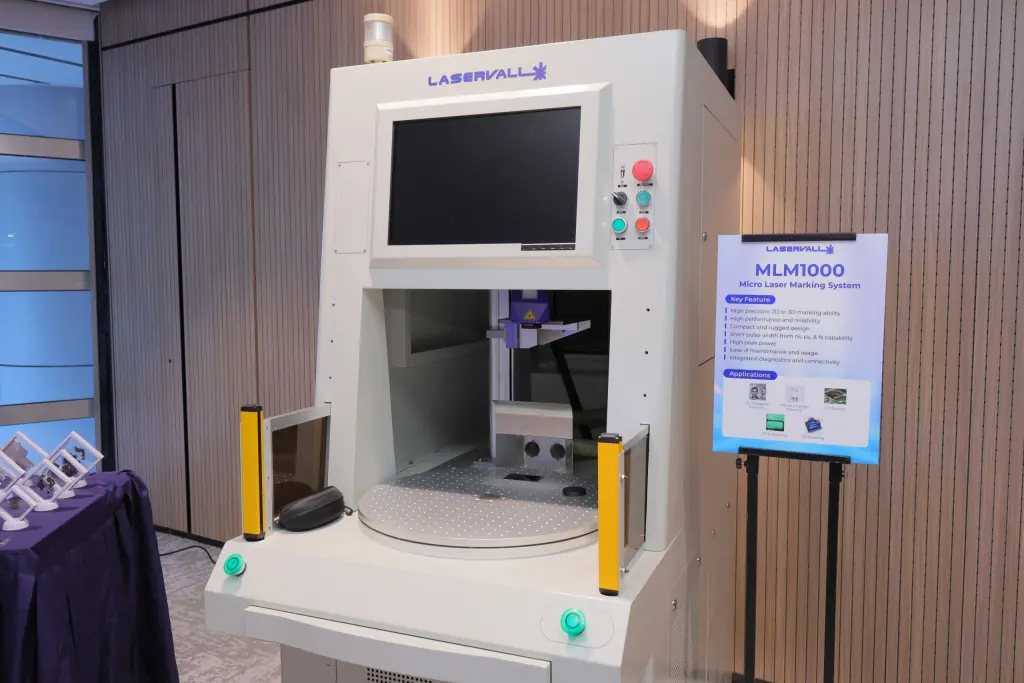
One of Laservall’s laser machines for manufacturing. / Photo credit: HKSTP
Beyond smartphones, Laservall’s solutions are crucial components in the production lines of electric vehicle manufacturers like Tesla and BYD as well as tech assemblers such as Foxconn and Luxshare.
“Our solutions cater to a diverse range of sectors,” says Laservall CEO Andrew Kim. “Our precision laser technologies are also integral in the production processes of companies in the solar energy sector, enhancing both efficiency and sustainability in new industrial applications.”
It’s all about the R&D
In a field as technologically embedded as Laservall’s, this commitment to staying ahead of the curve through research and development (R&D) is what allows the company to offer solutions that exceed industry standards.
“R&D allows us to innovate and develop cutting-edge solutions that meet the ever-evolving demands of the industries we serve,” Kim emphasizes.
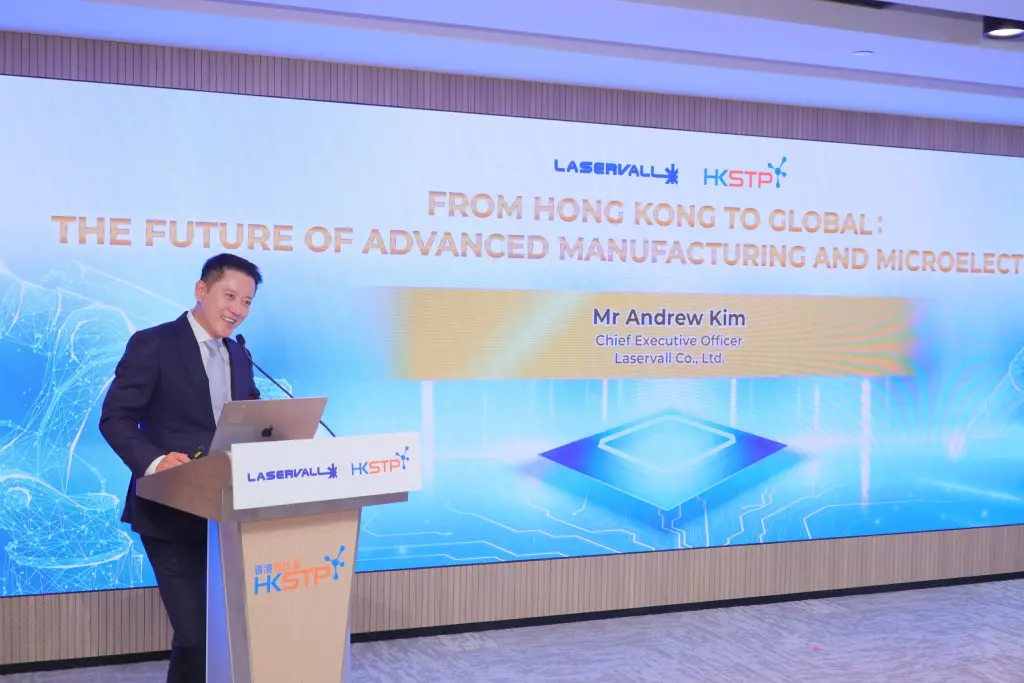
Andrew Kim, CEO of Laservall. / Photo credit: HKSTP
He adds that Laservall’s R&D and smart automation processes “involve integrating advanced AI-driven technologies to enhance manufacturing precision and efficiency.”
This includes developing laser systems for micron-level accuracy – that’s precision on the scale of a single bacterium. Imagine laser-cutting materials with such precision that you could etch the details of a microscopic organism.
These systems, along with modular automation setups, streamline complex manufacturing tasks. This leads to improved product quality, reduced production time, and lower costs.
For example, Laservall uses modular automation so that various machines – such as loading, laser cutting, soldering, and more – can be tailor-made and organized in different combinations, forming production assembly lines for specific customers’ needs. This is more cost-effective than having to develop new production lines for each first-time customer.
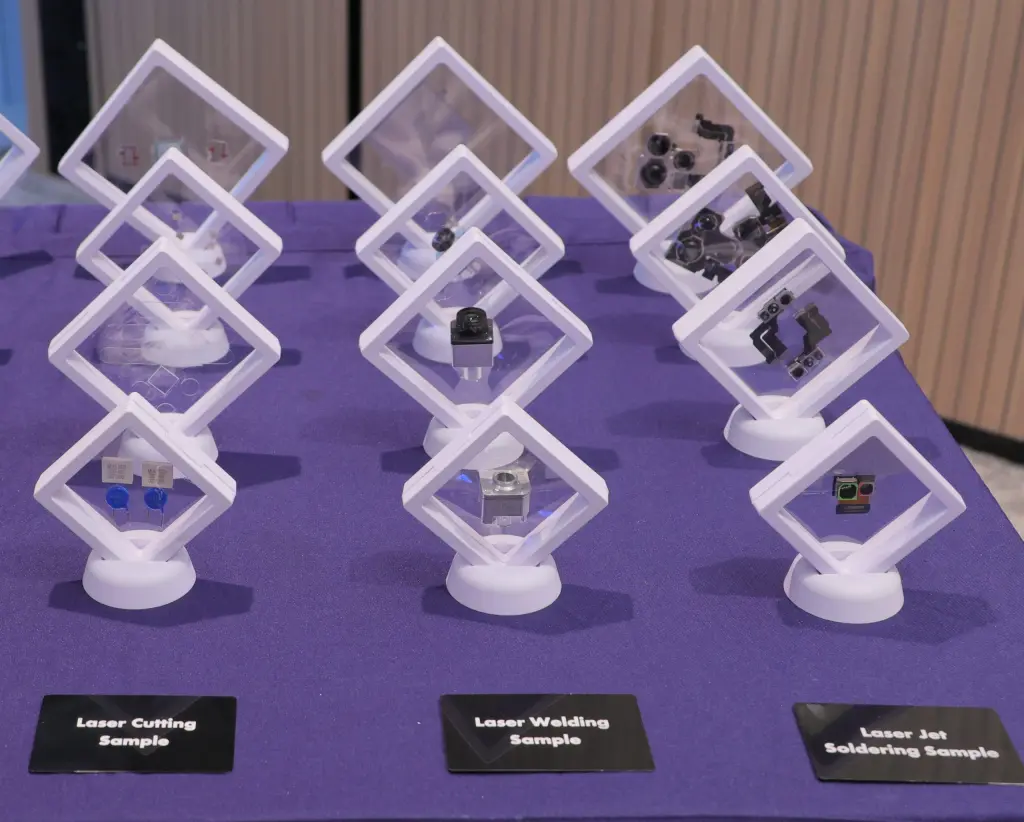
Just a few of the different components Laservall’s machines can produce. / Photo credit: HKSTP
The company also uses AI and machine learning to enhance its smart manufacturing systems. These technologies enable real-time troubleshooting, process optimization, and predictive maintenance, which relies on data analysis to predict when a machine needs servicing rather than following a fixed schedule.
“These technologies boost the productivity and sustainability of manufacturing operations,” Kim points out.
Laservall’s R&D efforts have led to the development of several solutions, including a laser-cleaning product that the company showcased at a recent event co-organized with Hong Kong Science and Technology Parks (HKSTP).
The tech uses precise lasers to clean materials, allowing them to be recycled more easily. This improves on traditional methods that use abrasive chemicals and cause pollution.
Partnership-driven innovation
Speaking of HKSTP, Laservall established its new R&D center there in March last year. The company was drawn by the park’s infrastructure, which can support the firm’s efforts across the entire life cycle of microelectronics development, and its strategic location, which offers access to key Asian markets like China, South Korea, Vietnam, Singapore, and India.
“HKSTP’s innovative environment, its network of tech talent, and the potential for collaborations with other tech firms based in the park have been very valuable,” says Kim.
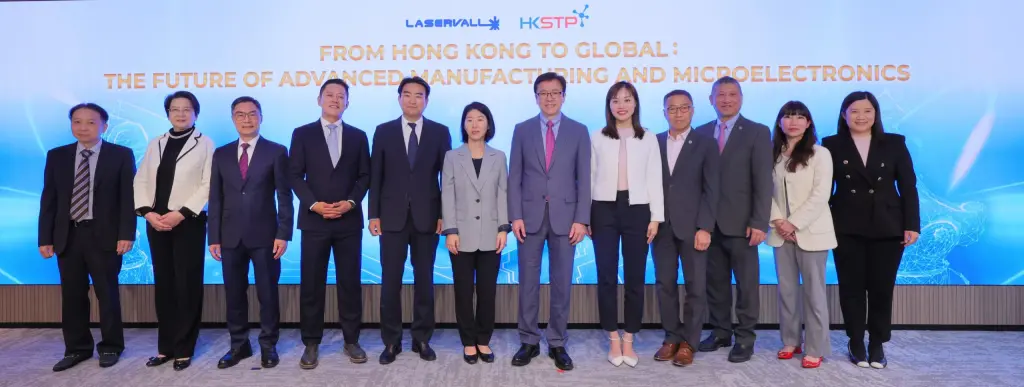
Kim (4th from left) along with other key stakeholders at the event co-organized by HKSTP. / Photo credit: HKSTP
Support from the HKSAR government was an encouraging factor for Laservall to consider establishing its R&D center in the park as well. The CEO points out that initiatives like the New Industrialisation Acceleration Scheme (NIAS) and the Pilot Manufacturing and Production Line Upgrade Support Scheme provide financial and logistical resources that enhance the firm’s development potential.
According to Kim, the NIAS represents a significant incentive for Laservall moving forward, as it can allow the company to access funds that may help offset costs for new investments, such as expanding its R&D center to accommodate future growth.
With these factors in place, Laservall recently announced a HK$300 million (US$38 million) investment plan over the next five years, focused on R&D, manufacturing technology enhancement, and tech talent development in Hong Kong.
“All these efforts and support are helping us position Laservall as pioneers of innovation for the next global success,” Kim says. Case in point: Over the last year, it developed a laser soldering machine that combines multiple functions, making it 1.5x to 3x more efficient than previous models.

The machine can be used to make components like smartphone camera modules and hard disk drives. / Photo credit: HKSTP
Kim adds that the partnership has advanced Laservall’s manufacturing processes and increased the efficiency and scalability of its production capabilities. It has also helped the company expand its global R&D team.
“Our investment in R&D and global expansion strategies have increased our market reach and allowed us to secure key contracts with major global brands like Samsung and BYD,” he shares.
“Our ambition is clear: to position Hong Kong as an international I&T hub. We should be the global powerhouse in advanced manufacturing and microelectronics,” says Albert Wong, CEO of HKSTP. He adds that the organization’s support for these sectors is critical because they’re the “backbone of every cutting-edge industry, from autonomous vehicles to smart devices.”
Eyes on the future
Looking ahead, Laservall has ambitious plans.
“We want to continue expanding our technological capabilities and explore new market applications, particularly in the automotive and clean energy sectors,” says Kim.
The company aims to develop more integrated and sustainable manufacturing solutions aligned with global trends toward greener technologies.
It’s also looking to double its R&D workforce by 2026 and increase it sixfold by 2028. This would further cement Hong Kong as the company’s global R&D headquarters, with potential plans for an advanced production base in the city.
All these efforts and support are helping us position Laservall as pioneers of innovation for the next global success
Kim adds that Laservall is “seeking collaborations with other high-tech firms and academic institutions to co-develop new technologies and solutions that can address the complex challenges of the modern manufacturing industry.”
Leveraging Hong Kong’s advantage as a “super-connector” between mainland China and the global market, Kim hopes to continue Laservall’s growth trajectory and solidify its position as a global leader in advanced manufacturing.
“The partnerships we’ve forged will be crucial in driving further innovation and maintaining Laservall’s competitive edge in this fast-paced market,” he says.
As one of the largest innovation and technology ecosystems in Hong Kong, HKSTP is home to over 2,200 technology companies and aims to develop Hong Kong into an international hub for innovation. The organization is committed to building a world-leading microelectronics ecosystem.
Visit HKSTP’s website to learn more.
This content was produced by Tech in Asia Studios, which connects brands with Asia’s tech community. Learn more about partnering with Tech in Asia Studios.
Stay updated on the go with our mobile app.
Get latest insights with smoother, more personalized experience through TIA mobile app.
Recommended reads
 Tracking AI hiring in Singapore: OpenAI, Anthropic, and more
 Last to board: why travel may be AI’s final frontier
 Why ‘cheaper’ no longer wins dev deals for Vietnam
 Alibaba’s capex isn’t the full story
 Forget startups. Buy the business running on Excel
 Life’s a game, and AI agents are Animoca’s new play
 Indonesian AI startup goes global
 Forrest Li on scaling Sea, building smarter bots, and founder grit
 An AI assistant that joins sales calls and scores team skills
 Beyond the check: Why VCs need more than capital




Editing by Jonathan Chew, Winston Zhang, and Lorenzo Kyle Subido
(And yes, we’re serious about ethics and transparency. More information here.)





📅 Upcoming Events
22 October 2026
Payoneer x CSPN Summit 2026