There are several startup truisms. One such recent truism is that one should always start with a ‘minimum viable product’ before committing to building a real product that the customers would pay for. If you are building a B2B product, I would point you to at least two cases where this truism does more harm than good, for an early stage product.
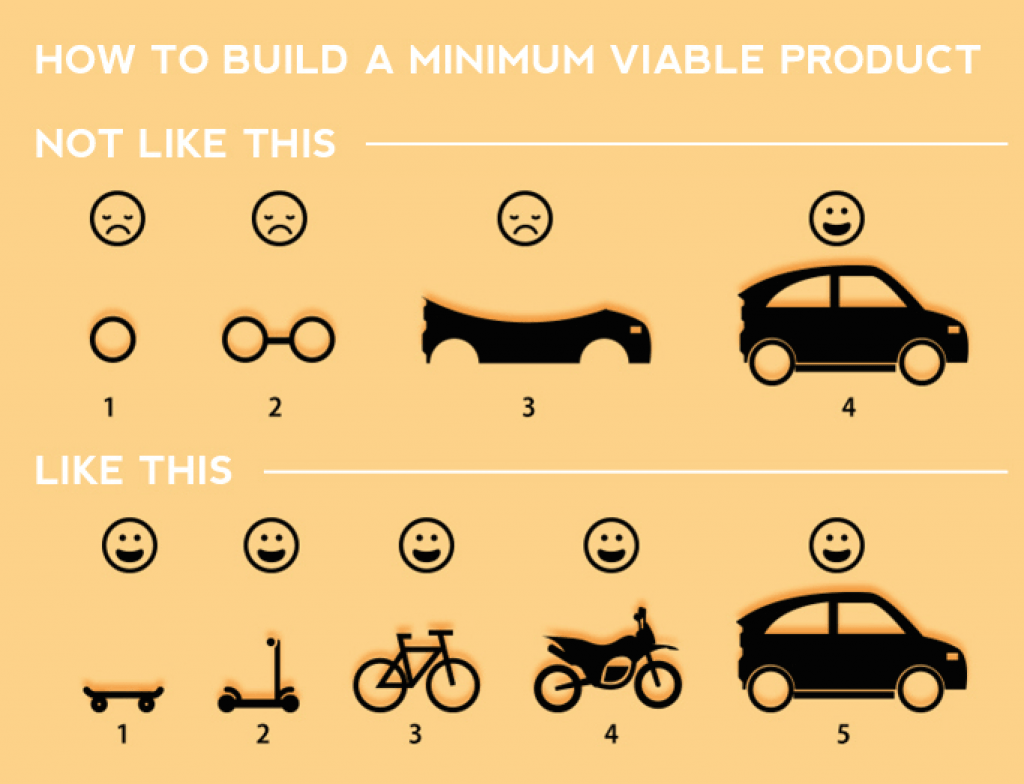
Let’s first get on the same page of what an MVP is supposed to do. I am stealing a slide from Hiten Shah, which he recently showed in the SaaSx Hacker Conference.
The wrong way to start the ‘product conversation’ with a customer is to be apathetic to their real needs and disregard their time. If you are building a product to transport a user from Point A to Point B, you’d be excused for handing over a skateboard, but you’d never be given an appointment even post your IPO, if you had just handed over a wheel to her and asked her to figure how to sit on it and go where she needs to go.
As an aside, this is a true story, shared in the same conference by the founder of a SaaS startup whose first prospect, refused to meet him a year after the first ‘embarrassing version demo’ that would’ve made Reid Hoffman proud.
So, what is the right way to think about an MVP in the B2B space?
Paraphrasing a founder I met at the conference, who lived through the above experience, try building a ‘Billable Viable Product’. When you are experimenting on a product, the subject is not a lab rat (even they have their rights!) but a real customer with a need and a lot of options.
The ‘embarrassing first version’ truism that we subscribe to, has a darker side to it — it’s embarrassing because we have been apathetic and insensitive to the customers’ needs and time. I’m sure Reid Hoffman was invoking attention through his articulation but we’ve carried it too far that we’re inflicting damage upon our startups by going for ‘literal’ embarrassment.
When you build a ‘Billable Viable Product’ instead, you are asking the customer to pay for solving a problem. If your B2B prototype is so bad that you cannot ask a customer to pay, how would you expect them to believe that they could do their business better, with your eventual product?
The notion of a ‘Billable Viable Product’ for B2B, sets the floor for what could be minimum and what is ‘really’ viable. Your BVP is what your customer will pay for.
Is there anything better than ‘Billable Viable Product’? Yes, it called NoMVP.
There are products that need evangelization and then there are products that everyone understands. CRM, HRMS etc. belong to the latter category. If you are building a better CRM, the operative word is ‘better’ and not ‘CRM’. You don’t need an MVP to prove the value of a CRM. ‘Better’ and ‘Minimal’ don’t quite go well with each other.





Stay updated on the go with our mobile app.
Get latest insights with smoother, more personalized experience through TIA mobile app.











📅 Upcoming Events
22 October 2026
Payoneer x CSPN Summit 2026