Not a day goes by without the announcement of some new and amazing technological advancement—flexible robots, bionic humans, crime detecting streetlights, to name a few. But we’re still stuck in the paradigms of a culture created by and based on the old rules of industrialization that led to the occupational restructuring in the 1950s-60s.
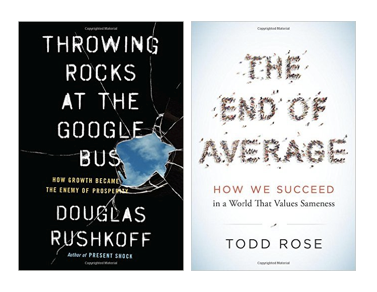
Four books I’ve read in the last few weeks—including Throwing Rocks At The Google Bus and The End of Average—have made me question a few things about the current nature of “work.” Thankfully, our technology is enabling us to rewrite these rules.
There is no ‘average’
I’ve never been a good standardized test taker. I can comfortably say this because my perceptions of my own abilities have never been based on my test scores. But the US and most of the world’s education system (healthcare systems and job markets, too) are based on this embedded rule of individual performance compared to a group average.
There are two archaic rules we assume about averages and society: Quetelet’s law of average man (individual traits are deviations from “proper” dimensions) and Galton’s law of rank (eminence is consistent; people who are superior in one thing are superior in all things). Deviation from the average suggests that the person being measured is not normal in their physical, mental, or health conditions. The impact is negative and huge; our jobs, our credit scores, and our social interactions have all been defined by this average.
Intuitively, we know that this is not quite right. And now, technology is allowing us to manage our lives for the individual. Todd Rose, in The End of Average, suggests that “jaggedness” (the multidimensional nature of skill, aptitude, and health in all individuals) makes it impossible to capture anything average in a world where our unique experiences, personal quirks, and environmental conditions impact our “score.”
Thankfully, with technology allowing us to personalize learning and focus on competence testing and accreditation—and whatever area of interest the individual has—we are moving to a system that doesn’t draw conclusions about capabilities based on just averages. We all know or have read of the implicit biases that exist in these tests anyway. It’s about time technology helps us break these rules that disenfranchise people, people like me—a poor test taker.
How creatives are paid for their work
I couldn’t agree more with the premise of Jon Westenberg’s blog post on how we and the system have screwed creatives. The pervasive rule—unfortunately still true in some circles—is that, for art to be true, the creative/artist needs to be poor while doing it. This rule of the starving artist has been immutable for a while. But that rule should no longer apply in a world where the internet allows creatives to do the work and have thousands—even millions—of people enjoy and benefit from it.
Jason Lerneir has an approach that’s worth considering in a world where technology allows a creative to benefit from their art. According to Jason, all the content creators/writers on Medium, for example, should be paid a cut of whatever revenues Medium makes. The problem isn’t our ability to measure the value a content creator provides to Medium (every writer on Medium gets analytics on the number of views/recommends/engagement on every article written). But this is not the case. The problem isn’t an issue with tracking either. With Blockchain, for example, every unique view or recommend can trigger a micropayment that can be credited to the account of the writer instantaneously.
The real problem is that the old rule says that the platform promoting the creative work (record companies for music, publishing houses for books, Galleries for art) is the value provider that captures the returns in the equation, and this is false. Technology enables us to change this rule, now.
The 40 hour work week
Clocking in at 9 am and clocking out at 5 pm with a lunch break in between is a remnant of a different time. Crazy as it may sound now, the typical work day was 10 to 16 hours in an age when most employees were factory and shift workers. Henry Ford moved the workday to eight hours, after the work of folk like Robert Owen, when he realized that employees needed rest to work efficiently. Factory work was an exchange of time for money. It was not based on productivity or value created by the individual. But modern day technology changes that.
Our technology makes us productive wherever we are. Think about it. When was the last time you actually spent eight hours at work, actively doing work all day? Research by Juliet Schor in her book The Overworked American provides some food for thought and suggests that employees sitting in an office for eight hours a day for five days a week do not provide much more productivity.
While telecommuting hasn’t solved the problem (it actually makes people work more), it did prove that there is a different way. And we all know that hanging around in your PJs at home doing work amounts to just about three to four hours of real productive work, anyway. Modern technology allows us to have bursts of creativity and productivity that are totally disconnected from the regular nine-to-five. My best work is done in 2-hour chunks of time, sometimes at 2 am in the morning. This level of flexibility because of the technological tools at our disposal is the new rule.
Years of experience as a metric for hiring
We are living in an age where the tools we are using for our work are brand new. Microsoft released a Creator’s update that allows you to draw 3D objects as you would a regular image—a new capability. Take machine learning software development or augmented reality operations headsets for linesmen. I dare you to find people with experience/skills of over 20 years using these tools.





Stay updated on the go with our mobile app.
Get latest insights with smoother, more personalized experience through TIA mobile app.












📅 Upcoming Events
22 October 2026
Payoneer x CSPN Summit 2026