- Insights This article was written by a TIA community member. Insights pieces undergo the same rigorous editorial process that newsroom-produced articles have.
 Peng T. Ong · · 4 min read
Why a proper sales engine is very important to both startups and big companies
Photo credit: Pixabay.
Why do big corporations find it so hard to innovate? Why is it difficult to create products that are different from what they have already produced? Why is it difficult to create products using different distribution channels? In short, what is the nature of innovation that makes it so difficult to “process-ize?” One of the reasons is why many startups do not get past the seed stage.
After decades of working with and creating startups, it’s clear to me that there are two phases of a startup. Phase 1 is what I call the Sales Engine Construction Phase, and Phase 2 is the Crank-Up Phase. Sometimes, when the financiers are in a rush (and feeling lucky), these phases get squashed together and overlap. Nonetheless, in the long term, a profitable, repeatable, and scalable sales engine is necessary. Without a proper sales engine, the crank-up is financed by the investors, which is not sustainable as a long-term strategy.
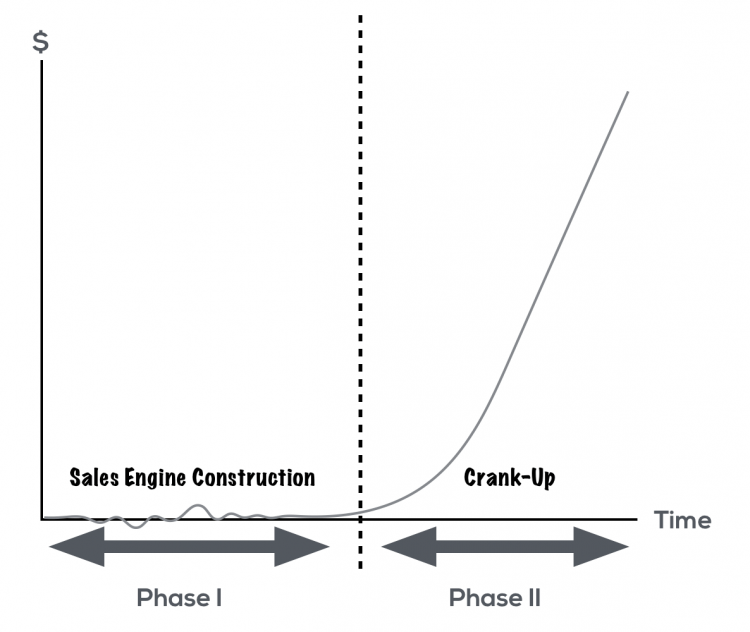
Phase 1: Sales engine construction
In the 90s, when a group of people got together to build a startup, there was not a lot of group-wide consciousness about the startup’s “job.” When you start a business, your goal is not to make a lot of money but to figure out a profitable, repeatable, and scalable way to make a lot of money. The initial goal of your startup (in Phase 1) is to build a sales engine.
When you build an engine, you have to be precise—as precise as when you are building a physical engine.
When Veritas Software founder and CEO Mark Leslie retired from his company and landed at Stanford Graduate School of Business as a lecturer in the early 2000s, he (luckily for us) thought through his experiences creating product lines at Veritas. (When Leslie retired, the company had four product lines, each generating about US$250 million in revenues per year.)
When he shared his ideas on Harvard Business Review where he discussed the sales learning curve, we were all relieved that someone finally articulated a framework (with no rigorous set of references) for something we all struggled with in our startups.
I use the term engine because many times, when I work with startups, the comments on what they were learning on the sales learning curve tend to be too qualitative. Yes, it’s about learning. Yes, it’s about experimenting. But when you build an engine, you have to be precise—as precise as when you are building a physical engine. You need to be as quantitative as possible. What is the efficiency of a component? What is the unit cost? What is the gearing ratio? And since sales has a higher level of unpredictability around some of the functions, what are the probability curves of the major components of the engine?
You will need to consider questions like:
- What are my acquisition channels?
- What are my CACs (customer acquisition costs) for each channel?
- What are the efficiencies for each channel?
- What are the stages of my sales cycle?
- What price points work best?
- What are the key value propositions?
- How do I ensure referenceability?
- What are the must-have features?
- Who are the decision makers?
- What is the retention, engagement, and virality expected over each cohort of users?
There are literally hundreds—if not thousands—of questions that you need to figure out to build your sales engine. Leslie’s article is a good starting point. Ben Horowitz’s recent article on distribution is also a great framework for the distribution part of the sales engine.
Phase 2: The crank-up phase
Many of the venture investments I’ve done were into series A rounds. I know series A is a label we put on a class of shares at a certain stage of a company’s life cycle. However, I like to think that series A is a round of funding that goes into starting the crank-up of a startup’s exponential growth. In real life, sales engines, being the fuzzy systems that they are, result in fits and starts as companies start cranking up.
Failure to construct





Stay updated on the go with our mobile app.
Get latest insights with smoother, more personalized experience through TIA mobile app.







📅 Upcoming Events
22 October 2026
Payoneer x CSPN Summit 2026