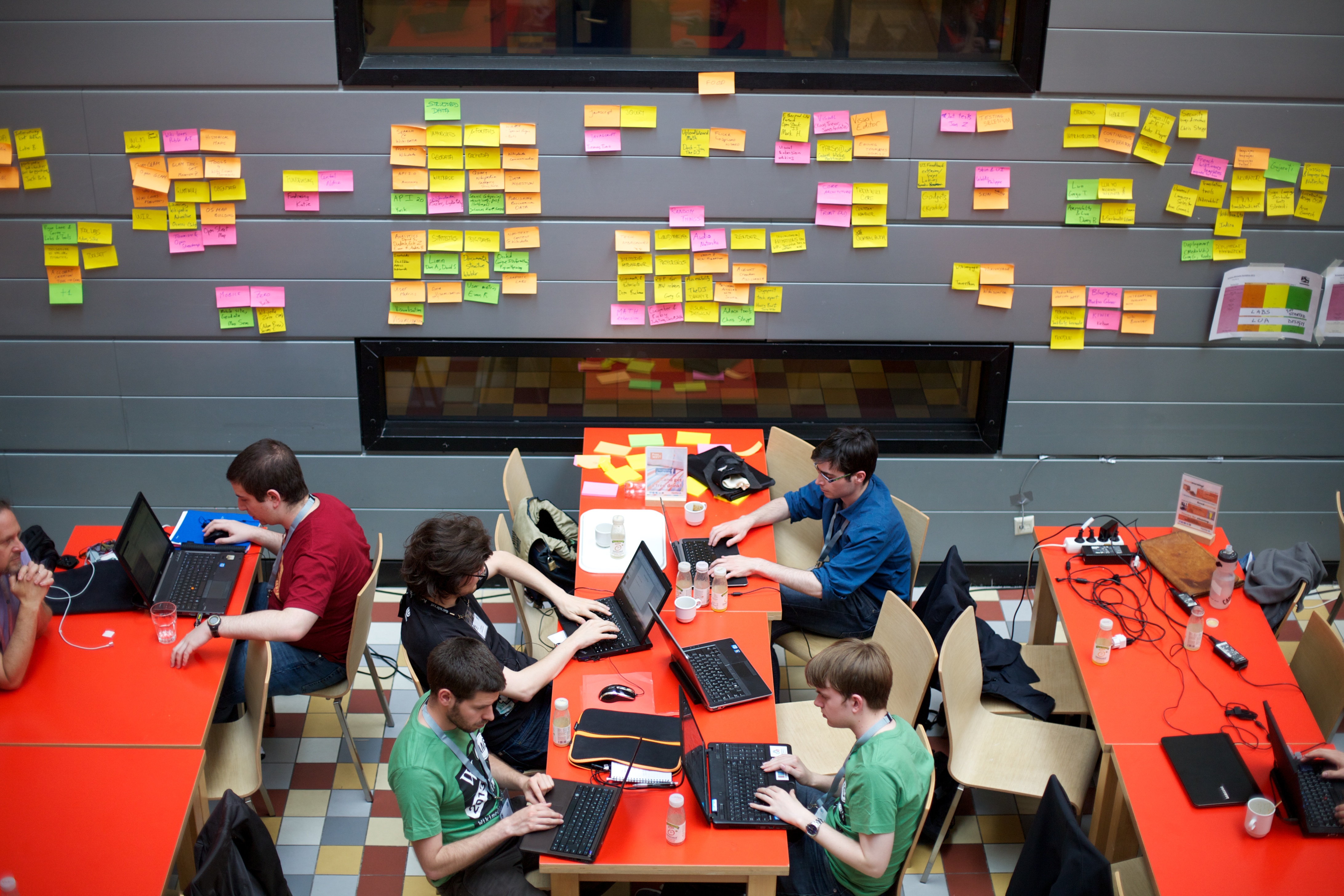
Hackathons are great opportunities. Photo credit: Sebastiaan ter Burg/CC BY 2.0.
Traditionally, hackathons are events that focus on engineering and entrepreneurship, often fueled by energy drinks and pizza, culminating in showcases of amazing working prototypes. Some of these hacks turn into amazing new ideas, like Carousell, while others go through many iterations before they reach their final form. Regardless of the outcomes, a hackathon is fundamentally a challenge to participants to turn their ideas into reality and a great illustration of what a sprint of dedicated work can accomplish.
As we’ve discovered, an internal hackathon can be like an extreme team-building challenge, especially if your startup is growing into an international tech company at breakneck speed. Unlike traditional team-building challenges like trust walks or treasure hunts, an internal hackathon results in ideas that can be implemented to improve the company.
An internal hackathon can be like an extreme team-building challenge.
It’s a great opportunity to return to, or embrace, the “Just Do It” mentality of a startup while tapping into the strengths of the highly specialized individuals working in Design, Engineering, Product, Sales, Operations, Marketing and CSS (Customer Support & Success).
And like us, you’ll be surprised at what happens when you leave bureaucracy and processes at the door in favor of no-holds-barred creativity: By the end of our hackathon, we had projects that focused on everything from new revenue streams to better customer experiences and even a custom-built TradeGecko game.
However, running a company-wide internal hackathon can be challenging for a couple of reasons. For a start, it is still a new concept without many guidelines to draw on, especially when the objective of your hackathon is “hacking culture.” More importantly, it can be intimidating to people who can’t “hack” in the traditional sense with code (like myself!). Here’s what we learned about running an awesome internal hackathon.
Set your goals
For a start, deciding on what you want to achieve from running a hackathon is important.
A well-run internal hackathon is great for team building and cross-disciplinary collaboration, as you’ll be able to encourage people to work outside of their regular cliques. You’ll also get some awesome new ideas when different disciplines come together to tackle a common problem as they each bring their individual areas of expertise.
In our hackathon, every team had to include members from at least three of the following functions (Engineering/Product/Design, Marketing, Sales, Operations, and Customer Support & Success) to ensure a mix of talents and experience in every group.
If you’re curious about how that works out in practice, my team consisted of a writer, two developers, a growth marketer and a sales representative. Our developers created a prototype of our app, the growth marketer pulled some numbers around our potential revenue, while our sales representative pounded the pavement speaking to potential clients to discover the market demand for our product. As the resident writer, my tasks included creating a landing page to describe our product and I learned some simple CSS/HTML for website design along the way.
Although we didn’t win, it helped me understand the process of how different teams could work together to ship something amazing.
Get everyone involved even before the event
An internal event is a company-wide event. For it to be successful, you’ll need to get everyone hyped up even before the event starts, so here are some ideas that worked for us:
Awesome swag.
Last thoughts





Stay updated on the go with our mobile app.
Get latest insights with smoother, more personalized experience through TIA mobile app.