 Tiago Alves · · 4 min read
Opinion: Blockchain can disrupt the Apple/Google app store duopoly
When you want to buy digital content today, there are hundreds of alternatives to choose from. But when it comes to apps, there are only two main options: the App Store and Google Play Store.
By taking advantage of blockchain technology, however, it’s possible to disrupt the US$77 billion app economy.
Blockchain addressing app store problems
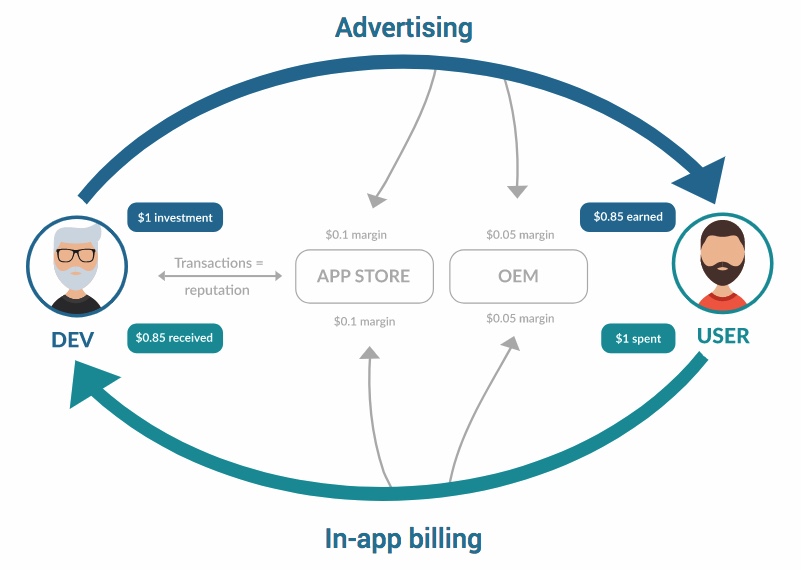
The blockchain has huge potential because it offers an unprecedented, transparent, and accessible public ledger that can redesign the way transactions are made. If correctly applied to the app store economy, it can address three major inefficiencies:
- Advertising: Ad tech middlemen make user acquisition non-transparent and costly. It’s possible to use smart contracts to establish direct relationships between app developers and users and eliminate intermediaries.
- In-app billing: App stores currently take a 30 percent cut from each in-app purchase. With blockchain, it’s possible to introduce a frictionless method to pay for in-app items, removing bank fees and exchange rate discrepancies.
- App approval: The Google Play Store has a reputation for being unsafe when compared to the App store. By developing a new reputation system based on a developer’s track record of transactions, which will be public in the blockchain, it’s possible to develop a more transparent and secure environment.
Here are more details on how each of these challenges can be tackled by taking advantage of blockchain technology.
Advertising
According to Statista, there are now more than 2.8 million apps in the Google Play Store and 2.2 million in the App Store. To stand out, developers invest in CPI (cost per install) campaigns. But intermediaries make this process expensive and non-transparent.
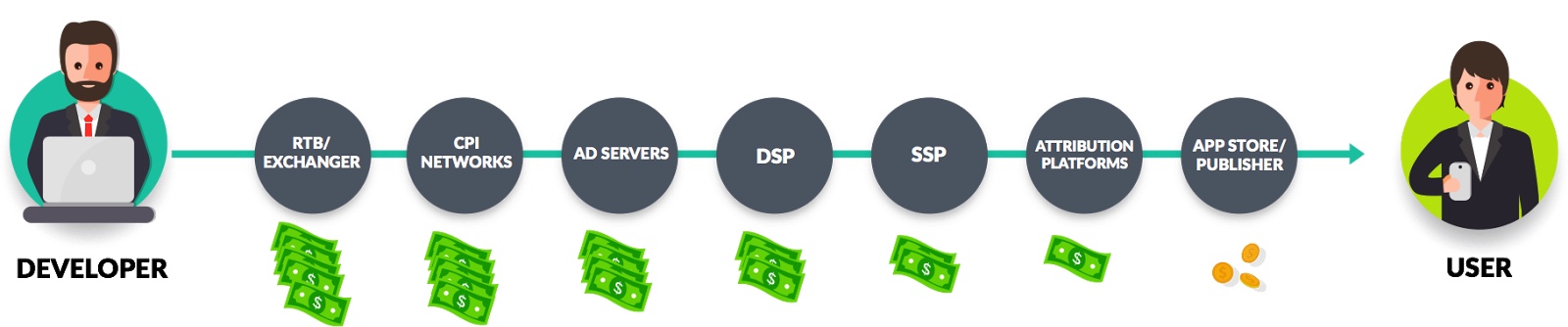
By using smart contracts, we can eliminate middlemen and create a new method to acquire users that will make CPI campaigns obsolete. We can call this CPAt (cost per attention). This allows a developer to directly reward a user for spending at least two minutes inside the app. We did an internal UX test which showed that two minutes was the minimum amount of time it takes for a user to make an informed decision about an app.
When one CPAt unit has been completed, a smart contract makes a transfer from the developer’s wallet to the user’s. The user then earns tokens, which can be used to buy in-app items (see the section below for more details), closing the loop. By using smart contracts, we can guarantee that the user spends the required time in the app. If the user fails to reach the two-minute threshold, they won’t earn any tokens.
All the transactions will be registered on the blockchain to guarantee user authenticity. Downloads and engagements will be available in the public ledger so an app developer can confirm that a user has actually installed the app. This will also reduce the risk of advertising fraud, which is responsible for over US$850 million in losses per year.
In-app purchases
Removing barriers for the unbanked
According to a report by We Are Social, more than half of the world now uses a smartphone. But according to a World Bank report, 2 billion of these smartphone users do not have access to payment methods required for in-app purchases such as credit cards.
App approval
Bonus: Rewarding manufacturers (OEMs)
Conclusion





Stay updated on the go with our mobile app.
Get latest insights with smoother, more personalized experience through TIA mobile app.









📅 Upcoming Events
22 October 2026
Payoneer x CSPN Summit 2026