
Photo credit: Neha Singh
As 2016 kicks into full swing, all eyes are on India’s mobile ecosystem.
Due to increasing access to smartphones and growing mobile Internet penetration over the past few years, the country has seen a staggering rise in everyday transactions carried out via mobile devices. A report released last year by market research firm Zinnov estimated that India’s market for mobile commerce would expand from $2 billion in 2014 to $19 billion by 2019.
To track its current trends and identify its potential moving forward, we decided to map out the Indian mobile commerce ecosystem going into 2016 (see below). In this context, we define “mobile commerce” as any transaction in which mobile devices directly or indirectly enable the exchange of money for goods and services. The companies on our map must enable one or more of the three key stages of these mobile transactions: discovery, payment and procurement.
We have only included companies with mobile applications, making our primary focus on consumer-facing mobile businesses. As a result, we have not included many technology solutions companies, ad platforms or other business-to-business (B2B) service providers that are crucial to the mobile ecosystem, but do not have mobile apps.
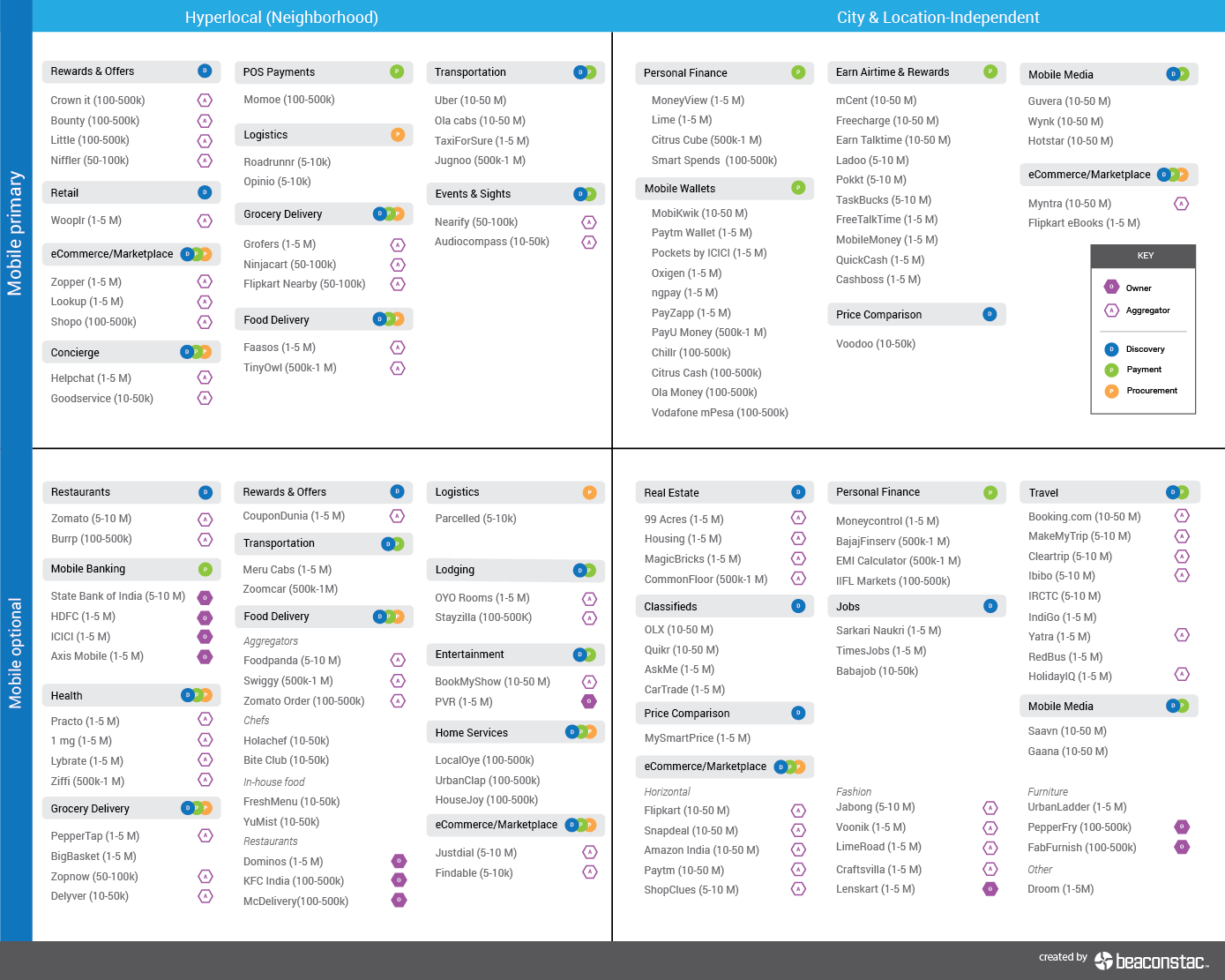
An accelerating transition from web to mobile
Looking at the mobile landscape as a whole, it quickly becomes clear that the “mobile optional” businesses significantly outnumber the “mobile primary” ones.
At the city and location-independent level, these are mostly web-first businesses that are naturally adapting to the mobile world. From ecommerce marketplaces (e.g. Flipkart) and travel aggregators (e.g. MakeMyTrip) to online classifieds (e.g. OLX) and media libraries (e.g. Saavn), many of these well-established digital businesses are continuing an inevitable transition to the rapidly growing channel of mobile.
Travel sites like MakeMyTrip, Cleartrip and Yatra, for instance, have been making big moves in mobile in the last year. After struggling to become profitable in a disjointed travel industry, these companies have begun to emphasize mobile in hopes of cashing in on the country’s growing smartphone user base. And this strategic shift seems to be working. In the last quarter, Cleartrip saw 60 percent of its total traffic coming from mobile channels — outpacing desktop traffic for the first time ever.
Ecommerce marketplaces push for mobile
Among all of these established players, though, ecommerce marketplaces have seen a particularly aggressive push for mobile.
Last year, fashion e-tailer Myntra announced it would be the first ecommerce company to do away with its desktop and mobile sites altogether as it opted for an app-only shopping experience. Some speculated this was an attempt by Flipkart, its parent company, to boldly experiment with mobile without putting its own brand on the line. However, it appears that this pioneering effort has not showed good enough results, since Myntra announced late last year that it will be adding a “lite” mobile site back into its digital strategy.
Flipkart and Snapdeal have also launched similar basic mobile versions of their ecommerce sites, which allow users to shop via mobile web browsers in addition to the company’s app.
A new wave of hyperlocal commerce
Conclusion





Stay updated on the go with our mobile app.
Get latest insights with smoother, more personalized experience through TIA mobile app.













📅 Upcoming Events
22 October 2026
Payoneer x CSPN Summit 2026