Vivek Wadhwa · · 4 min read
India deserves better than Mark Zuckerberg’s watered-down internet
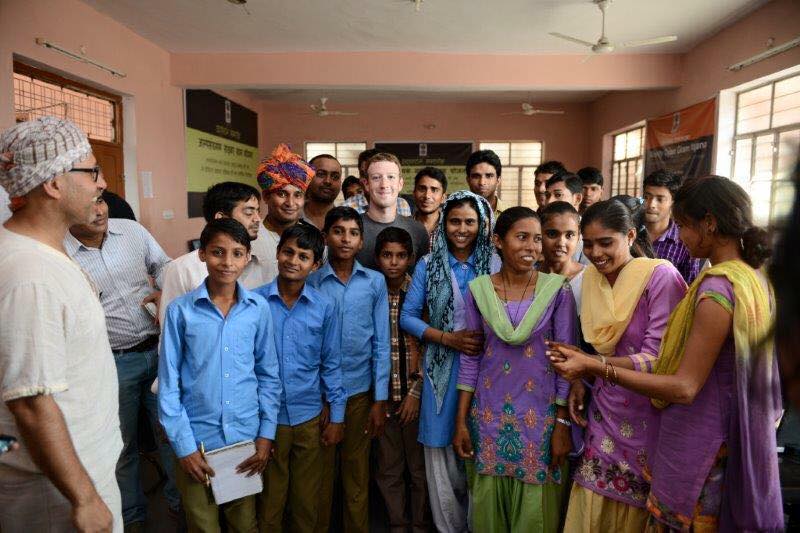
Zuckerberg during the launch of Internet.org in India. Photo credit: Facebook
Mark Zuckerberg is taking intense fire in India over an initiative that his organization Internet.org launched, to provide limited internet access to the masses. He seems genuine in his desire to bring digital equality to the world: in an op-ed for The Times of India, he defended this initiative, called Free Basics, citing the example of a farmer named Ganesh, who would be able to find weather information and prepare for monsoons, look up commodity prices to get better deals, and invest in new crops and livestock.
Clueless about the Indian culture
Zuckerberg is on the defensive because he doesn’t understand the culture and values of Indians. He doesn’t realize that Ganesh cherishes the freedom that India gained from its British colonizers in 1947 and doesn’t want a handout from a Western company. Ganesh may be poor, but he doesn’t want anyone to dictate what sites he can visit, what movies he may watch, or what applications he can download.
Like a billion other Indians, Ganesh can afford a cellphone that lets him call and text anyone, anywhere. He is saving up for a beautiful new smartphone, just like the ones he sees other people using, which costs around $40. He would rather spend 50 cents a month for 100 megabytes of unrestricted data access than compromise his freedom and dignity.
Zuckerberg is right about the benefits of internet access: it will enable village artisans to access global markets; farmers to learn about weather and commodity prices; and laborers and maids to find work through sharing-economy applications. With unrestricted web access, they will have access to same ocean of knowledge as we do and become our equals online.
Problem with Free Basics
And here is the problem with Free Basics: the internet access on offer is not unrestricted. Facebook and the mobile carriers get to decide what websites people can visit, and Facebook becomes the center of the internet universe. Users can’t do Google searches and explore the web; they can only go to supported sites and search Facebook.
Zuckerberg compares this limited service to libraries and hospitals. But imagine a private corporation being allowed to decide which books your children could read and which videos they could watch — and to monitor everything that they did. Imagine the corporation’s dictating what services your hospital would offer and what treatments it would provide. Would you accept that?
And here is the problem with Free Basics: the internet access on offer is not unrestricted.
The debate centers on the concept of net neutrality — whether a mobile carrier should be allowed to favor which websites a person visits. This is not an Indian issue; we are fighting these battles in the United States. The Federal Communications Commission enacted rules in March 2015 to require broadband providers to treat all data equally rather than provide preference to some sites. A federal appeals court is challenging these rules at the behest of the telecommunications industry.
Facebook is not alone
Google has the same motivations as Facebook — to bring billions more people online. But it is pursuing a more sensible strategy: it is setting up fast and free wifi access points at 400 railroad stations all over India. These are located in most central locations and frequented by tens of millions of people. Facebook could one-up Google by setting up access points at thousands of schools, libraries, and villages. This “no strings attached” approach would earn it gratitude — and signups — rather than resentment.
The ultimate solution, unrestricted internet for everyone, is, however, something that Facebook, Google and others are already working on providing, via drones, balloons, and microsatellites.
With its Aquila Unmanned Aircraft and laser technologies, Facebook has demonstrated the ability to deliver data at a rate of tens of gigabits per second to a target the size of a coin — from 10 miles away. This is 10 times faster than existing land-based technologies. With interconnected drones, it will, within two or three years, most likely be able to provide web access to the most remote regions of the world.
Google has the same motivations as Facebook — to bring billions more people online.
Google is further ahead in its efforts. It has already piloted a technology in Brazil, Australia and New Zealand to beam internet data from the sky. Google’s balloons, called Loons, are essentially floating cell towers that can relay a signal to a mobile device on the ground. Loons fly twice as high as commercial aircraft and navigate by taking advantage of wind patterns in the stratosphere.
Final thoughts





Stay updated on the go with our mobile app.
Get latest insights with smoother, more personalized experience through TIA mobile app.