- Insights This article was written by a TIA community member. Insights pieces undergo the same rigorous editorial process that newsroom-produced articles have.
 Michelle Tarunadjaja · · 5 min read
Find your startup’s valuation in 3 easy steps

Vector credit: Freepik
This article is part of Tech in Asia’s partnership with Convergence Ventures, where we publish articles that feature the firm’s valuable insights. Read more from Convergence Ventures here.
One of the first things you learn as an analyst at a venture fund is the approach to valuing early-stage startups.
Unlike financial analysts that have access to abundant historical data that allows them to do a bottom-up DCF analysis, any data that is available from early-stage startups will be difficult to use to accurately project future value. So, the approach is simplified for VCs and startups.
The good news here is that any founder can perform these calculations with some straightforward research and present a solid rationale for the valuation they’re presenting.
To clarify, this is not the only valuation method that exists; a wide variety of approaches have been used to evaluate young companies such as the Berkus Method as well as the Scorecard Method. By and large however, the most commonly used method for VC firms is some form of the Comparable Method. As such, it is never a bad idea to calculate this for yourself to get a sense of where a VC would place your company’s value.
Here are three straightforward steps to perform a startup valuation using the Comparable Method.
For this example, we will use an ecommerce startup. A commonly used north star metric for a startup in this category is gross merchandise value (GMV), which is simply the sum total sales value of merchandise sold on an online retail site over a period of time. This will be the baseline metric we will use to evaluate the startup.
Step 1: Find proxy companies and research their traction
Let’s assume that your startup is an ecommerce marketplace specializing in electronics across Southeast Asia. The first step involves identifying companies that have similar business models (in this case, an ecommerce marketplace) operating in a variety of markets.
(Note that it is preferred but not essential to do your comparisons with companies in similar funding stages.)
In many cases, both GMV and valuation figures can be extrapolated from publicly disclosed fundraising announcements. We can assume that the amount represents 20 to 30 percent of equity at that point in time. So in the case of our research below, valuation equals the fundraised amount divided by 0.2.
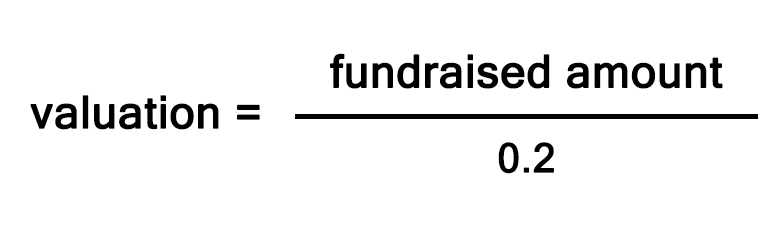
The formula for startup valuation
(You can download the below spreadsheet here.)
Step 2: Calculate the average valuation multiple of your industry
Step 3: Derive your startup’s valuation
Considerations





Stay updated on the go with our mobile app.
Get latest insights with smoother, more personalized experience through TIA mobile app.