Last weekend we took the kids to the Computer History Museum, and the volunteer, a nice man that showed us around, talked about the “first computerized offices”. He mentioned that not too long ago computers were not a part of our work life – computers were used by big banks and universities, but rarely by small, medium, and even most of the large companies. Today, you cannot imagine an office without computers.

A computer in every office?
The mobile office era
After the computerized office era came the mobile office era — companies found it useful to let workers, sales reps, field personnel use company-owned, and later personal-owned mobile devices to facilitate day to day tasks. In many cases today our office is a mobile phone, sometimes coupled together with a laptop. Your office is blurred between the office, a coffee shop and home. This trend becomes even more dominant when we work on a global team in different timezones.
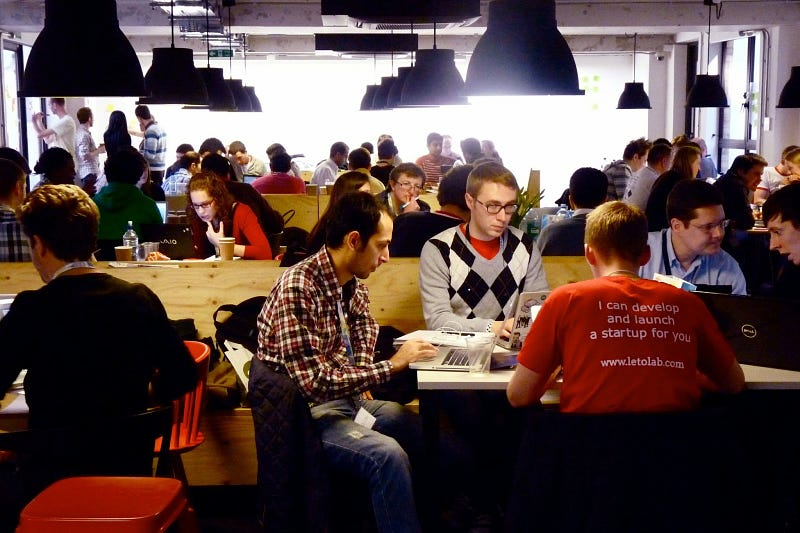
The mobile office is everywhere.
The conversational office era
It seems that the next step of this evolution is here — let’s call it the conversational office era. Today’s offices are highly distributed, highly productive, with a major focus on online communication and knowledge sharing. The modern office communication medium is text-based, rather than face-to-face interaction or phone calls. This communication becomes the office knowledge-base, it facilitates collaboration, makes cross group work more productive and makes the on-boarding of new workers easier.
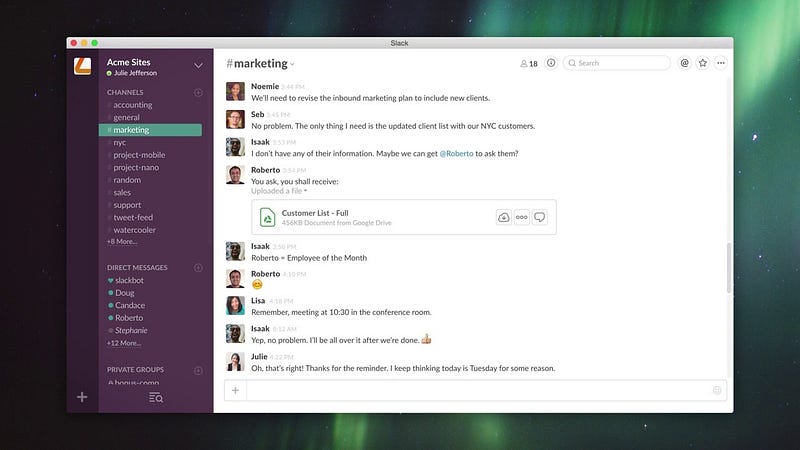
Conversations make our work more productive.
A place where humans and systems meet to talk
The real breakthrough in the conversational office era, is that office workers (AKA people) are not the only ones joining the conversation. It seems that office computerized systems and services are making themselves available through this conversational interface as well. Our bug system sends a status report over this interface, our CRM happily sends us a message when a lead is closed, our servers ask for help and send error logs in the same way a human would do.
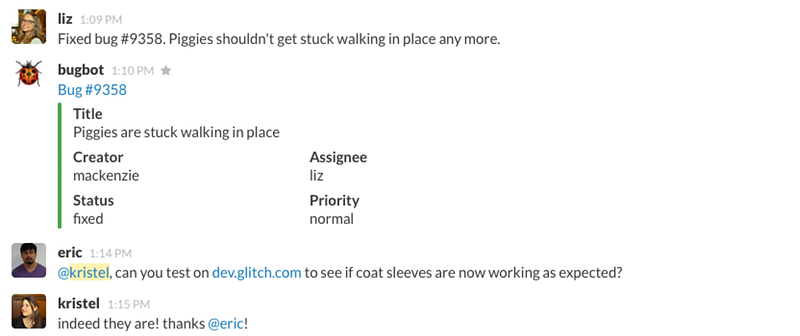
Computers joining the conversation.
Why is this so exciting? Why is it so great that we converse with our systems? Why should a computer communicate with us through this chat-based user experience? The answer to that lays in the fact that most current systems provide a sucky (hard and unproductive) user interface. We hate our vacation system because it is hard to navigate, we shy away from our expense system because it is cumbersome, our CRM is a nightmare of checkboxes and data fields we do not understand, our bug and production system is a shrine that only the IT managers and developers can step into. Basically, most of the office computerized systems make us feel like this:

We all love our enterprise system.
How will it work in real life?
I will have my bots talk to your bots





Stay updated on the go with our mobile app.
Get latest insights with smoother, more personalized experience through TIA mobile app.