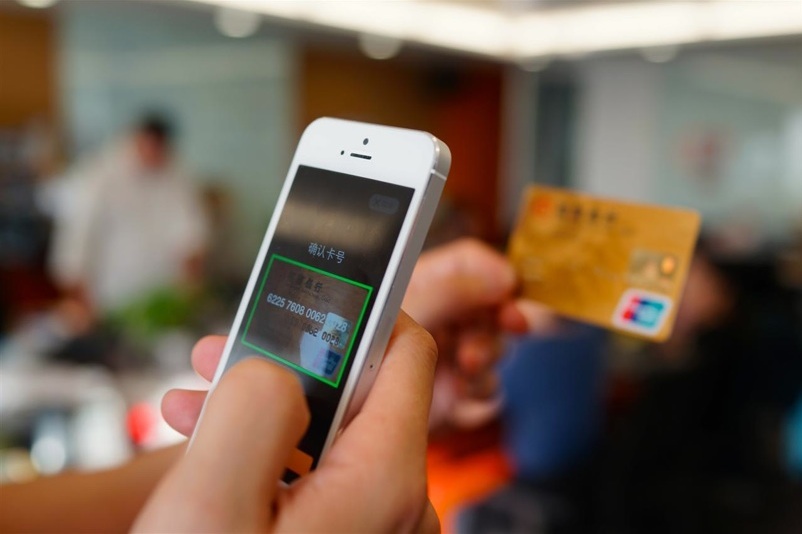
Last week, I received a promotional email from a local telecom operator attempting to make me use their mobile wallet more often. In an effort to stimulate this incremental usage, the offer promoted up to 2% interest rate per annum on the savings account linked to the wallet. This offer rang a bell.
Back in 2009, at the tail end of the economic downturn, banks were desperate to find alternative and cheaper ways to improve revenue and, since acquiring new customers was not an economical nor quick option, they were trying to extract value from the existing clients. At that time, when I was part of MasterCard’s Retail Banking and Debit Knowledge Center, we looked for answers by breaking down the retail banking profitability.
What we found out was eye opening, at least for me: credit cards, mortgages, consumer loans, and long-term savings contributed about 65% to the bottom line while the remaining 35% of revenue was generated by current accounts. When we looked deeper, we realized that only 5% of that revenue came from fees directly related to the account (overcharge and ATM fees), 25% came from Debit Card (largely, if not all, from interchange), and a very chubby 70% came from Net Interest Income [1].
The question we were posed – how to extract more value from existing customer – suddenly had a clearer answer: Leverage the strict correlation between debit card usage and average daily balances [2] held in the current account to drive increased revenue. By pushing debit card usage more at point-of-sale and less at the ATM, a bank could have increased revenue not only from debit card interchange but also from Net Interest Income.
How? Imagine two cardholders, Maria and Mario:
- Maria uses her debit card only to withdraw cash at the ATM and never at a POS terminal. Maria habitually withdraws cash once per week, four times per month, and withdraws always the same amount. This gives her peace of mind and a way to control her spending (when she finishes cash, she knows she ran out of her weekly budget).
- Mario uses his debit card only at POS and never at the ATM. Mario instead doesn’t want to have cash in his pocket, never withdraws cash, and always uses his debit card to pay for purchases at Point-of-Sale. He finds debit cards more convenient and secure, and he gets some rebates and loyalty points.
If you compare Maria and Mario’s behaviors, their debit card usage styles will look something like the picture below:
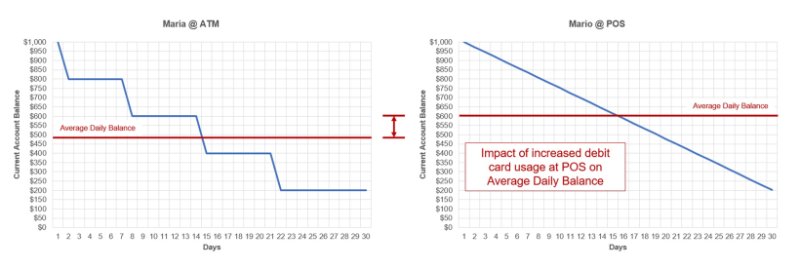
ATM vs POS
Multiply the increased average balance by the number of customers you have in your portfolio, then by the interest your bank makes on deposits, and you find the magnitude of the impact of increased debit card usage at POS on the bottom line.
Let’s fast forward to today. The situation isn’t much different compared to 2009. Banks are still looking for ways to engage with their customers at a deeper level and are still trying to extract more value from each single one of them. The difference is that today they can leverage the same lifecycle marketing techniques proved effective in increasing debit card usage applied to debit cards within a mobile wallet.
Stimulating usage of mWallets linked to a debit card and, implicitly to the underlying current account, becomes a neat example of an ‘old’ lifecycle tactic that could change cardholder/wallet behavior in such a way that the user increases the average balance held in the current account and, therefore, revenue from Interchange and Net Interest Income too. Value propositions can leverage proven techniques involving a minimum number of transactions to qualify for the offer, a minimum spend per transaction, and a minimum month-end balance. Same old. Same old.
The beneficial difference today is that, on top of the usual behaviors associated with debit card usage such as convenience and security, banks could now promote speed of payments, coolness of waiving or tapping smartphones at POS terminal and increased security from tokenization and relative end-to-end encryption.





Stay updated on the go with our mobile app.
Get latest insights with smoother, more personalized experience through TIA mobile app.










📅 Upcoming Events
22 October 2026
Payoneer x CSPN Summit 2026