For many people, getting an offer from a startup creates mixed emotions.
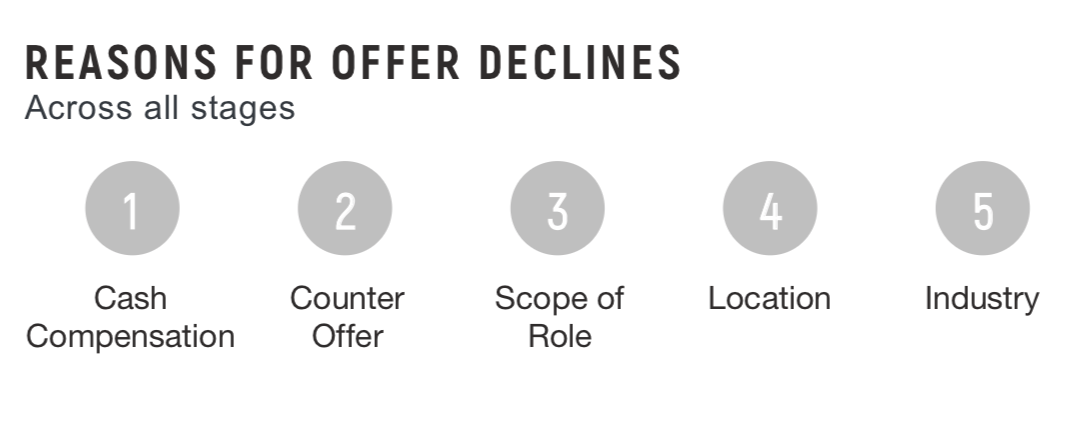
Often, the role would sound perfect during the interview process, only to find that the offer package is far from expectations. The cash compensation is likely lower than competing offers, and instead, candidates are told that equity is the path to future riches.
Even for seasoned startup veterans, understanding the value of equity can be challenging. This is compounded by the fact that many founders, recruiters, and hiring managers often lack a deep understanding of it themselves. The disparity between how candidates and companies prioritize equity leads to declined offers across the startup ecosystem.
To address this challenge, our Talent Infrastructure team at Lightspeed recently hosted a portfolio company workshop to discuss equity fundamentals and share best practices on selling the value of equity. We want to share some learning from the session to help startups improve their ability to hire top candidates.
It starts with a simple question: Why would anyone take lower cash compensation to join a high-risk startup?
Creating the story
The best companies don’t just give details of the offer. They use real-world exits (IPOs or acquisitions) to tell a compelling story about its potential value.
We recommend creating three scenarios, which are outlined in this graphic:
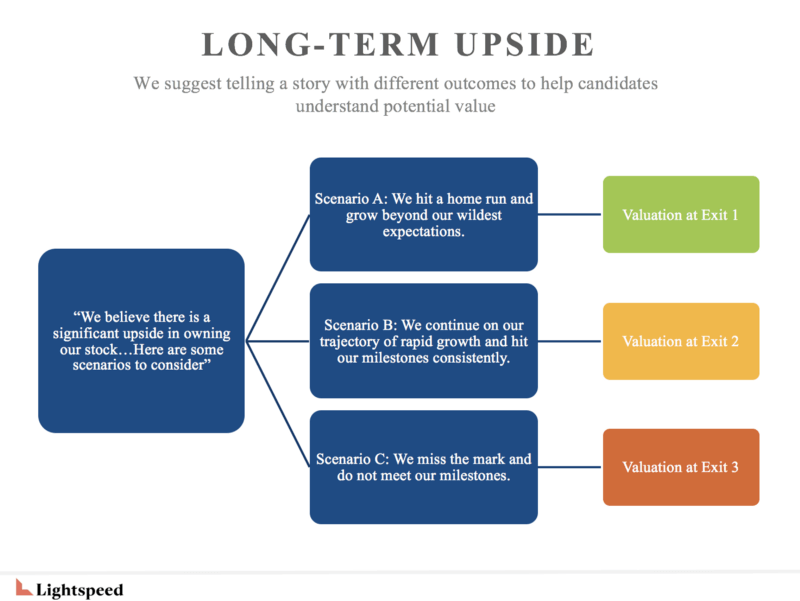
A slide from Lightspeed’s Equity and Offer Process Optimization workshop
A few tips:
- Pick companies in the same industry. You need to tell a credible story of how each scenario can be achieved and how the candidate will contribute to that outcome.
- The “high” scenario can be aspirational but should still have a reasonable pathway to success. Example: “We launch our second product and capture 5 percent of a billion-dollar market.”
- The “mid” scenario is a healthy exit, likely at a significant valuation, and may include a “unicorn” benchmark. Example: “We continue to scale sales and hit US$100 million in revenue.”
- The “low” scenario should be an exit sub US$500 million. If the candidate doesn’t believe that base assumption, they likely aren’t bought into the long-term vision. Example: “Our growth stalls and we don’t increase our customer base or surpass US$20 million in revenue.”
- Be sure to emphasize these are theoretical outcomes and candidates should do their own research and due diligence.
 Luke Beseda