- Insights This article was written by a TIA community member. Insights pieces undergo the same rigorous editorial process that newsroom-produced articles have.
 Eric Feng · · 9 min read
Consumer startups are dead. Long live consumer startups.
About 10 years ago, Apple first unveiled the App Store and kicked off one of the greatest periods of product innovation, entrepreneurial achievement, and disruption we’ve ever seen, namely the consumer rebellion.
Like what the internet rebellion did 10 years before, the consumer rebellion would spawn startups that evolved from tiny companies into titans of industry, all fueled by the introduction of a new computing platform: the smartphone.
Who are the members of the Rebellion? In 2009, Pinterest, WhatsApp, and Uber all launched. In 2010, Instagram and Xiaomi. In 2011, Snapchat. And in 2012, Toutiao. These are some of the most iconic consumer companies that touch more than a billion mobile users every day and have become fundamental parts of our society.
The consumer rebellion was in full force. It was unstoppable—until 2013 at least.
The golden age
To illustrate the timeline of the consumer rebellion, let’s look at data from Crunchbase. I’ve queried all consumer unicorns since 2005 and plotted them by their founding date.
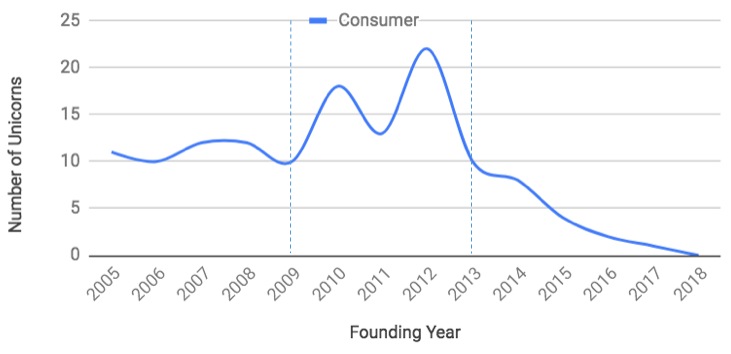
As expected, there’s a steep spike starting 2009, exactly when the mobile app economy began with the App Store’s launch and the subsequent founding of consumer giants like Airbnb and Instagram. But there’s a similar steep decline in 2013. This golden age emerged from 2009 to 2012 and then declined afterward.
But maybe the picture is simply incomplete. Companies take time to develop, right? A great consumer startup founded in 2018 will take several years to mature and grow in value, so obviously there will be fewer consumer unicorns this year because of the time horizon we’re looking at.
Yes, there’s truth to this. When evaluated, there will absolutely be more than zero consumer unicorns from this current 2018 vintage. But that doesn’t explain the decline in 2013 and 2014. Those companies have had four or five years to develop by then, which is a long enough period for the winners to separate themselves.
In other words, the unicorns of 2013 and 2014 should have matured already, and they won’t change substantially even over several more years.
To illustrate this point, let’s look at the same chart but add in enterprise unicorns.
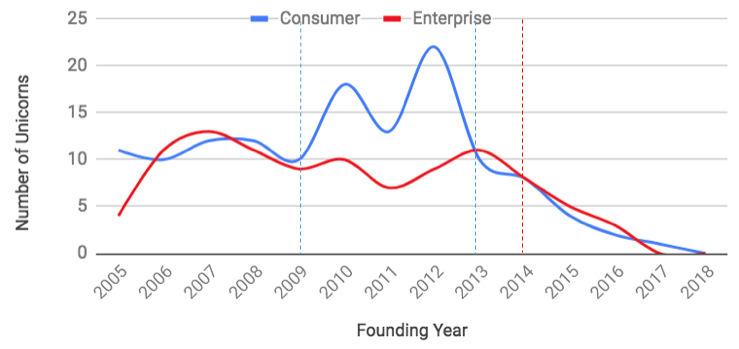
As the number of consumer unicorns declined steeply, the number of enterprise unicorns held up. In other words, enough time had passed for hit enterprise startups from 2013 and 2014 to break out, making those vintages mature.
The empire strikes back
Network effects, distribution, and talent
Consumer startups are dead. Long live consumer startups.
The return of the consumer rebellion





Stay updated on the go with our mobile app.
Get latest insights with smoother, more personalized experience through TIA mobile app.