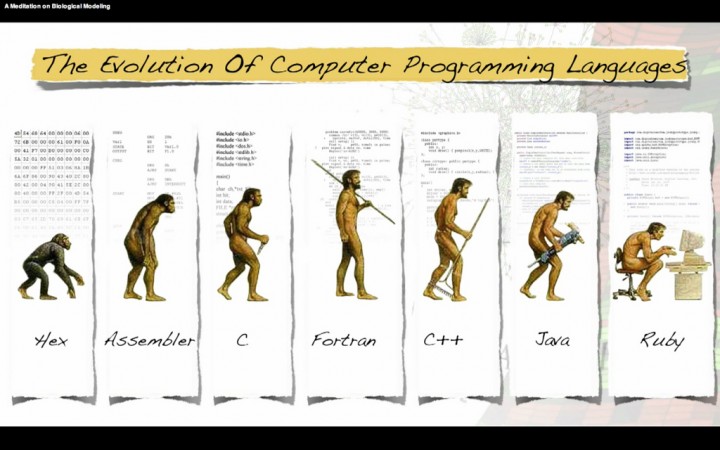
Spotted this interesting article on Bloomberg. Here are 9 coding languages that were created as far back as the 1950s that are still in use today. Are you using any of these languages? If yes, what do you use it for? If not, which other coding language is your favorite?
1. ALGOL
Created: 1958.
Named for: “Algorithmic Language.”
Inventors: A widespread group of European and American computer scientists.
Peak Years: 1958–1968.
Main Use: Mostly scientific computation. ALGOL was essentially the first attempt to write a language that could transcend its platform and be used on many different machines. It turned out to be better for lab work than for commercial applications because it didn’t (in its initial form) have any input-output protocol: That is, an ALGOL program couldn’t prompt you for a number but rather had to have those numbers written into the code.
Contemporary Presence: Minimal, but its DNA lie in many major languages used today.
Linguistic Equivalent: Classical Greek.
2. COBOL
Created: 1959.
Named For: “Common Business-Oriented Language.”
Inventors: A large committee that included pioneering computer scientist Grace Hopper, most famous for creating the term “bug” when she found a dead insect stuck in a circuit.
Peak Years: 1960s through 1980s.
Main Use: Big business systems: accounting, bookkeeping, insurance.
Contemporary Presence: It’s still taught in schools because there’s a ton of legacy code out there, notably in big corporate organizations and governments. In 2000, financial institutions had to pull COBOL programmers out of retirement to dig into their old code and rewrite around the Y2K problem. A few years ago,Computerworld reported that young programmers who knew COBOL were commanding a significant salary premium and others were often being told they’d have to learn it to maintain older code.
Linguistic Equivalent: Church Latin
3. PL/I
Created: 1964 (introduced 1969).
Named For: “Programming Language One.”
Inventors: A committee convened by IBM.
Peak Years: Early 1970s.
Main Use: A general purpose language for the IBM System/360 mainframes, which were employed for everything from bookkeeping to astrophysics. Was intended to supplant COBOL, FORTRAN, and other contemporary languages and was much more widely used in the Soviet Union than in the West.
Contemporary Presence: Lost favor in the 1970s; it was perceived as a resource-hogging, overcomplicated language, and users resisted being locked into yet another proprietary IBM product. But given IBM’s dominance back then, a lot of old PL/I is still out there, and an update released just weeks ago allows it to play with newer Web code.
Linguistic Equivalent: Old Church Slavonic
4. PASCAL
Created: 1968.
Named For: Mathematician Blaise Pascal.
Inventor: Niklaus Wirth.
Peak Years: 1980s.
Main Use: Arguably the most widely used descendant of ALGOL, it was used mostly for teaching and the development of software for early Apple computers. Borland’s widely popular 1983 version was called Turbo Pascal.
Contemporary Presence: Still used for teaching object-oriented programming but much less frequently than 30 years ago.
Linguistic Equivalent: Esperanto.
5. LISP
Created: 1958.
Named For: “List Processing.”
Inventor: John McCarthy.
Peak Years: 1960s.
Main Use: Artificial intelligence, air-defense systems, computer blackjack.
Contemporary Presence: Still one of the dominant languages in AI work.
Linguistic Equivalent: Sanskrit.
6. APL
Created: 1962.
Named For: “A Programming Language.”
Inventor: Ken Iverson.
Peak Years: 1960s.
Main Use: Applied mathematics, mostly. Known for extreme simplicity and clarity of syntax. Downside: Required Greek letters and obscure symbols, and thus a special keyboard. Reads right to left, like Hebrew.
Contemporary Presence: Not widespread, but it’s still used in certain very specific niches: DNA identification and weirdly, accounting theory.
Linguistic Equivalent: Navajo.





Stay updated on the go with our mobile app.
Get latest insights with smoother, more personalized experience through TIA mobile app.