- Insights This article was written by a TIA community member. Insights pieces undergo the same rigorous editorial process that newsroom-produced articles have.
 Max Parasol · · 5 min read
China’s preferential regulations can help it win the self-driving race
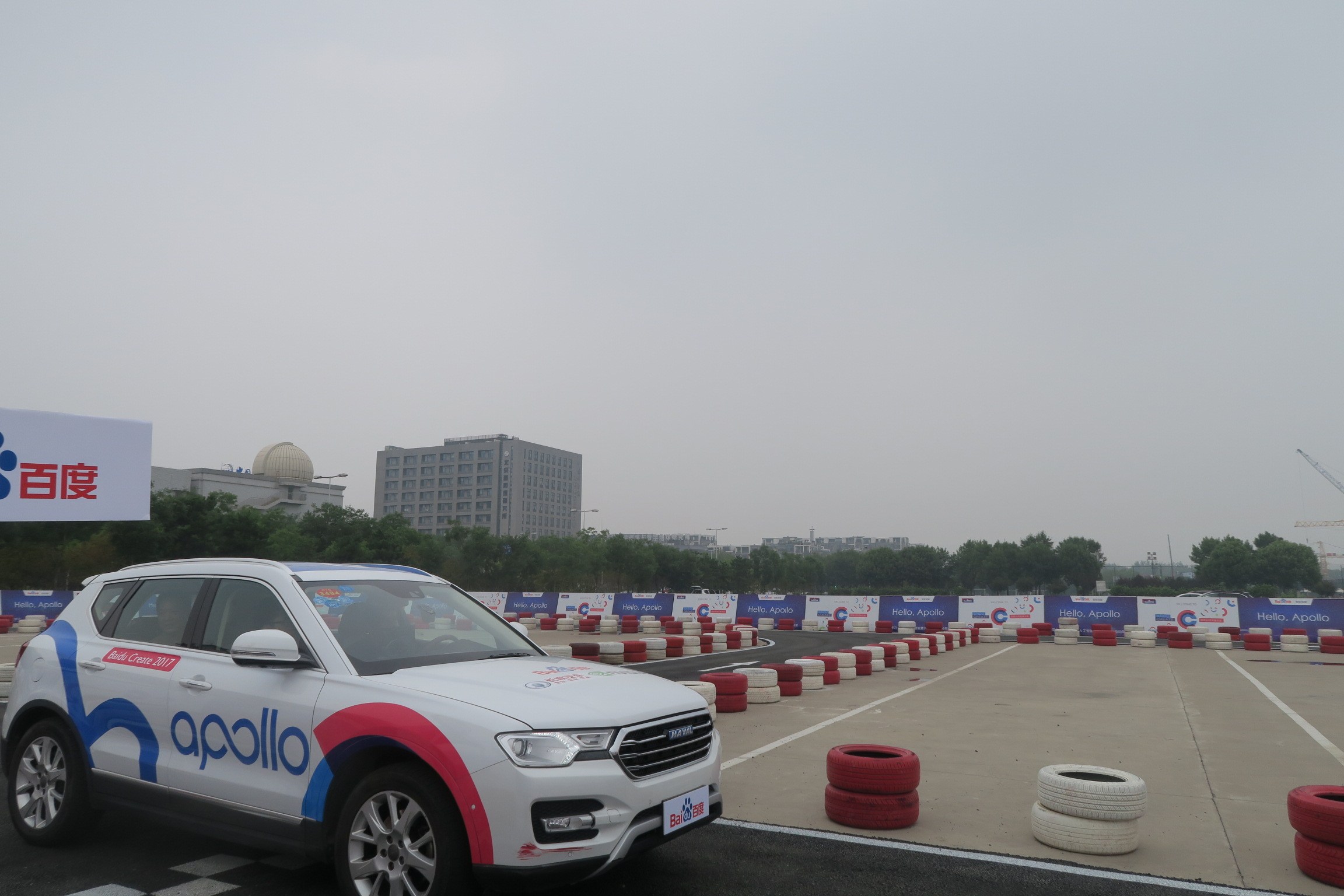
One of Baidu’s test cars at an AI conference / Photo credit: Tech in Asia
Faced with regulatory hurdles at home, Chinese companies have headed en masse to California to conduct road tests for driverless vehicles. According to data released by the California Department of Motor Vehicles, 12 of the 50 firms seeking permission to conduct such tests are from China or have a Chinese founder. Chinese transportation startups JingChi, TuSimple, California based-Pony.ai, and others are all testing self-driving cars in California.
Yet many, including Baidu co-founder Robin Li and Sinovation Ventures’ Dr. Kai-Fu Lee, suggest China could win the self-driving race due to a preferential regulatory environment.
The Chinese self-driving regulatory landscape
China identified autonomous cars as one of the key sectors in its “Made in China 2025” program to transform the country into a world leader in innovation. But Beijing only became the first Chinese city to allow autonomous vehicle road tests in December 2017. The city’s autonomous driving guidelines allow entities registered in China to test five vehicles simultaneously after completing tests in designated closed zones.
In late January 2018, China completed the first draft of its national rules for driverless vehicle road testing, including city-planning elements that are crucial to testing autonomous vehicles. Apart from detailing the testing requirements for drivers, cars, and companies, the regulations seek to identify suitable road sections for tests and how roads should be reconstructed to offer a better testing environment—at least at the early stages.
Purpose-built testing zones are certainly one reason early-stage Chinese autonomous driving looks promising.
So why test in the US?
Global ecosystem
Chinese firms are going global to utilize R&D talent bases in the US, Singapore, and elsewhere. Chinese AI firms are increasingly connected to the global AI ecosystem and are firmly embedded within a global entrepreneurial, financial, and supply chain web.
Chinese giants like Baidu, for example, have AI R&D bases in the US. Processing chips used for high-end Chinese AI are often sourced from the US, as Nvidia is the major GPU processing chip supplier for AI globally. US venture capital permeates top Chinese AI startups, such as 4Paradigm, SenseTime, and Mobvoi.
Open source collaboration
Open source collaboration is also a key to technical breakthroughs in the autonomous vehicle space. Google’s open source platform for machine learning, TensorFlow, for example, was released in November 2015. Baidu also unveiled project Apollo, an open source self-driving platform for its partners, in July 2017. Apollo now has almost 90 member companies on board including global partners Ford, Daimler, Intel, Microsoft, Nvidia, and others.
Baidu receives valuable road test data from these partners to train better autonomous cars. Data is fed into the company’s algorithms to make rapid improvements in autonomous driving.
According to China’s Xinhua News Agency, this is not a “global tech cold war” between China and the US on AI. “Artificial intelligence involves progressive learning that requires a continuous flow of AI-ready data,” the March 1 article reads. “It is open sourced and will become stronger with more players.”
Why China can win: techno-utilitarianism
China made the development of AI a national strategy in July 2017 and has recruited Tencent, Alibaba, iFlyTek, and Baidu to an “AI national team,” each focusing on specific fields of AI. However, while determined private entrepreneurs have led the development, they benefit from favorable regulations. Once a centrally-planned agenda is set in Beijing, people, startups, and capital follow, historically creating industry bubbles.
But what about data laws?





Stay updated on the go with our mobile app.
Get latest insights with smoother, more personalized experience through TIA mobile app.