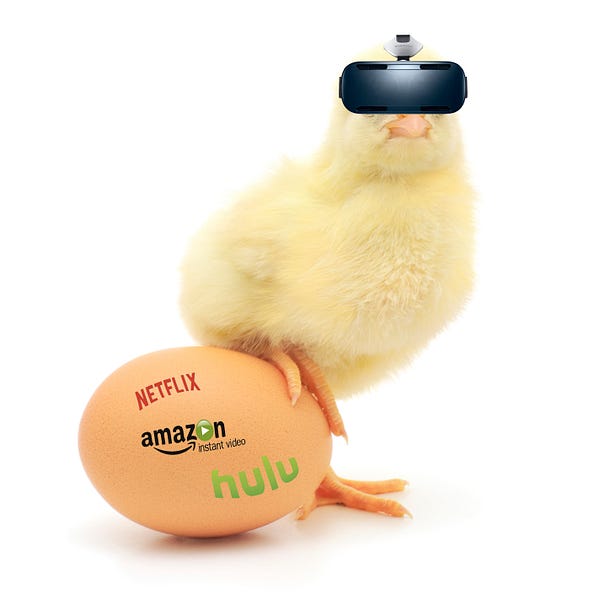
We are only starting to discover the many uses for VR. Among the broad array of potential applications and content types, entertainment is commonly regarded as one of the first to arrive to consumer market.
In its report this January, Goldman Sacks predicts “VR to be bigger than TV in 10 years”. Even if it is not to this extent, many agree VR is the next big medium.
Looking back at 2015, even in the absence of an existing consumer market, we saw a large number of brands creating VR promotions, including Patron, Mountain Dew, Porsche, North Face, and many more.
Looking at traditional media, from consumers’ point of view, we can broadly divide entertainment content into two buckets ; free or paid. Free content is paid for by brands or studios that hope to convert viewers into customers. Another form of free content is user generated content, which is usually distributed on free platforms (e.g. YouTube) that make money from ads. Paid content (from the consumers’ POV) is TV shows, movies, interactive experiences and any VOD/Pay-per-view/subscription service you can think of.
When we look at entertainment content in VR, so far most of it is free for consumers. Alongside the branded content mentioned above, we see an early rise of User Generated Content (UGC) in VR.
Early consumer hardware such as the Ricoh Theta S (and newly announced LG & Samsung cameras), and online streaming platforms such as Littlstar, Vrideo, MettaVR and most recently Facebook and YouTube, have pioneered with lowering the barriers to entry for casual content creators, and it is now possible for non-technical people to create 360 videos and distribute them, potentially, to millions of people. While the quality of this content is far from production grade, not only that it’s getting better, but its value is undebatable, with the opportunity to expose more people to unique places and experiences (such as war struck or remote places), as well as social interactions that are pure fun.

River Studios & Rothenberg Ventures’ peep using the Ricoh Theta right
There are several ways to measure the success of such uncurated platforms. Some will survive only if they make money through ads (when the user volume is large enough to move the needle), and some will be a cost center, but will drive engagement (e.g. Facebook), which is valuable looking at the bigger picture.
Still, with all that said, there is a huge unexplored opportunity to create a different kind of entertainment content, one that consumer would be willing to pay premium dollars for.

Netflix’s app on Samsung GearVR. Currently showing 2D content only
Premium VR entertainment content is one that consumers are paying for, either in the form of a Video-On-Demand (VOD)/Pay-per-view model, or through a subscription model.
The Chicken — No Premium Content
The Egg — No Premium Channels
Solving the Chicken-and-Egg Problem





Stay updated on the go with our mobile app.
Get latest insights with smoother, more personalized experience through TIA mobile app.













📅 Upcoming Events
22 October 2026
Payoneer x CSPN Summit 2026