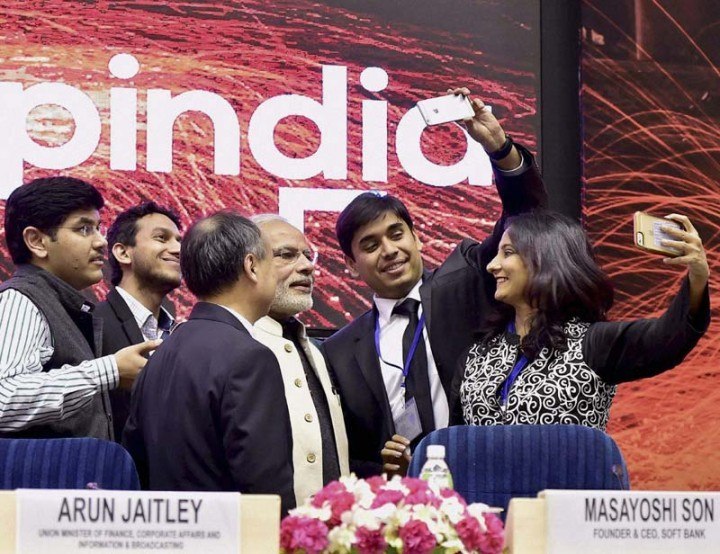
(Holding phones) MapMyGenome CEO Anu Acharya and InMobi CEO Naveen Tewari try to click a Selfie with Indian Prime Minister Narendra Modi at Startup India event in January, this year. Photo Credit: The Financial Express
Even as India’s finance minister Arun Jaitley announced his annual budget measures for the country on Monday, the startup industry was left a tad disappointed. Tech startups are creating a large number of jobs and are impacting every sector, whether it’s retail, transport, or food delivery. And yet, no big announcement was made for them.
The highlights of India’s budget were:
100% tax exemption: Already announced in January this year, the government reiterated that startups are exempt from tax on net profit in the first three years of their existence. However, which startup makes profits in first few years, Mr. Finance Minister?
Capital gains tax: People who invest in ‘startups’ will not have to pay a capital gains tax if and when they make an exit. By definition, none of the big unicorns are startups. Exiting from a unicorn, or any other company more than five years old? Get ready to pay a huge tax.
Loans for entrepreneurs: The government has mandated banks to distribute at least two loans per branch to entrepreneurs that fall into certain categories, including women, scheduled castes, or scheduled tribes. While US$73 million has been allocated for the purpose, entrepreneurs are still asked to keep a collateral to get a loan, making the effort null and void.
Unique ID number: India’s ambitious plan to give a unique digital identification number (called Aadhaar) to each of its citizens will get lawful status this year, as the government plans to introduce a bill on it. More services are likely to work with Aadhaar and tech services and software will be needed to integrate applications. This means more business. Startups, are you listening?
100 percent foreign investments in food: Startups such as Hector Beverages, which are making food products from India, are now eligible to receive 100 percent foreign investment. India is a country of over 800 million young people (under 35 years of age), and everybody loves to snack it out. This means more opportunities for micro breweries, snack makers, and tea making startups.
One-day registration: The government plans to introduce a bill in Parliament to this effect this year. The fine print is yet to be seen. Currently, it takes about 45 days to incorporate a company in India, complete with its relevant tax registrations.
Comments on the budget:
Photo by Maciej Dakowicz
India’s software product startups association – Ispirt
“We are disappointed with no attention being given to easing taxation norms of software companies where there is significant friction, the confusion on ‘goods’ versus ‘service’ tax on online downloads. There is no remedy on tax deduction at source (TDS) on sale of software products and the competition from foreign companies selling B2C products without any tax in India.”
Bhavish Aggarwal, CEO of Ola
“Creating inroads for entrepreneurship in the public transportation space and amendments in the Motor Vehicles Act to allow for innovations will provide a strong impetus towards enabling mobility for citizens. These proposed initiatives give us immense confidence as we work towards our mission of building mobility for a billion Indians.”
Shashank ND, Founder & CEO, Practo
“Reduction of long term capital gains from 3 years to 2 years is a positive move by the government. With regards to the infrastructure improvement and focus on electrification of all villages will help to promote connectivity and give rural India access to the internet.”
Subho Ray, President, Internet and Mobile Association of India
“We had suggested for waiver of capital gains tax waiver for VC funds, to bring them at par with stock markets. It is disappointing that the long standing demand of the industry is not met. This would have further boosted the startup ecosystem in India.”
Pramod Saxena, Chairman & MD, Oxigen
“A statutory status to Aadhaar will play a very big role in promoting digital payments, social benefit transfers, and allowing several services beyond banking and insurance. It will open a way for more government payments and subsidies to flow into the financial inclusion program.”
Sandeep Agrawal, Founder & CEO, Droom
“The silver lining was the announcement for women, scheduled caste, and scheduled tribe entrepreneurs with US$73 million allotments. As an entrepreneur, I was hoping that the government would include:
· Tax benefits for startups in terms of capital gain and dividend taxes
· Easier and cheaper access to capital for entrepreneurs
· Offering R&D credits and lower costs for innovations.”
Stay updated on the go with our mobile app.
Get latest insights with smoother, more personalized experience through TIA mobile app.
Recommended reads
 SG’s crypto brain drain and India’s new digital rupee
 Is Dubai stealing Singapore’s thunder in crypto?
 Binance to form JV with Thai power firm to enter local market
 Vietnam demands user data be kept locally as tech regulations tighten
 Indonesian regulator halts new crypto exchange registrations
 Binance to halt off-chain transfers with embattled WazirX
 SG wealthtech investment grows 7x, outpaces region: report
 The Philippines pauses digital asset licenses for 3 years
 Ethereum’s ‘The Merge’ will cause chaotic grab-and-dump campaign
 Thailand SEC bars crypto firms from offering lending, staking services





Editing by Meghna Rao & Erik Crouch
(And yes, we’re serious about ethics and transparency. More information here.)






📅 Upcoming Events
22 October 2026
Payoneer x CSPN Summit 2026