- Insights This article was written by a TIA community member. Insights pieces undergo the same rigorous editorial process that newsroom-produced articles have.
 Ning Png · · 4 min read
The startup challenges and opportunities of Singapore’s maritime industry
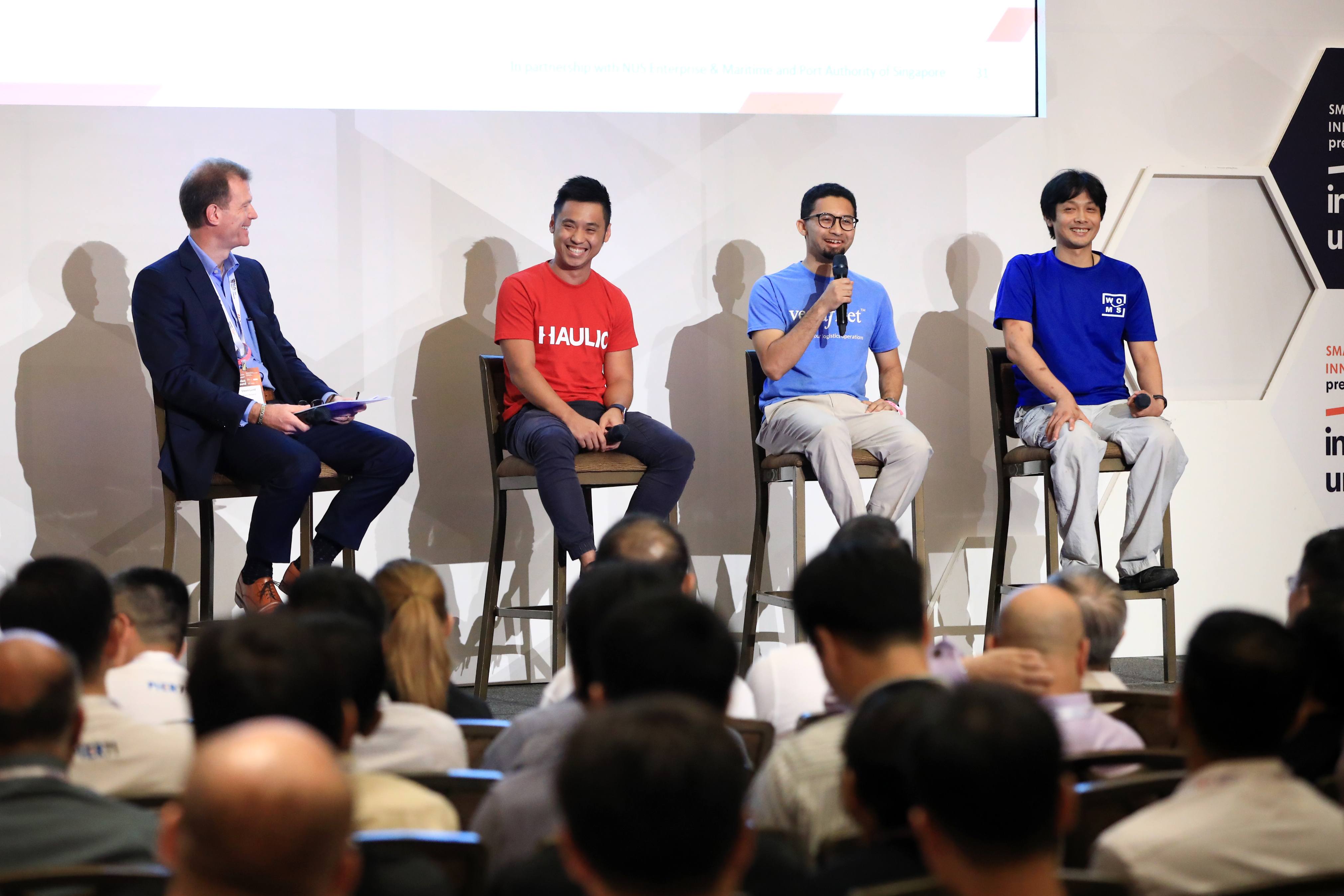
(L-R) Singapore Shipping Association council member Steen Lund and founders Alvin Ea (Haulio), Shamir Rahim (VersaFleet), and Aaron Gong (MyBot)
Where’s my boat? Where’s my package? Where’s my container?
According to representatives from startups MyBot, VersaFleet, and Haulio, these are typical questions within the maritime industry. All of these questions have the same inadequate answer: “On the way!”
Here are some lessons on the maritime industry from this year’s Innovfest Unbound, a week-long series of events that showcases Asia’s latest innovations.
Slow to adopt new technologies
The maritime sector, despite being a flagship industry in Singapore, is slow to adopt new technologies. For example, many maritime companies still rely on arcane practices, such as using pen and paper to handle all their planning.
“I work with many haulage companies, and if you want to stop operations for the day, all you need to do is go to their office and steal all the paper on the desk,” says Alvin Ea, co-founder of Haulio, a startup connecting the haulage community through a B2B platform. According to him, “It’s a challenge for [these companies] to even use a software like Microsoft Excel.”
Aaron Gong, founder of MyBot, a startup focusing on the small boat industry, agrees with this sentiment. “My customers also do all their planning on pen and paper, so it is hard to keep track of things.”
For Gong, before any disruption can take place, the company must learn to digitize their systems first. He and his team have spent two and a half years trying to get their customers into the digital space. They taught them to use chatbots, SMS, mobile apps, or web apps.
While Gong concedes that it’s been a slow process, he also acknowledges that “my customers are finally starting to record down things electronically.”
Pot of gold for startups
Despite having a traditional mindset, the maritime sector is a potential pot of gold. There are many opportunities for technology startups to make an impact through innovative solutions that can bring the maritime sector into the 21st century.
To leverage these opportunities, startups need to know the customer better and understand the challenges they are facing. This will allow them to adapt existing technology solutions to solve these problems. And with Singapore being one of the busiest ports in the world, startups here are well positioned to testbed their solutions before scaling globally.
Shamir Rahim, founder of transport management solution VersaFleet, found one of these existing challenges. According to him, “Typically, planning operations would take two to four hours every day, allocating thousands of packages that need to be delivered by drivers.” So, he founded his startup to automate the planning. “Drivers now get their routes quickly via a mobile app rather than waiting for the physical run sheet, and [they now] have e-signature capabilities to confirm deliveries,” he said.
Ea shared his difficulties in getting to know the challenges of the bosses in the maritime sector (who he calls uncles). According to him, “Most are resistant to change. When I founded Haulio, a lot of uncles were wary. They didn’t want to talk to me and thought I was there to put them out of business.”
The problem Gong is trying to address, on the other hand, is on customer service. “When a boat is launched, the operator can track the boat and knows its location,” he says. “However, the customer doesn’t, and should it be late, [they] will call the front desk, demanding to know where their boat is and when it will arrive.”
Accelerators on the rise





Stay updated on the go with our mobile app.
Get latest insights with smoother, more personalized experience through TIA mobile app.